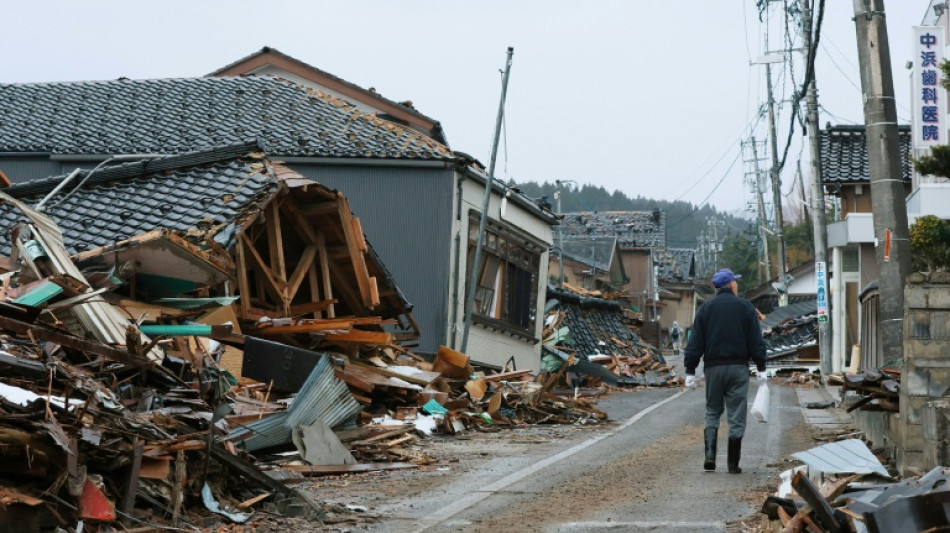
Japan's 'megaquake' warning explained / Photo: STR - JIJI Press/AFP/File

 Assefa seeks 'better than my best' at Berlin marathon

 US court refuses to overturn Pentagon ban on Anthropic

 Verstappen and Norris blame slow cars as Mercedes tops qualifying

 Crowds cheer pope in Paris after AI 'paradise of machines' warning

 Teen swimmer makes Games history as Thai, Chinese sprinters win gold
 Man City found guilty of 114 Premier League charges - reports

 Concerns over 'missing' UK explorer Ranulph Fiennes

 Suspected Paris killer of Argentine rugby star begs forgiveness

 Oil prices fall on cautious hopes for US-Iran progress

 Noskova, Muchova take Czech Republic into BJK Cup final

 Thai sprinter Puripol breaks own Asian Games record to win 100m gold

 Russell takes pole for Azerbaijan GP, Antonelli crashes out

 Williams boss hails Chadwick as F1 inspiration for women

 World No.1 Sinner delays return with China Open withdrawal

 South Lebanon children return to school destroyed by Israel strike

 Jewish group urges Berlin far-left vote winners to tackle antisemitism

 European stock markets climb as oil prices drop

 Trump accuser E. Jean Carroll finally has her damages

 Germany's Havertz, Musiala ruled out of Greece match with injury

 Ireland's Gaza stance spills from Eurovision into football
 Welcome aboard the Costa Serena, the Asian Games floating hotel

 Asian markets mixed after recent oil surge

 Cash for nature protection: hotelier's offer to Principe islanders
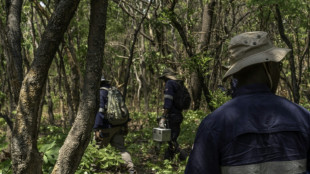 US miner KoBold bets on AI to gain edge in DR Congo mineral hunt

 Internet disrupted in Ethiopia as conflict rages

Japan's earthquake scientists say the country should prepare for a possible "megaquake" one day that could kill hundreds of thousands of people -- although they stress the warning does not mean a colossal tremor is imminent.
The Japan Meteorological Association (JMA) warning is the first issued under new rules drawn up after a 2011 earthquake, tsunami and nuclear disaster killed around 18,500 people.
What does the warning say?
The JMA's "megaquake advisory" warns that "if a major earthquake were to occur in the future, strong shaking and large tsunamis would be generated".
"The likelihood of a new major earthquake is higher than normal, but this is not an indication that a major earthquake will definitely occur during a specific period of time," it added.
The advisory concerns the Nankai Trough "subduction zone" between two tectonic plates in the Pacific Ocean, where massive earthquakes have hit in the past.
What is the Nankai Trough?
The 800-kilometre (500-mile) undersea trough runs from Shizuoka, west of Tokyo, to the southern tip of Kyushu island.
It has been the site of destructive quakes of magnitude eight or nine every century or two.
These so-called "megathrust quakes", which often occur in pairs, have been known to unleash dangerous tsunamis along Japan's southern coast.
In 1707, all segments of the Nankai Trough ruptured at once, unleashing an earthquake that remains the nation's second-most powerful on record.
That quake -- which also triggered the last eruption of Mount Fuji -- was followed by two powerful Nankai megathrusts in 1854, and then a pair in 1944 and 1946.
How much is at stake?
Japan's government has previously said the next magnitude 8-9 megaquake along the Nankai Trough has a roughly 70 percent probability of striking within the next 30 years.
In the worst-case scenario 300,000 lives could be lost, experts estimate, with some engineers saying the damage could reach $13 trillion with infrastructure wiped out.
"The history of great earthquakes at Nankai is convincingly scary," geologists Kyle Bradley and Judith A Hubbard wrote in their Earthquake Insights newsletter.
And "while earthquake prediction is impossible, the occurrence of one earthquake usually does raise the likelihood of another", they explained.
"A future great Nankai earthquake is surely the most long-anticipated earthquake in history -- it is the original definition of the 'Big One'."
How worried should people be?
Japan is reminding people living in quake zones to take general precautions, from securing furniture to knowing the location of their nearest evacuation shelter.
Many households in the country also keep a disaster kit handy with bottled water, long-life food, a torch, radio and other practical items.
But there's no need to panic -- there is only a "small probability" that Thursday's magnitude 7.1 earthquake is a foreshock, according to Bradley and Hubbard.
"One of the challenges is that even when the risk of a second earthquake is elevated, it is still always low," they said.
"For instance, in California the rule of thumb is that any given earthquake has around five percent chance of being a foreshock."
P.Mira--PC