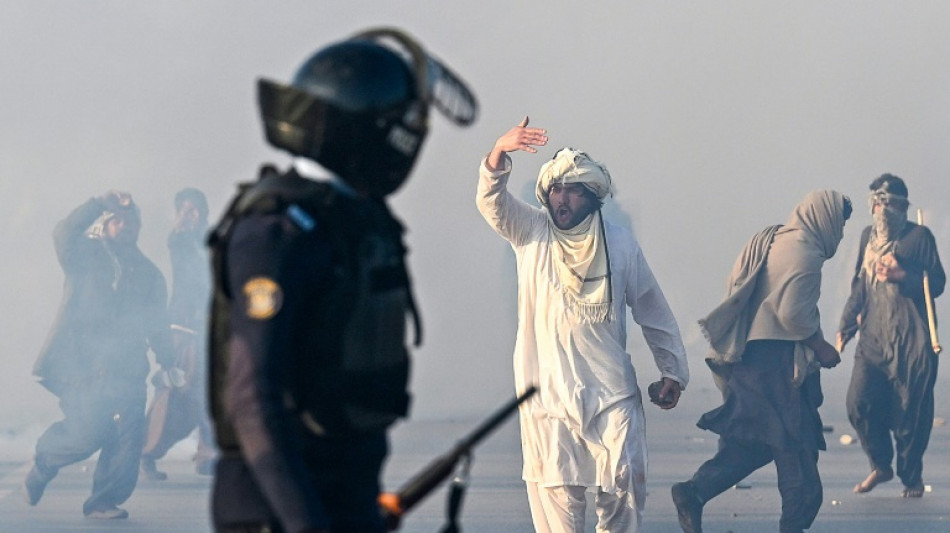
Pakistan web controls quash dissent and potential / Photo: Aamir QURESHI - AFP

 Calgary builder draws on decades of DIY work to increase Ford engine power

 Record-setting Hemi Plymouth Superbird heads to auction

 Calgary dancer describes stripping as a career built on independence and community

 Rohit Sharma Reappointed Mumbai Indians Captain for IPL 2027 with Focus on Team Spirit

 Calgary budget hearing delayed during debate over Tourette syndrome accommodation

 Business phone systems gain AI tools, but human oversight remains essential

 Huawei outlines 2030 network plans at Africa Tech Festival

 Governments and courts tighten restrictions on camera-equipped smart glasses

 South Africa’s sovereign satellite plan remains stalled despite higher cost

 EasyEquities faces pressure for clearer answers after security outage

 US patent disputes involving Korean chipmakers reach record level

 SK hynix doubles daily share purchases after steep stock decline

 Former soldier stopped with blank round at Incheon Airport
 Korea Post breach exposes data of at least 113,855 customers

 Many AAPI Candidates Win Seats in Orange County Local Elections

 Holly Ramsay and Adam Peaty Welcome Daughter Daphne June at Portland Hospital

 Honda and Toyota Recall 1.6 Million Vehicles Over Takata Airbag Risks

 Court Dismisses Fenech’s Bid to Revoke Theuma’s Pardon
Besieged by political turmoil, Pakistan's government is turning to draconian internet censorship which threatens to cut the country off from a promising future, experts and citizens say.
Social media site X has been down since February, internet outages are becoming more common and severe, and web tools used to evade state censorship will soon be banned for personal use.
Analysts say the measures are ramping up as Islamabad is being challenged by supporters of jailed ex-prime minister Imran Khan, who commands the loyalty of legions of young and web-savvy Pakistanis.
Khan was barred from standing in February polls which his followers say were rigged, and they have defied a crackdown both online and offline to stage unruly protests calling for his release.
During clashes in the capital this week between security forces and over 10,000 Khan supporters, authorities blocked mobile data in much of the city and also severed home internet in some areas, citing security fears.
"Censorship and surveillance we are seeing right now in Pakistan is unprecedented and very sophisticated," said Pakistani digital rights activist Usama Khilji.
"It's creating frustration in society," he told AFP.
- 'Wasting time' -
Mobile internet outages have become common fixtures during protests by Khan's Pakistan Tehreek-e-Insaf (PTI) party since he was ousted in 2022, but a home internet cut off is far more unusual.
The Interior Ministry said the measure was taken in the capital "only in areas with security concerns".
Shahzad Arshad, head of the Wireless and Internet Service Providers Association of Pakistan, told AFP the measure was taken because "residents had opened their wifi" to demonstrators on previous marches.
But without a connection, Muhammad Fahim Khan, an assistant professor, said he suffered a double lockdown -- unable either to reach his university in person or to teach remotely.
"Ongoing projects come to a halt due to internet outages," the 37-year-old said. "Productivity and the quality of life have been quite ruined."
Last year Pakistan was on the brink of default, saved only by bailouts from abroad, and the new government has touted tech as a potential economic lifeline for its recovery.
But student and blogger Khadija Rizvi said internet cuts "undeniably worse than ever before" have left her disillusioned about her prospects.
"The persistent internet outages have rendered it impossible to make any meaningful progress," the 25-year-old said. "This internet shutdown feels like a complete waste of valuable time and potential."
Thousands of food delivery drivers who scrape a living using online apps were also left without work during the capital protests, which subsided early on Wednesday.
- 'Assistance in sin' -
Islamabad is a city of just one million, but the other 240 million people in Pakistan have also suffered a grinding internet slowdown since August.
Digital analysts say the government has been testing a "firewall" that monitors some platforms and gives the power to block content, like photos or videos of rallies shared on WhatsApp.
Social media site X went dark after allegations of vote tampering circulated following elections, but government officials including Prime Minister Shehbaz Sharif continue to post there.
Many Pakistanis used Virtual Private Networks (VPNs) -- tools masking the location where they are logging on -- in order to circumvent restrictions.
VPNs are also vital for many online freelancers signing in to client networks abroad to earn a living virtually in professions like tech support or software development.
Nearly 2.4 million people work this way, according to the Pakistan Freelancers Association.
But this month the government's Council of Islamic Ideology, which checks whether laws comply with religious teachings, declared them non-halal.
The chief cleric said they could be used as an "assistance in sin" to access sites with pornography or blasphemous content, both banned in Pakistan.
The Pakistan Telecommunication Authority has said starting from December 1 all VPNs must be registered or blocked, and that only commercial use will be allowed.
Freelancers have been cleared to apply, but they must have the backing of an employer and provide their personal data to the state, increasing the potential for surveillance according to experts.
"Pakistan is working to strengthen its digital economy while simultaneously taking draconian steps to police online content," said Michael Kugelman, South Asia Institute director at The Wilson Center.
"This is a textbook case of shooting yourself in the foot. Both feet in fact."
H.Portela--PC