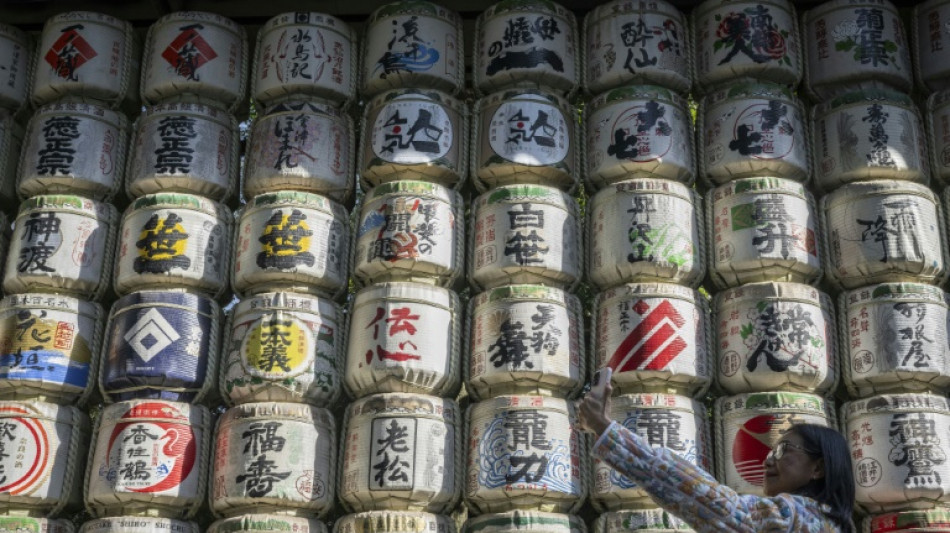
Kampai! All about Japanese sake / Photo: Yuichi YAMAZAKI - AFP

 What's behind the Pakistani strikes on Afghanistan?
 Hundreds protest for return of Nobel peace laureate Machado to Venezuela

 Aubameyang to miss two months for Deportivo after knee surgery
 Newsom says Trump presidency 'as we know it' ends in November
 Stocks fall as oil prices rise and bonds back under pressure

 Russell leads Mercedes 1-2 in Azerbaijan GP practice

 Ukrainian kills priest, wounds four at Polish abbey

 Sri Lanka captain Mendis hits century in 321-6 against England

 Oscar-winner Cotillard fears being moved by AI actor
 Agassi demands proper break for exhausted tennis stars

 Seixas 'crushes' teammates in training to draw Pogacar comparisons

 Trump welcomes Xi to White House, touting agreement on AI

 Stocks fall, oil prices rise as global bonds back under pressure

 UK man died putting women, children first in Mozambique jihadist siege: coroner

 Russell leads Mercedes 1-2 at Azerbaijan GP practice
 Alcaraz shrugs off pressure of packed calendar at 'joyful' Laver Cup

 Fury to face British rival Joshua in Cardiff on December 11

 Streamex Converts Interest Into Capital as GLDY Investment Strategy Secures $1M+ Institutional Allocation

 STARTRADER Named Best Fintech Forex Broker at Forex Expo Dubai 2026
 Japan swimmer Ohashi, 17, shrugs off Covid to smash world record
 Shin Ohashi: Junk food-loving teen and new world record-holder

 Greek PM urges 'courage' in talks with UK over Parthenon Marbles

 'I was drowning': Iran Nobel winner exposes pain of separation from children

 Israel's US envoy says son fighting for life

 Olympic champion Yulo completes gymnastics gold collection at Asian Games
Japanese tipples sake and shochu -- and the knowledge and skills honed over centuries to make them -- have been added to UNESCO's Intangible Cultural Heritage list.
AFP looks at how sake, a rice wine, is made, its myriad varieties, and its role in everyday life and traditions:
- History -
It's believed people in the archipelago began brewing rice in a simple way some two millennia ago, with a third-century Chinese chronicle describing the Japanese as fond of alcohol.
By around 1000 AD, the imperial palace had a department to supervise the manufacturing of sake and its use in rituals, according to the Japan Sake and Shochu Makers Association.
The multi-staged brewing techniques still used today are thought to have been established around the 1700s.
Nowadays there are around 1,400 sake breweries in Japan.
Shochu, which was also added to UNESCO's Intangible Cultural Heritage list on Wednesday, is a spirit distilled from different ingredients such as sweet potato, mainly in the country's southwest.
- The process -
Sake is stronger than beer or wine made from grapes, but weaker than shochu. It is made by fermenting special rice with bigger and rounder grains than varieties eaten in meals.
First, the grains are polished to remove the outer layers, revealing a water-absorbent white core rich in starch.
Brewers wash, soak and steam the polished rice before growing a special mould on it called koji. They then mix it with water and yeast to create a starter.
Adding more steamed rice and water several times sparks two types of chemical reactions in a single cask –- converting starch to sugar and sugar to alcohol -- a more complex process than making wine from sugar-rich grapes.
- What's koji? -
Koji is mould from bacteria found in humid Asian countries. It is an essential element of Japanese cuisine -- used to make not just sake but also miso, soy sauce and other food.
The genus designated as Japan's national mould is called aspergillus oryzae, also known as "koji-kabi".
"Over more than a thousand years, brewers selected and cultivated the best type of mould from all the wild ones out there," Taku Takahashi, from Tokyo's Toshimaya Shuzo brewery, told AFP.
The sake-making process as we know it now, where humans intervene to spark fermentation, was developed "after many, many failures", he added.
- Sake varieties -
Generally speaking, there are two types of sake: one made purely from rice, and the other, mixed with distilled alcohol.
The higher the grade of grain polishing, the fruitier and drier the sake.
More polished varieties requiring more rice tend to be pricier, but some gastronomists appreciate less polished types for their rich and mellow flavour.
Breweries adjust their flavours to suit local delicacies. For example, near the Pacific Ocean, dry sake is produced to pair with red-meat fish such as tuna and bonito.
- How is it consumed? -
Sake "has a very important role" in society and is drunk at weddings and funerals, Takahashi said.
It is also drunk to mark store openings and election victories -- or just to say "kampai" meaning "cheers" in Japanese pubs.
Traditionally three ritual offerings are made to the many gods of Japan's Shinto religion: rice, a rice cake and sake.
And at Shinto weddings, the bride and groom drink sake from the same porcelain cup to symbolise their union.
Breweries still hang a ball of cedar leaves outside, which change colour from green to brown -- letting customers know when the "nouveau" sake is ready in early winter.
- Going forward -
Sake consumption has declined a lot in Japan over 50 years, as other drinks like beer and wine become more popular.
The agriculture ministry says the country drank only 390 million litres of sake in 2023, down from 1.7 billion litres in 1973.
However, exports of sake have more than doubled since 2011, and it is now brewed as far afield as New Zealand, France and the United States.
G.M.Castelo--PC