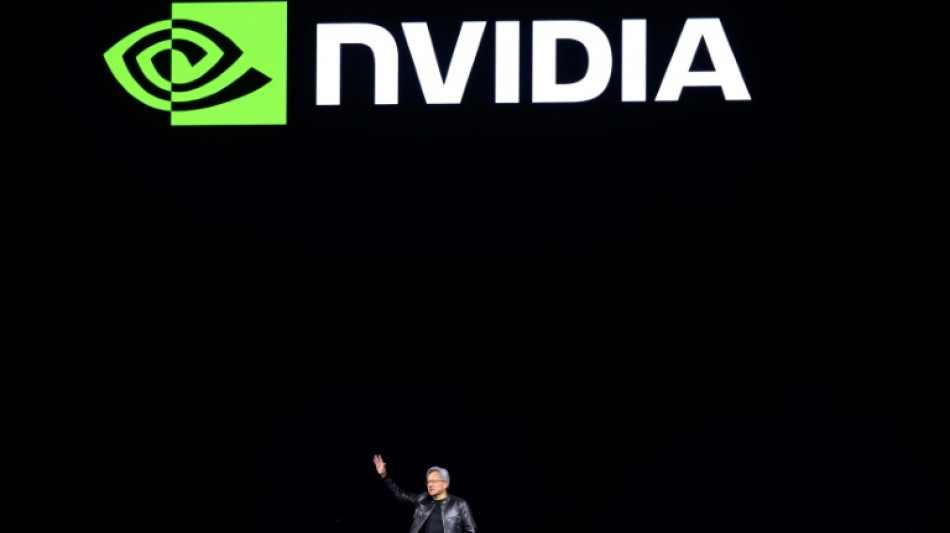
China probes Nvidia for 'violating' anti-monopoly law / Photo: JOSH EDELSON - AFP/File

 Former soldier stopped with blank round at Incheon Airport

 Korea Post breach exposes data of at least 113,855 customers

 Many AAPI Candidates Win Seats in Orange County Local Elections

 Holly Ramsay and Adam Peaty Welcome Daughter Daphne June at Portland Hospital

 Honda and Toyota Recall 1.6 Million Vehicles Over Takata Airbag Risks

 Court Dismisses Fenech’s Bid to Revoke Theuma’s Pardon

 Fundraiser launched for Daniel Buttigieg after boat accident

China on Monday launched an investigation into US chip giant Nvidia for allegedly violating its anti-monopoly laws, a top government agency said, as the two countries race for global chipmaking dominance.
Beijing's state administration for market regulation, the authority on antitrust issues, launched the probe "in accordance with the law", according to a statement shared online.
Nvidia is also suspected of violating commitments it made in 2020, the statement said, when it acquired Israeli data center firm Mellanox.
Shares in Nvidia dropped Monday after Beijing announced the probe.
Nvidia did not immediately respond to a request for comment.
China and the United States have in recent weeks clashed over exports of key chipmaking technology, where Nvidia is a major player.
Beijing last week said it would restrict exports to the United States of some key components in making semiconductors, after Washington announced curbs targeting China's ability to make advanced chips.
Among the materials banned from export are metals gallium, antimony and germanium, China's commerce ministry said in a statement that cited "national security" concerns.
In its own latest curbs, Washington has announced restrictions on sales to 140 companies, including Chinese chip firms Piotech and SiCarrier, without additional permission.
The move expands Washington's efforts to curb exports of state-of-the-art chips to China, which can be used in advanced weapons systems and artificial intelligence.
The new US rules also include controls on two dozen types of chipmaking equipment and three kinds of software tools for developing or producing semiconductors.
The US tech behemoth has seen its profits soar on the back of strong demand for its artificial intelligence technology.
In November, Nvidia surpassed Apple to become the highest-valued company in the world as the artificial intelligence boom continues to excite Wall Street.
But the Chinese market has been a rare weak spot.
The US government in 2023 restricted Nvidia from selling some of its top AI chips to China, which the US sees as a strategic competitor in the field of advanced semiconductors.
Although Nvidia in November reported record high quarterly revenue, investors were wary of US-China tensions reheating with the return of Donald Trump to the White House.
But during an event in Hong Kong last month, Nvidia's Taiwan-born CEO Jensen Huang told reporters "open science and open research in AI is absolutely global" and that "nothing" would stop that.
P.L.Madureira--PC