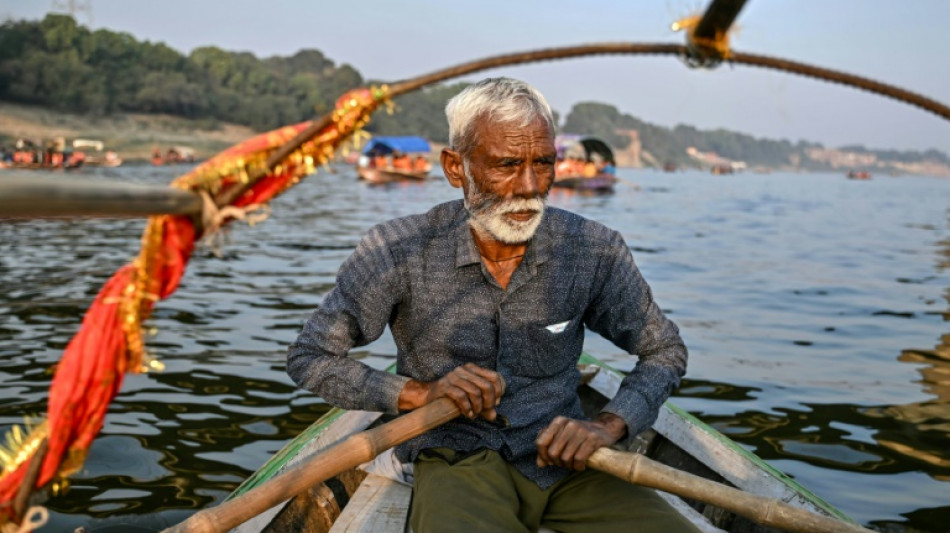
India's sacred boat service for giant Hindu festival / Photo: Idrees MOHAMMED - AFP

 Filmasia 2026: 16 Films Across Prague, Brno, and České Budějovice

 Kojey Radical Launches Burger Collaboration at Dallas Burger Joint in Shoreditch

 Kelly Stafford Reflects on Matthew's Lions Thanksgiving Era Ahead of Rams' Netflix Debut

 World Experiences First Six Consecutive Days Above 2C Preindustrial Threshold

 Luxembourg Housing Petition Passes Threshold for Parliamentary Consideration

 Raheem Sterling Receives Suspended Sentence After Lamborghini Crash

 Audience to Choose the Set List at Luxembourg's First FAMIL Jukebox Night

 Luxembourg Pay Rise Delayed as Regional and World Headlines Develop

For millions of Hindu pilgrims at India's millennia-old vast Kumbh Mela festival, the culmination of their journey is ritual bathing in the holy waters where sacred rivers meet.
And for as long as anyone can remember, it has been generations of boatmen from the Nishad community who have provided the ferry service, rowing devotees to the holiest site at the confluence of rivers.
"We bring the devotees to the holy place in our boat," said 52-year-old boatman Chhote Lal Nishad, returning after taking six pilgrims out on the water at dawn in his narrow wooden boat.
"We allow pilgrims to bathe with love and happiness and then return safely."
Nishad boatmen say they are the proud inheritors of an ancient profession, not only transporting pilgrims but narrating the significance of the waters and the religious history of the Kumbh Mela.
With years of navigation experience, they often help rescue drowning bathers.
Hindus believe that those who immerse themselves in the waters cleanse themselves of sin, breaking free from the cycle of rebirth and ultimately attaining salvation.
Nishad boatmen row the pilgrims throughout the year, but trade surges during the Kumbh Mela, a six-week-long Hindu celebration of prayer and bathing, held every 12 years, which runs until February 26.
Tens of millions of people are attending the festival in the north Indian city of Prayagraj.
Viraj Nishad, 23, from the same community as Chhote Lal Nishad but no relation, is part of the new generation of rowers, carrying forward his father's legacy.
"It is because of us that devotees can visit the holy site and take a dip in the river," he said with pride.
- 'Joy and experience' -
Normally, the boatmen take pilgrims to the heart of the confluence of the Ganges and Yamuna rivers, where Hindus believe the mythical Saraswati river also flows.
But the authorities have this year barred the boatmen from the busiest areas during the festival for safety reasons.
"The river is the only support for the Nishad community," said Chhote Lal Nishad, who has been rowing pilgrims since he was a boy. "If there is no river we will die of hunger."
"I had great hopes that I would be able to earn some money for the children," he added. "That hope is shattered."
Organisers say the scale of the Kumbh Mela is that of a temporary country, boasting that as many as 400 million pilgrims are expected to attend.
Last month, at least 30 people were killed and many more injured after a surging crowd spilled out of a police cordon and trampled bystanders.
The boatmen are still taking pilgrims to holy bathing sites, but slightly away from the confluence thronged with crowds.
They remain busy despite the restriction for many pilgrims say they prefer the traditional boats rather than larger modern crafts.
"The wooden boat moves slowly, and the joy and experience... is something which you cannot feel in modern boats," said Ajeet Kaur Prajapati, 60, from the capital Delhi.
"The pleasure of eating food cooked by your mother is the same pleasure as travelling in a wooden boat," she said.
M.A.Vaz--PC