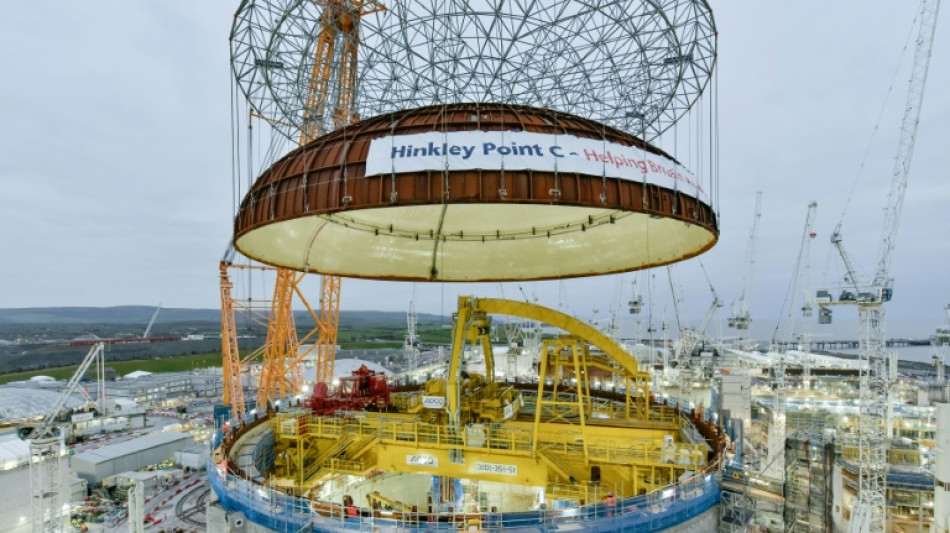
UK to quicken rollout of mini-nuclear reactors / Photo: Handout - EDF ENGERY/AFP/File

 Filmasia 2026: 16 Films Across Prague, Brno, and České Budějovice

 Kojey Radical Launches Burger Collaboration at Dallas Burger Joint in Shoreditch

 Kelly Stafford Reflects on Matthew's Lions Thanksgiving Era Ahead of Rams' Netflix Debut

 World Experiences First Six Consecutive Days Above 2C Preindustrial Threshold

 Luxembourg Housing Petition Passes Threshold for Parliamentary Consideration

 Raheem Sterling Receives Suspended Sentence After Lamborghini Crash

 Audience to Choose the Set List at Luxembourg's First FAMIL Jukebox Night

 Luxembourg Pay Rise Delayed as Regional and World Headlines Develop

Britain's Labour government on Thursday said changes to planning laws will speed up the country's rollout of mini-nuclear reactors aimed at providing cheaper and cleaner energy.
"Reforms to planning rules will clear a path for smaller, safer, and easier to build nuclear reactors -- known as Small Modular Reactors (SMR) -- to be built for the first time ever in the UK," a statement said.
"This will create thousands of new highly skilled jobs while delivering clean, secure and more affordable energy for working people."
The government led by Prime Minister Keir Starmer noted that China is constructing 29 reactors and the European Union has 12 at planning stage.
"My government was elected to deliver change," said Starmer, whose party came to power in July following 14 years of Conservative rule.
"I'll take the radical decisions needed to wrestle Britain from its status quo slumber, to turbocharge our plan for change."
The current plans restrict nuclear development to just eight UK sites.
Greenpeace voiced scepticism at the changes, while urging the government to focus on renewable energy which includes wind and solar.
Labour presents "as fact things which are merely optimistic conjecture on small nuclear reactor cost, speed of delivery and safety, which is courageous -- or stupid -- given that not a single one has been built", Greenpeace policy director Doug Parr said in a statement.
While scrapping the limit on site numbers, the government on Thursday stressed there will "continue to be robust criteria for nuclear reactor locations, including restrictions near densely populated areas and military activity", adding it would take into account environmental impacts.
Labour believes easing regulations across various sectors will help to grow a stagnant UK economy. It argues that for the nuclear industry it should help to speed up net zero carbon emissions and improve energy security.
"The British people have been left vulnerable to global energy markets for too long -- and the only way out is to build our way to a new era of clean electricity," Energy Secretary Ed Miliband said in the joint statement.
Britain has five nuclear power plants in operation of which four will have their lifetime extended according to an announcement in December by their French operator EDF, as the UK aims to fully decarbonise its energy grid by 2030.
EDF, which is building the new nuclear power plant Hinkley Point C in southwest England, decided last year to withdraw its interest to construct Britain's SMRs.
L.E.Campos--PC