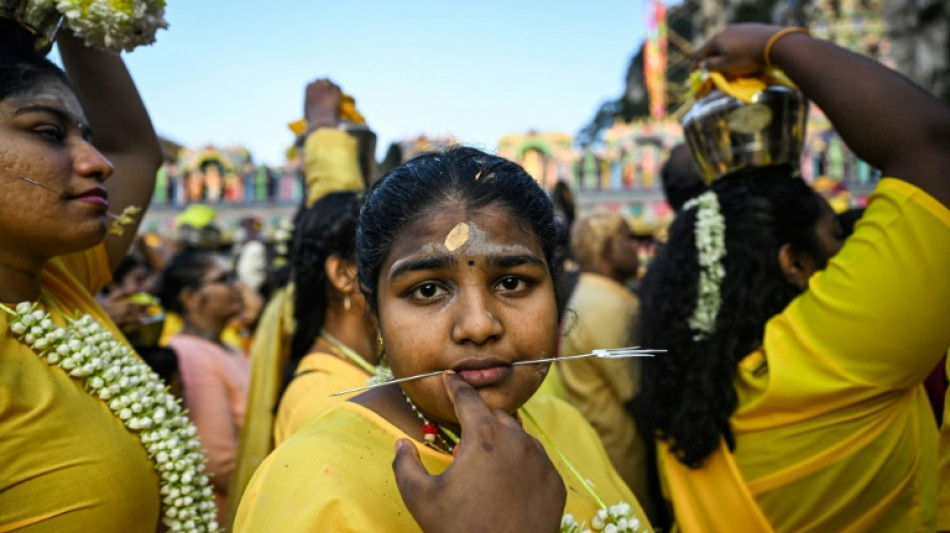
Malaysia's Hindus mark Thaipusam festival with fervour / Photo: Mohd RASFAN - AFP

 Malaysia Sues Google for $146m Over Harmful Content

 Black Wind Turbine Blades Reduce Bird Deaths by 74% in Spain Study

 Brazil’s Landless Movement Partners with China to Build Affordable Tractors for Family Farms

 Twickenham Grounds Team Prepares Pitch for Six Matches in Three Days

 Luxembourg Pay Rise Delayed as Regional and World Headlines Develop

 Audience to Choose the Set List at Luxembourg's First FAMIL Jukebox Night

 Raheem Sterling Receives Suspended Sentence After Lamborghini Crash

 Black Friday Discounts Cut Prices on Two Top-Rated Wiper Blades

 Arizona Gun Regulation Battle Intensifies Under New Democratic Legislative Majority
Hundreds of thousands of Hindus flocked to temples across Malaysia to celebrate the Thaipusam festival Tuesday, with many piercing their bodies with hooks and skewers in acts of devotion.
Thaipusam is marked with particular zest in multicultural Malaysia, a Muslim-majority nation where ethnic Indians make up about seven percent of the 34 million population.
One of the most important religious festivals for primarily Tamil Hindus, the event commemorates the day when the goddess Parvathi gave her son Lord Murugan a powerful lance to fight evil demons.
The festival is also celebrated in India, Singapore and other areas with large Hindu Tamil communities.
Celebrations centred, as they have for more than a century, at the Batu Caves complex on the outskirts of the capital Kuala Lumpur.
Devotees bearing offerings such as milk pots or carrying elaborate and heavy metal structures called "kavadis" walked barefoot up 272 steps to reach the temple at Batu Caves.
Some kavadis can weigh as much as 100 kilogrammes (220 pounds) and those bearing the structures often gyrate to the beat provided by percussionists alongside religious chants and devotional folk songs.
Some worshippers pierce themselves with skewers or hang hooks and chains from their bodies in acts of penance.
"We will pray every day but once our prayers are a success, we say thank you to Lord Murugan. We are carrying the kavadis and milk pots to fulfil our vows," said Revathi Ramasundra, 45, a senior nurse.
Businessman Mahendran Masialamoney, who was at the temple complex, told AFP: "This year, I prayed for my children's education as well as my career prospects."
L.Torres--PC