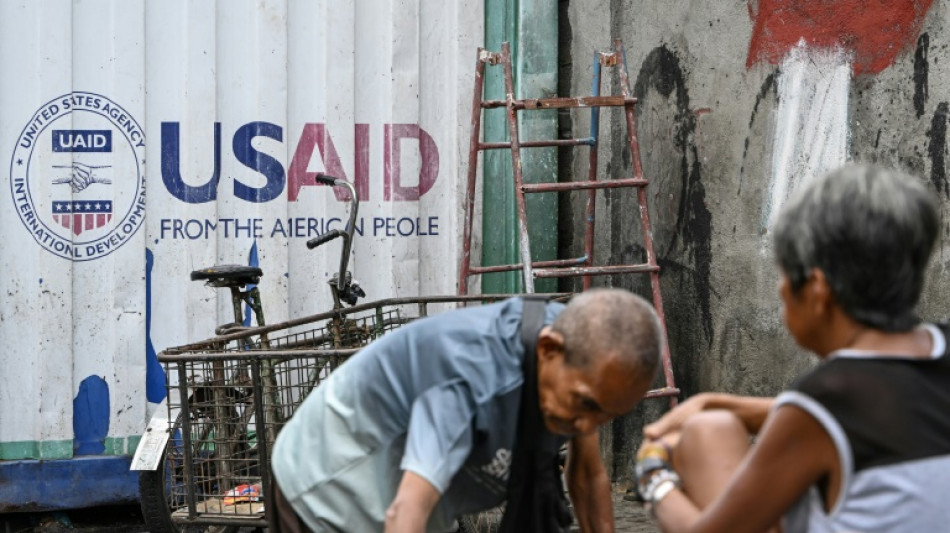
US funding freeze is 'bombshell' for world aid sector / Photo: JAM STA ROSA - AFP

 Malaysia Sues Google for $146m Over Harmful Content

 Black Wind Turbine Blades Reduce Bird Deaths by 74% in Spain Study

 Brazil’s Landless Movement Partners with China to Build Affordable Tractors for Family Farms

 Twickenham Grounds Team Prepares Pitch for Six Matches in Three Days

 Luxembourg Pay Rise Delayed as Regional and World Headlines Develop

 Audience to Choose the Set List at Luxembourg's First FAMIL Jukebox Night

 Raheem Sterling Receives Suspended Sentence After Lamborghini Crash

 Black Friday Discounts Cut Prices on Two Top-Rated Wiper Blades

 Arizona Gun Regulation Battle Intensifies Under New Democratic Legislative Majority
US President Donald Trump's order to suspend most foreign aid has sent shock waves through the humanitarian sector, threatening to trigger mass layoffs at many NGOs and possibly destroy others altogether.
Less than a week after Trump returned to power, the US Agency for International Development told NGOs they would have to cease operations immediately because the new administration had frozen USAID's budgets.
The US president has ordered a 90-day review of USAID -- which runs health and emergency programmes in around 120 countries, including the world's poorest.
The campaign is being spearheaded by his billionaire ally Elon Musk, who has boasted of feeding USAID "through the wood-chipper".
Trump's administration has since issued waivers for some "life-saving" aid, while the freeze included exceptions to funding for Israel and Egypt.
But confusion reigns over how those waivers will be implemented and the uncertainty has already taken its toll.
The order to stop work immediately hit "like a bombshell", said a source at an NGO in Kenya.
He asked to remain anonymous out of fear his charity could be punished by the Trump administration.
"It threw people into panic mode," the aid worker said of the freeze, pointing out that the lack of notice meant staff had no time to adapt.
They were instantly put on compulsory unpaid leave and the organisation was no longer able to pay their rents or salaries, he said.
"What's that going to mean for people who have children?" he asked, aghast.
- Impossible to compensate -
According to aid network ALNAP, more than 630,000 people were employed in the aid sector in 2020, more than 90 percent of them local staff.
For many locals, the US freeze spells unemployment in countries with fragile economies where finding another job is almost impossible.
Expatriates working for aid agencies also face disruption.
"We notified everyone on US budgets that they had been suspended temporarily," said a source at the European headquarters of an NGO mostly financed by US funds.
The consequence for expatriates, she said on condition of anonymity, is that "they put you on a plane and you go back home".
Except, she added, "you don't necessarily have a home" because many expat aid workers go from mission to mission, with no home base in their country of origin.
USAID manages a budget of $42.8 billion -- representing 42 percent of humanitarian aid disbursed worldwide.
NGOs will have to "lay off employees in proportion to their dependence on US funds", she said.
"If an NGO depends 60 percent on USAID, it will have to lay off 60 percent of its employees. If it depends 40 percent, it will lay off 40 percent."
It would be "impossible to compensate for the loss of US funds", she said.
- 'Brutal' -
The Norwegian Refugee Council, one of the world's largest aid agencies, said on Monday it was forced to abruptly suspend US-funded "urgent humanitarian work for hundreds of thousands of people in nearly 20 countries affected by wars, disasters and displacement".
Just under 20 percent -- $150 million -- of its funding came from the United States last year, providing vital support for 1.6 million people.
While the initial US funding freeze was set to last 90 days, the administration has already begun slashing USAID's workforce, and many in the aid sector fear a drastic long-term drop in US support.
Trump and Musk have publicly vowed to shutter USAID for good.
"We're not so vulnerable that we'll just fold in 90 days. The problem is, will this last 90 days or go on much longer?" said Kevin Goldberg, head of Solidarites International, which is 36 percent US-funded.
Local partners of international NGOs, "who depend on our ability to transfer part of the US aid allocated to us", would also suffer, he added.
Goldberg said he "feared for the entire humanitarian chain".
"There are a lot of players in the aid sector that will disappear" because European state funding is also decreasing, warned Jean-Francois Corty, head of Medecins du Monde.
He told AFP the US decision was an "apocalyptic revolution" for a humanitarian ecosystem that was "being... strangled to death".
An executive from another international NGO said she feared the "brutal" Trump method would have repercussions in Europe, where far-right parties drawing from the US president's playbook are gaining ground.
"This earthquake... forces us to rethink everything," she told AFP.
dl-fv-al-jf/mr/gil
M.A.Vaz--PC