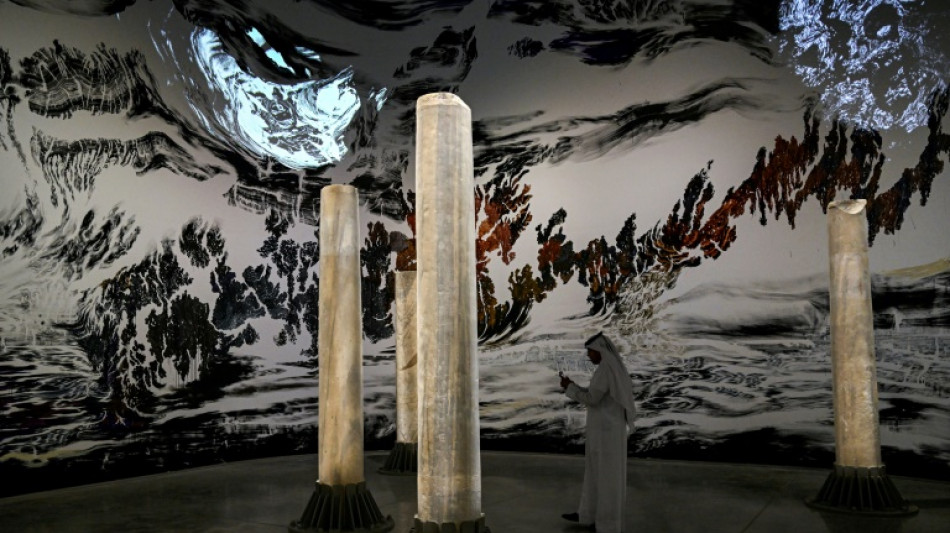
Saudi art biennale seeks to modernise Islamic tradition / Photo: Amer HILABI - AFP

 Malaysia Sues Google for $146m Over Harmful Content

 Black Wind Turbine Blades Reduce Bird Deaths by 74% in Spain Study

 Brazil’s Landless Movement Partners with China to Build Affordable Tractors for Family Farms

 Twickenham Grounds Team Prepares Pitch for Six Matches in Three Days

 Luxembourg Pay Rise Delayed as Regional and World Headlines Develop

 Audience to Choose the Set List at Luxembourg's First FAMIL Jukebox Night

 Raheem Sterling Receives Suspended Sentence After Lamborghini Crash

 Black Friday Discounts Cut Prices on Two Top-Rated Wiper Blades

 Arizona Gun Regulation Battle Intensifies Under New Democratic Legislative Majority
Under a vast canopy of tents in the Saudi city of Jeddah, religious artefacts are on display alongside contemporary art pieces, part of the kingdom's bid to transform its ultraconservative image.
The second edition of the Islamic Arts Biennale, titled "And All That Is In Between", features as its centrepiece segments of the "kiswa", the black cloth embroidered with gold and silver that covers the Kaaba, the cubic building towards which all Muslims pray.
Hundreds more works are on display at the west terminal of King Abdulaziz International Airport in the coastal city, including valuable objects on loan from London's Victoria & Albert Museum and the Louvre in Paris, and rare artefacts from the Vatican Library such as a medieval Quran in Hebrew script.
"This bringing together of the contemporary and the past really emphasises the change that Saudi Arabia is going through," said Saudi artist Muhannad Shono, curator of the exhibition.
Home to Islam's holiest sites, the kingdom has long been dominated by Wahhabism, a strict interpretation of Islam that prohibits the representation of human and animal figures.
As a result of the prohibition of such depictions in most Sunni Muslim schools of thought, geometric patterns came to be widely prevalent in Islamic art.
But the biennale in Jeddah features medieval Persian illuminations, including royal portraits, as well as a fountain designed by Yemeni-Indonesian artist Anhar Salem whose mosaic tiles, assembled by colour using artificial intelligence, are made up of avatars sourced online.
- 'Traditional conceptions' -
"We have traditional conceptions of Islam and its history, which I feel we should begin to re-examine from a new perspective," said visitor Abdelelah Qutub, a 31-year-old architect from Mecca.
A few metres (yards) away, Franco-Lebanese artist Tamara Kalo had recreated the camera obscura, the precursor to the modern camera invented in the 11th century by Muslim philosopher Ibn al-Haytham (Alhazen).
Kalo told AFP her installation, made out of copper, sought to raise the question of "what it means to see and what it means to be a witness".
The exhibition has also encouraged artists to be bold with scale, as can be seen from a massive disc covered in petrol -- a nod to Saudi Arabia's position as the world's leading crude exporter -- that spins endlessly.
Its creator, Italian artist Arcangelo Sassolino, said: "For me it represents time... it's something that keeps evolving while we're watching the piece."
Under his "Vision 2030", de facto Saudi leader Crown Prince Mohammed bin Salman has sought to transform the kingdom's image, weighed down by decades of repression and ultraconservatism.
According to James Dorsey of the National University of Singapore, Saudi authorities are seeking to address what he described as a "reputation deficit", having long been considered a "secretive, ultraconservative kingdom".
Efforts to project "openness", including the biennale, are "key to the success of Vision 2030", he said.
- 'Share space with the West' -
Strategically located in a terminal adjacent to the one reserved for Muslims on a pilgrimage to Mecca, the Jeddah biennale attracts a mix of both art enthusiasts and pilgrims.
"We had pilgrims coming from over the road here to see the Mecca and Medina pavilions last time," said art historian Julian Raby.
The first edition in 2023 attracted 600,000 visitors -- approaching the Venice Biennale's 700,000 visitors in 2024.
Now, the Islamic Arts Biennale aims to exceed a million visitors, many from abroad.
"That internationalism is exactly the opposite of how many people consider Saudi Arabia. They look at Saudi Arabia and consider it as a cloistered country," said Raby.
"The Islamic world has never been cloistered, it's been in dialogue, dynamic
In front of her monumental sculpture, a black steel bush of roses floating above a fountain, Jordanian artist Raya Kassisieh was proud to benefit from the platform provided by the biennale.
"We are able and at the level to converse and share space with the West," she said.
C.Cassis--PC