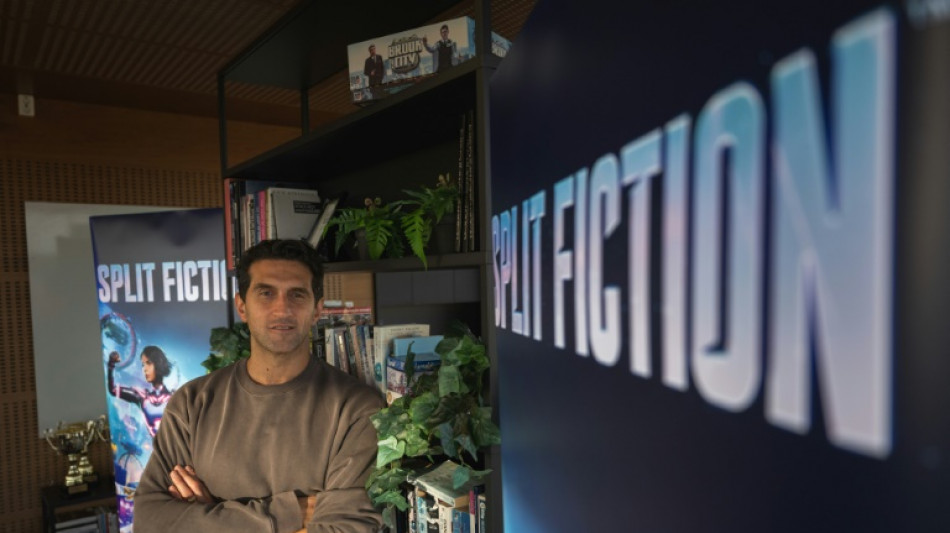
Swedish video game maker wants industry to stop chasing money / Photo: Jonathan NACKSTRAND - AFP

 Malaysia Sues Google for $146m Over Harmful Content

 Black Wind Turbine Blades Reduce Bird Deaths by 74% in Spain Study

 Brazil’s Landless Movement Partners with China to Build Affordable Tractors for Family Farms

 Twickenham Grounds Team Prepares Pitch for Six Matches in Three Days

 Luxembourg Pay Rise Delayed as Regional and World Headlines Develop

 Audience to Choose the Set List at Luxembourg's First FAMIL Jukebox Night

 Raheem Sterling Receives Suspended Sentence After Lamborghini Crash

 Black Friday Discounts Cut Prices on Two Top-Rated Wiper Blades

 Arizona Gun Regulation Battle Intensifies Under New Democratic Legislative Majority
Swedish-Lebanese filmmaker-turned-game-developer Josef Fares is on a mission to put storytelling first in video games, slamming money-driven designs for stifling creativity.
"From a creative perspective, if you involve money too much, then it will affect it," Fares, whose 2021 game "It Takes Two" was a critical and commercial success, told AFP in Stockholm.
The 47-year-old does not a have a lot of patience for video game industry trends such as microtransactions, where players are encouraged to repeatedly pay small amounts for virtual in-game items.
The model provides developers with a revenue stream after the initial purchase of a game, or in some cases the game is made free upfront with such transactions being the only form of revenue.
Fares conceded that in some cases it has been extremely profitable, but "we will never have those in our games".
Animated, he explained that introducing such mechanics inevitably starts affecting design decisions.
"Those decisions shouldn't be in video games. It shouldn't be like: 'Okay, let's change that so you pay more money'," Fares said.
Fares, who fled to Sweden when he was 10 during Lebanon's civil war, is known for speaking his mind, using an expletive at the 2017 Video Game Awards to blast the Oscars.
In the early 2000s, Fares wrote and directed five Swedish feature films, both comedies and dramas.
He founded Hazelight Studios in 2014, following the success of his first video game project, "Brothers: A Tale of Two Sons".
The Stockholm-based studio focuses on games that require two players to play and work together.
It has released two games so far and is putting the finishing touches on their latest project, "Split Fiction".
- 'Friendship' -
The themes of the studio's first two games can each be summed up with one word, Fares said.
"A Way Out" (2018), in which two prisoners escape from prison together, was about "trust," he said.
The critically acclaimed follow-up, "It Takes Two" (2021), was about "collaboration," telling the story of a married couple planning to get divorced but transformed into small dolls, forcing them to work together to navigate the perils of their own home.
"'Split Fiction' is about friendship," Fares explained.
The story follows aspiring writers Mio and Zoe, who have clashing personalities, as they become trapped inside a simulation of their own stories, and must overcome their differences to make it out.
"It's kind of like a buddy movie, that you obviously play," Fares said.
But Fares said directing movies and video games is not the same.
"You have to understand that they are two entirely different mediums, one is interactive, one is passive," he said.
Movies, a passive medium, have been around much longer and therefore the art of storytelling has had more time time to grow, "to figure out how tell a story."
Dealing with an interactive medium, where the player chooses how and when to proceed, the developers don't have the same control over things like pacing or where the player focuses.
Telling engaging stories in this environment is still being figured out.
"We want to be part of figuring out how to tell stories in video games," Fares told AFP.
Sweden's video game industry has long punched above its weight for such a small country, spawning hit franchises such as "Minecraft" and the "Battlefield" series, as well as mobile games such as "Candy Crush".
Globally, the video game industry went through a rough patch in 2024, with many studios cutting staff.
According to a report by the Game Developer's Conference (GDC), one in 10 developers were laid off during the year, with restructuring and declining revenues cited as the top reasons.
Fares told AFP he still believes the industry is in "a good place", but hopes that developers focus on creating the games they want, rather than trying to chase the next big thing.
"I hope it's going to get better, but I just hope people take more decisions based on what they love and want to do," Fares said.
G.Teles--PC