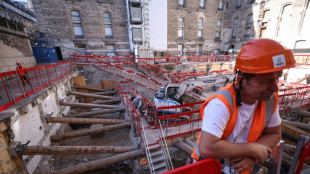
TEPCO takes on challenge of making space for Fukushima nuclear debris / Photo: Atish PATEL - AFP

 US judge weighing Trump's White House ban on media outlets
 At UN, OpenAI's Altman calls 'for extreme care' in AI

 Hamilton gives thumbs up to Gulf GPs despite Iran conflict

 Leclerc admits going 'too far' in Hamilton shunt in Italy

 Row engulfs Dolly Parton's estate as manager accuses nephew of making threats
 Mandela Digital Extends Early Access Programme to 11 February 2027 Following Strong Response

 US seeks 11th Presidents Cup win in a row over global foes

 McDonald's to boost franchisees as inflation weighs on consumers

 Trump invites Putin to G20 summit in Miami

 Archaelogical 'breakthrough' could confirm origins of Paris

 ILO financial crisis takes centre stage in leadership race

 Stocks dip, oil soars despite Trump hailing "productive" Iran talks

 China's Xi to get rare airport welcome from Trump

 Turkey reassures investors over investment fund crisis

 Saka says England still have 'scar' from World Cup semi-final loss

 アレックス・ボディ氏とシュテファン・ハウプト教授、ルーマニアの伝説的な美術コレクションをめぐり提携に合意

 亞歷克斯·博迪與史蒂芬·豪普特教授就羅馬尼亞傳奇藝術收藏達成合作協議

 Алекс Боди и проф. д-р Стефан Хаупт договорились о сотрудничестве в рамках легендарной коллекции произведений искусства в Румынии

 French foreign minister says Palestinians 'must' hold polls

 Fresh Russian strikes on Ukraine's infrastructure kill seven

 Eriksen to return to Denmark after parting ways with Wolfsburg

 Brad Pitt says working with dog co-star was 'really moving'

 Golan will remain Syrian, vows President al-Sharaa at UN

 Blueberry Strengthens MENA Presence with CMA Category 5 License and Dubai Office Launch

 Russia probes bear attacks, as official says town under 'siege'

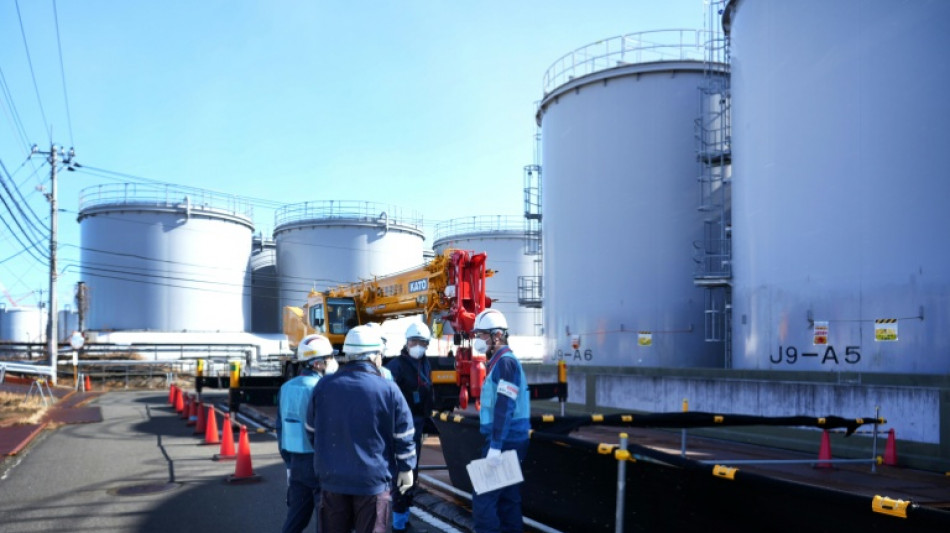
Workers at Japan's crippled Fukushima nuclear plant have started dismantling water storage tanks to free up space for tonnes of nuclear debris, 14 years after the facility was hit by a devastating tsunami.
Operator Tokyo Electric Power Company (TEPCO) has been charged with finding a suitable place to store around 880 tonnes of radioactive material that remains inside the Fukushima Daiichi plant's damaged reactors.
"Currently, there is no more land available in Fukushima Daiichi", Naoki Maeshiro, project manager for TEPCO, who is overseeing the operation which began on Friday, told AFP.
Three of plant's six reactors were operating when a tsunami caused by a massive earthquake hit on March 11, 2011, disabling their cooling systems and sending them into meltdown.
Ever since, TEPCO has been holding 1.3 million tonnes of water -- a combination of groundwater, seawater and rainwater -- at the site, along with water used for cooling the reactors.
The water, which is treated to remove various radioactive materials, has been held inside more than 1,000 tanks that occupy much of the plant.
In one of the zones called "J9", the giant steel tanks tower over employees at work, obstructing the view of the rest of the plant.
"To proceed with the next steps, such as retrieving the fuel debris, a certain amount of land is necessary," added Maeshiro.
Scrapping the water tanks became possible after TEPCO began discharging treated water from the plant into the Pacific Ocean in August 2023.
Japan and the International Atomic Energy Agency (IAEA) have assured that the operation does not harm the environment.
Getting rid of the welded containers is considered a crucial step in the decades-long decommissioning process.
Once removed, the utility company plans to build facilities to store highly dangerous molten fuel debris after extracting it from inside the reactors.
"As long as the fuel debris remains in its current state, the risks remain very high," Nobuhide Sato, a risk specialist at TEPCO, told AFP.
- Arcade-style claw machine -
The company has developed a telescopic device that can collect debris remotely for safety reasons and to avoid radioactive material leaks.
A demonstration attended by AFP was carried out in reactor number five, which was not in operation when the tsunami hit.
Before entering the zone, which is under high surveillance, employees put on masks, safety helmets, a full body protective white suit, and three pairs of socks and gloves as a precaution against radiation.
Armed with a flashlight, Sato stopped in front of a hole, around 60 centimetres (two feet) in diameter, that has been drilled into the structure protecting the reactor's core.
The plan is to extend the specially developed telescopic device several metres through the hole to reach the radioactive debris in the reactor.
The device resembles an arcade claw machine, so the "arm grabs the debris, lifts it, and retrieves it," said Sato.
In early November, TEPCO announced a debris sample weighing 0.7 grams (0.025 ounces) had been successfully extracted and sent to a laboratory near Tokyo.
The analysis will help determine radioactivity levels and the chemical composition of the molten fuel debris, a key step in the colossal dismantling project.
"Depending on the results, we will see whether it is better to use water to collect (the fuel debris) in the reactor or to do it in a dry environment," Sato said.
The TEPCO employee then enters the base of the reactor, where workers can only spend a maximum of two hours a day due to radiation levels.
"If we can properly recover the fuel debris and store it safely, it be a great help in reassuring nearby residents," Sato added.
A second sampling of nuclear material is scheduled between "March and April," according to TEPCO, which should provide enough information about its composition to move to the next stage -- a larger-scale extraction of radioactive debris by 2030.
The overall project is expected to take between 30 and 40 years, the company said.
C.Amaral--PC