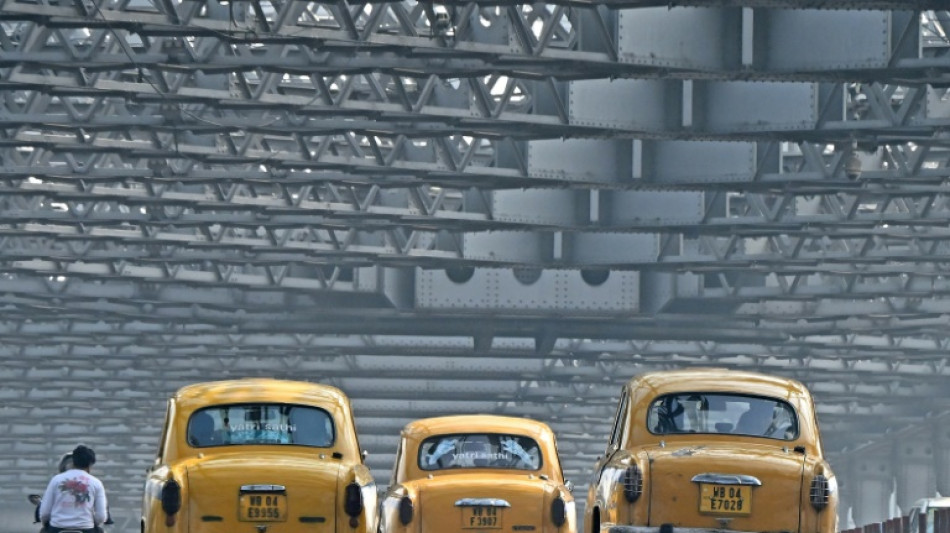
End of the road for Kolkata's beloved yellow taxis / Photo: Dibyangshu SARKAR - AFP

 US judge weighing Trump's White House ban on media outlets

 At UN, OpenAI's Altman calls 'for extreme care' in AI

 Hamilton gives thumbs up to Gulf GPs despite Iran conflict

 Leclerc admits going 'too far' in Hamilton shunt in Italy

 Row engulfs Dolly Parton's estate as manager accuses nephew of making threats

 Mandela Digital Extends Early Access Programme to 11 February 2027 Following Strong Response

 US seeks 11th Presidents Cup win in a row over global foes

 McDonald's to boost franchisees as inflation weighs on consumers

 Trump invites Putin to G20 summit in Miami

 Archaelogical 'breakthrough' could confirm origins of Paris

 ILO financial crisis takes centre stage in leadership race

 Stocks dip, oil soars despite Trump hailing "productive" Iran talks

 China's Xi to get rare airport welcome from Trump

 Turkey reassures investors over investment fund crisis
 Saka says England still have 'scar' from World Cup semi-final loss

 アレックス・ボディ氏とシュテファン・ハウプト教授、ルーマニアの伝説的な美術コレクションをめぐり提携に合意

 亞歷克斯·博迪與史蒂芬·豪普特教授就羅馬尼亞傳奇藝術收藏達成合作協議

 Алекс Боди и проф. д-р Стефан Хаупт договорились о сотрудничестве в рамках легендарной коллекции произведений искусства в Румынии

 French foreign minister says Palestinians 'must' hold polls

 Fresh Russian strikes on Ukraine's infrastructure kill seven

 Eriksen to return to Denmark after parting ways with Wolfsburg

 Brad Pitt says working with dog co-star was 'really moving'

 Golan will remain Syrian, vows President al-Sharaa at UN

 Blueberry Strengthens MENA Presence with CMA Category 5 License and Dubai Office Launch

 Russia probes bear attacks, as official says town under 'siege'

Kolkata locals cherish their city's past, which is why many in the one-time Indian capital are mourning a vanishing emblem of its faded grandeur: a hulking and noisy fleet of stately yellow taxis.
The snub-nosed Hindustan Ambassador, first rolling off the assembly line in the 1950s with a design that barely changed in the decades since, once ruled India's potholed streets.
Nowadays it is rarely spotted outside Kolkata, where it serves as the backbone of the metropolitan cab fleet and a readily recognisable symbol of the eastern city's identity.
But numbers are dwindling fast, and a court ruling means those that remain -- lumbering but still sturdy -- will be forced off the roads entirely in the next three years.
"I love my car like my son," Kailash Sahani, who has sat behind the wheel of an Ambassador cab for the past four decades, told AFP.
"It's a simple car -- no electronics, no frills," the 70-year-old added. "It's unbelievable how much things have changed... The end of these taxi cars also marks our end."
Sahani is among thousands of Kolkata cabbies relinquishing their vehicles in line with tough emissions standards introduced in 2009 to ease the city's endemic smog problem.
Only around 2,500 Ambassador taxis were still working at the start of this year, down from 7,000 a year earlier, according to Bengal Taxi Association figures.
Another 1,000 will be retired this year, and West Bengal state transport minister Snehasis Chakraborty told AFP that the remainder will be gone by the end of 2027.
"The car is strong. Parts and maintenance are cheap and if it breaks down, it's easy to find a mechanic," said Bengal Taxi Association spokesman Sanjeeb Roy.
Their disappearance, he added, "represents all that's wrong with India's changing economy".
- Litany of defects -
The Hindustan Ambassador was the cornerstone of India's automotive industry for decades from its 1957 debut at a factory on Kolkata's northern outskirts.
Modelled on a similarly regal sedan car from Britain's now long-defunct Morris Motors, the car was a triumphant achievement of industry in the first years of India's history as an independent nation.
A deluxe model, its windows adorned with lace curtains, was for years the main means of conveyance for government ministers and captains of industry.
But the car's shortcomings also served as a reminder of deep structural problems with the quasi-socialist economic system that prevailed in India at the time.
Buyers sat on wait lists for years because pervasive red tape stopped Hindustan Motors from raising production to meet demand, while a near-monopoly on sales left no incentive to maintain quality standards.
That gave rise to an oft-repeated joke about the litany of defects found in the average "Amby": the only thing in the car that doesn't make a sound is its horn.
Market reforms from the 1980s onwards saw the Ambassador muscled off Indian roads by more modern vehicles, and production was halted entirely in 2014 after years of flatlining demand.
- 'Get with the times' -
Kolkata, the headquarters of Hindustan Motors, is the last place where the cars are seen in any great number -- a reminder of the tethers binding the city to India's past.
Grand public buildings evoke the immense riches that flowed through the city's tree-lined boulevards back when it was the second-largest city in the British Empire, after London.
Nobel laureate poet and polymath Rabindranath Tagore was born and died in Kolkata, where the national anthem he composed was sung for the first time during India's long independence struggle.
The city is also renowned for its thrumming nightlife, with crowded and dimly lit restaurants serving up chicken Kiev alongside the same suite of old-world European staples that have been listed on their menus since the late colonial era.
But its importance has shrunk dramatically since that heyday, first with the relocation of India's capital to Delhi in 1911 and then with Mumbai's ascension as the country's most important commercial hub.
Many of Kolkata's younger generations have left in search of better opportunities elsewhere, giving it a median age at least six years older than other big Indian cities, according to census data.
The city's skewed demographics prompted its pre-eminent novelist Amit Chaudhuri to once quip that while Delhi was for seeking power and Mumbai was for chasing riches, Kolkata was for visiting one's parents.
"People like me are under pressure to get with the times," retired Kolkata schoolteacher Utpal Basu, 75, told AFP.
"Old cars go, new ones come," he added. "But it will break my heart when the city loses another icon."
A.S.Diogo--PC