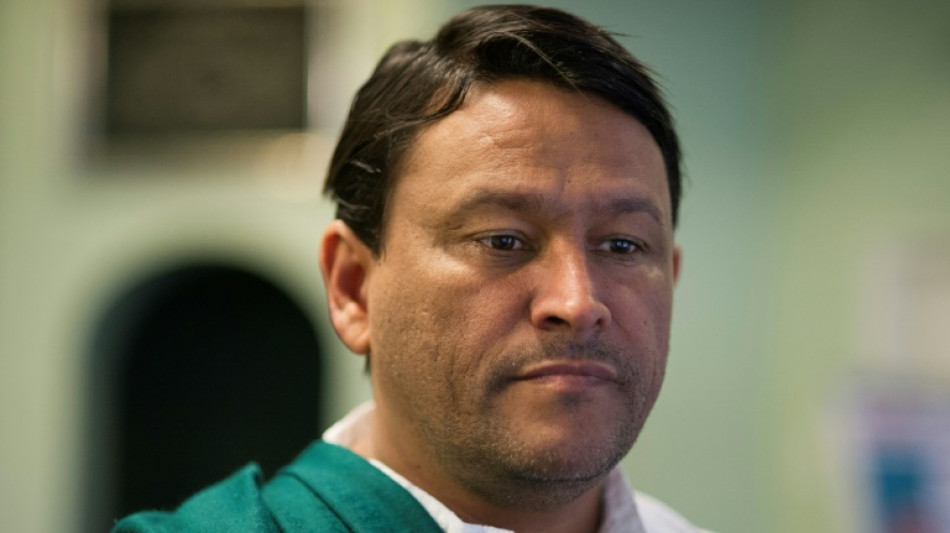
Muhsin Hendricks: S.Africa's gay imam who broke the mould / Photo: RODGER BOSCH - AFP/File

 Malaysia Sues Google for $146m Over Harmful Content

 Black Wind Turbine Blades Reduce Bird Deaths by 74% in Spain Study

 Brazil’s Landless Movement Partners with China to Build Affordable Tractors for Family Farms

 Raheem Sterling Receives Suspended Sentence After Lamborghini Crash

 Luxembourg Pay Rise Delayed as Regional and World Headlines Develop

 Audience to Choose the Set List at Luxembourg's First FAMIL Jukebox Night

 Twickenham Grounds Team Prepares Pitch for Six Matches in Three Days

 Black Friday Discounts Cut Prices on Two Top-Rated Wiper Blades

 Arizona Gun Regulation Battle Intensifies Under New Democratic Legislative Majority
Muhsin Hendricks, considered the world's first openly gay imam who was gunned down last weekend in South Africa, stood as a man who valued authenticity -- both in action and words.
"This is who I am, and if that means I am going to be killed because of my authenticity, then that is how I choose to meet God," he told AFP in an interview.
Police have said they are investigating Saturday's brutal daylight shooting in the coastal city of Gqeberha and have stopped short of calling it a hate crime.
But the murder has unleashed a climate of fear among the LGBTQ community in South Africa, where the constitution prohibits discrimination based on sexual orientation but stigma and violence persist.
Described as gentle and affable, Hendricks cracked Islam's rainbow ceiling by coming out as a gay cleric in 1996 and founded an organisation that helped Muslims reconcile religion with their sexuality.
The grandson of an imam, he was born in June 1967 in Cape Town, home to South Africa's largest Muslim community, to a mother who taught at a mosque and a spiritual healer father.
Raised in a rigid household where discipline was paramount, he endured his grandfather's stern sermons and later pursued religious studies at a university in Pakistan, though he nearly got expelled for struggling to grasp the teachings.
On returning to South Africa, he married a woman from Cape Town in 1991.
But he was living with a deep secret: his sexual orientation.
"I got divorced at the age of 29 after being married for six years," he told AFP in 2016.
"That was the point where I just felt -- no more double life. I needed to be authentic with myself, and part of that process was to come out."
- 'Beacon of hope' -
Hendricks, a well-built cleric with full black hair and a noticeable streak of grey at the temples, then set up South Africa's first LGBTQ-friendly mosque, providing a safe haven and training in human rights activism for worshippers of all genders and sexual orientation.
South Africa was the first country in the world to write a ban on discrimination on the grounds of sexual orientation into its constitution. It remains the sole African nation to perform same-sex marriages, legalised in 2006.
But in practice, discrimination and violence are still widespread.
Hendricks was a "beacon of hope" in the LGBTQ community, 56-year-old Reverend Toni Kruger-Ayebazibwe, told AFP.
She heads the Johannesburg-based Global Interfaith Network, a non-governmental organisation of LGBTQ people of faith which Hendricks co-founded in 2012.
"He represented for many people the actual, real-life possibility that you could be both a queer person and a person of faith -- and specifically a Muslim person of faith," she said.
In one of his last posts on social media, where he routinely shared his Islamic teachings and preached tolerance, Hendricks can be seen lip syncing to a Hindi song about love.
"He was trying to empower and educate people... challenging dogma in a beautiful, loving and compassionate way," said Jacqui Benson-Mabombo, 48, a friend of Hendricks and co-founder of the Cape Town-based Queer Faith Collective.
Hendricks preached a "God of radical love and justice for all human beings", said the Centre for Contemporary Islam in a statement condemning the "intense homophobia permeating the Muslim and other faith communities".
- 'Feeling vulnerable' -
Yet a target had always been on Hendricks' back.
The father of three had raised concerns about his safety, often describing the threats he faced both online and in person for his advocacy.
In 2022, he had denounced a fatwa, or religious edict, condemning homosexuality issued by the South African Muslim Judicial Council shortly after the release of a documentary showcasing Hendricks' work, called "The Radical".
The murder nonetheless came as a shock, said Kruger-Ayebazibwe.
"Many of us are suddenly feeling a lot more vulnerable."
T.Vitorino--PC