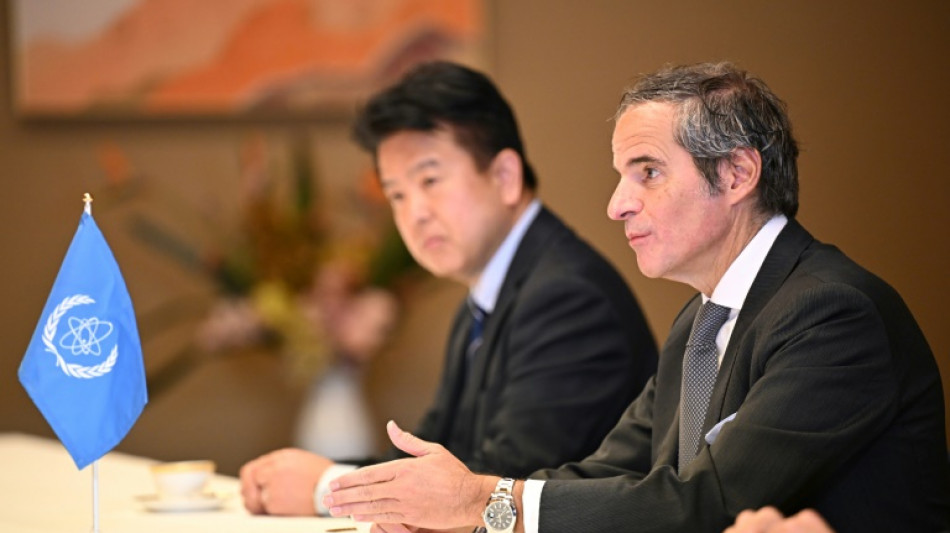
UN watchdog chief visits Fukushima as Japan returns to nuclear power / Photo: Philip FONG - AFP

 US judge weighing Trump's White House ban on media outlets
 At UN, OpenAI's Altman calls 'for extreme care' in AI

 Hamilton gives thumbs up to Gulf GPs despite Iran conflict

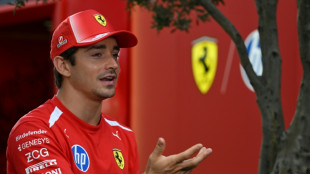 Leclerc admits going 'too far' in Hamilton shunt in Italy

 Row engulfs Dolly Parton's estate as manager accuses nephew of making threats
 Mandela Digital Extends Early Access Programme to 11 February 2027 Following Strong Response

 US seeks 11th Presidents Cup win in a row over global foes

 McDonald's to boost franchisees as inflation weighs on consumers
 Trump invites Putin to G20 summit in Miami

 Archaelogical 'breakthrough' could confirm origins of Paris

 ILO financial crisis takes centre stage in leadership race

 Stocks dip, oil soars despite Trump hailing "productive" Iran talks

 China's Xi to get rare airport welcome from Trump

 Turkey reassures investors over investment fund crisis
 Saka says England still have 'scar' from World Cup semi-final loss

 アレックス・ボディ氏とシュテファン・ハウプト教授、ルーマニアの伝説的な美術コレクションをめぐり提携に合意

 亞歷克斯·博迪與史蒂芬·豪普特教授就羅馬尼亞傳奇藝術收藏達成合作協議

 Алекс Боди и проф. д-р Стефан Хаупт договорились о сотрудничестве в рамках легендарной коллекции произведений искусства в Румынии

 French foreign minister says Palestinians 'must' hold polls

 Fresh Russian strikes on Ukraine's infrastructure kill seven
 Eriksen to return to Denmark after parting ways with Wolfsburg
 Brad Pitt says working with dog co-star was 'really moving'

 Golan will remain Syrian, vows President al-Sharaa at UN

 Blueberry Strengthens MENA Presence with CMA Category 5 License and Dubai Office Launch

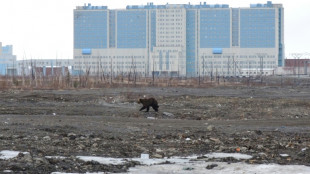 Russia probes bear attacks, as official says town under 'siege'

The UN nuclear watchdog chief visited Japan's stricken Fukushima plant on Wednesday, the day after Tokyo approved an energy plan that marks a return to nuclear power to meet growing demand for AI.
The International Atomic Energy Agency (IAEA) is monitoring Japan's efforts to decommission the Fukushima Daiichi plant after a 2011 earthquake-triggered tsunami killed 18,000 people and set off the worst nuclear disaster since Chernobyl.
As IAEA head Rafael Grossi arrived in Japan on Tuesday, the cabinet adopted a plan to increase reliance on nuclear power to help meet growing energy demand from artificial intelligence and microchip factories.
"At a moment where Japan is embarking on a gradual return to nuclear energy in its national energy mix, it is important that this is also done in complete safety and with the confidence of the society," Grossi said after meeting the foreign minister.
Japan had previously vowed to "reduce reliance on nuclear power as much as possible".
But this pledge was dropped from the latest Strategic Energy Plan -- which includes an intention to make renewables the country's top power source by 2040.
Under the plan, nuclear power will account for around 20 percent of Japan's energy supply by 2040, up from 5.6 percent in 2022.
The return to nuclear comes as the country is decommissioning Fukushima Daiichi, a process expected to take decades with the most dangerous part still ahead: removing around 880 tonnes of radioactive debris from the reactors.
Grossi, making his fifth visit to Fukushima, viewed the vast "interim" soil storage facilities near the plant for the first time.
Around 13 million cubic metres of soil and 300,000 cubic metres of ash from incinerated organic material -- enough to fill 10 stadiums -- were scraped from land in the region to remove harmful radiation.
On Wednesday, trucks and construction vehicles went back and forth between several areas where hundreds of large soil-filled black bags were stacked, some covered by a thin layer of snow.
Hanging on a locked fence around the storage site was a sign displaying the radiation level.
- Seafood bans -
Japan plans to recycle roughly 75 percent of the soil -- the portion with low radioactivity -- for building projects such as road and railway embankments.
The remaining material will be disposed of outside the Fukushima region ahead of a 2045 deadline.
Stripping topsoil was "very effective" to decontaminate land close to waterways, said Olivier Evrard, research director at France's Atomic Energy Commission.
But the operation was expensive, "generated a massive amount of waste and still poses fertility issues" for agriculture, he told AFP.
It stands in contrast to the decision to fence off a large area after the 1986 Chernobyl disaster and more or less "leave it to wildlife", Evrard said.
Experts from the IAEA and countries including China and South Korea will also take new seawater and fish samples from Fukushima on Wednesday.
Plant operator TEPCO began discharging 1.3 million tonnes of groundwater, seawater and rainwater, along with water used for cooling the reactors, into the sea in 2023.
The water release is endorsed by the IAEA and TEPCO says all radioactive elements have been filtered out except for tritium, levels of which are within safe limits.
However, countries including China and Russia have criticised the release and banned Japanese seafood imports.
China said in September it would "gradually resume" importing seafood from Japan but this has yet to begin.
J.Pereira--PC