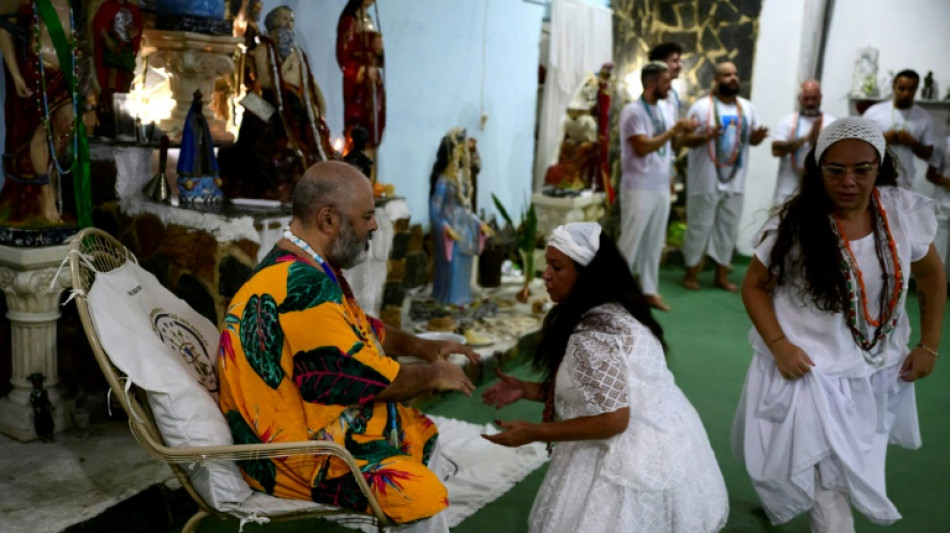
Feted at Carnival, Afro-Brazilian faiths face hate in daily life / Photo: Pablo PORCIUNCULA - AFP

 Row engulfs Dolly Parton's estate as manager accuses nephew of making threats

 Mandela Digital Extends Early Access Programme to 11 February 2027 Following Strong Response

 US seeks 11th Presidents Cup win in a row over global foes

 McDonald's to boost franchisees as inflation weighs on consumers

 Trump invites Putin to G20 summit in Miami

 Archaelogical 'breakthrough' could confirm origins of Paris

 ILO financial crisis takes centre stage in leadership race

 Stocks dip, oil soars despite Trump hailing "productive" Iran talks

 China's Xi to get rare airport welcome from Trump

 Turkey reassures investors over investment fund crisis

 Saka says England still have 'scar' from World Cup semi-final loss
 アレックス・ボディ氏とシュテファン・ハウプト教授、ルーマニアの伝説的な美術コレクションをめぐり提携に合意

 亞歷克斯·博迪與史蒂芬·豪普特教授就羅馬尼亞傳奇藝術收藏達成合作協議
 Алекс Боди и проф. д-р Стефан Хаупт договорились о сотрудничестве в рамках легендарной коллекции произведений искусства в Румынии
 French foreign minister says Palestinians 'must' hold polls
 Fresh Russian strikes on Ukraine's infrastructure kill seven

 Eriksen to return to Denmark after parting ways with Wolfsburg

 Brad Pitt says working with dog co-star was 'really moving'

 Golan will remain Syrian, vows President al-Sharaa at UN

 Blueberry Strengthens MENA Presence with CMA Category 5 License and Dubai Office Launch

 Russia probes bear attacks, as official says town under 'siege'

 Robertson tells Spurs to 'forget' past woes

 Italy police find 3 million euros stashed in mobster's house

 Renard versus Queiroz in AFCON qualifying blockbuster

 Former Mexico boss Aguirre returns to Spain with Valencia
In a busy workshop, Leandro Vieira oversees preparations for Rio de Janeiro's dazzling Carnival parade, where his samba school will celebrate the spiritual richness of Candomble, one of the main Afro-Brazilian faiths.
Elsewhere, an Umbanda priestess named Mother Fernanda -- the practitioner of another Afro-Brazilian religion -- tearfully assesses damage to her vandalized temple, where sacred items were destroyed and equipment stolen.
The perpetrators left a Bible on the ground, alongside the remains of an image of Oxum, the goddess of love.
Oxum and other African deities, known as "orixas," will be honored by most of the 12 samba schools competing from Sunday to Tuesday in the famed Carnival parade, with celebrants relaying a story through the use of towering floats, drummers and dancers.
Thousands of spectators will cheer on the myths and rituals that emerged with the arrival of five million African slaves trafficked to Brazil -- a reaction far removed from the reality these religions face in daily Brazilian life.
The parade is "sold to the world as a mark of Brazilian culture, but (the country) discriminates against religions of African origin," Vieira, the 41-year-old artistic director of the Imperatriz Leopoldinense school, told AFP.
This paradox "shows that Brazilian society misunderstands the aesthetic, artistic, social and narrative contribution of black culture."
- 'We are being silenced' -
"People accept Carnival, Carnival is beautiful, but we suffer a lot of prejudice," said the Umbanda priestess Fernanda Marques Franco dos Anjos, a 42-year-old lawyer.
"Our daily reality is this: we are being silenced, destroyed."
In Brazil, attacks on religious freedom increased by 81 percent between 2023 and 2024, according to official data, confirming a trend in recent years.
Attacks tripled against followers of Umbanda and Candomble, whose faiths are often wrongly associated with witchcraft or Satanic practices.
They face insults and mockery, intimidation, physical attacks and property damage, according to the independent Observatory of Religious Freedoms (OLR).
In a 2023 report presented to the UN, the observatory documented cases of temples being burned down, priests threatened and faithful adherents who lost their jobs.
"You can't (display your faith) on LinkedIn," or "wear a protection necklace" on Instagram, because "that often costs you your job," said Isabella Menezes Antas, 41, the "mother" of the Umbanda Academy temple in downtown Rio that has also suffered attacks.
- Intolerance rooted in racism -
"Violence has always been practiced against religions of an African origin," said Christina Vital, a professor of Sociology at Fluminense Federal University.
"Their artistic and cultural importance is recognized, but this is not enough to overcome the reasons that structure racism and intolerance," Vital added.
Maria Eduarda Oliveira, a 24-year-old hairdresser, recalls being called a "macumbera monkey" by a boy at school -- a derogatory term referring to someone who follows Afro-Brazilian rituals.
"That shook me, but because I was very educated about (defending) my blackness and my history, I was able to move on," she said on Ipanema beach while making an offering to Iemanja, the goddess of the sea.
The stigma even hit Brazilian funk star Anitta, who lost 300,000 followers on social media after showing her devotion to Candomble.
- 'Our ancestors survived slavery' -
Academic and OLR member Ivanir dos Santos attributes the persecution to the "political growth of evangelical groups" and "Christian fundamentalist groups," which have sought to "suffocate" African spiritual heritage in Brazil.
Evangelicals now represent almost a third of Brazil's population of over 200 million people, with Evangelical lawmakers and senators comprising one of the biggest and most powerful lobbies in the National Congress.
In favelas and other poor neighborhoods, priests and followers of Afro-Brazilian faiths often suffer persecution from the criminal factions that rule over these areas -- banning them in favor of Christianity, according to the OLR.
"People must respect the right of each person to follow their religion," Minister of Racial Equality, Anielle Franco, said recently.
She has set up an anonymous reporting service and programs to combat religious intolerance.
According to the latest census data in 2010, nearly 600,000 Brazilians identify as followers of religions of African origin.
"Our ancestors survived slavery. Even with this violence, we will continue to survive," said dos Santos.
P.Cavaco--PC