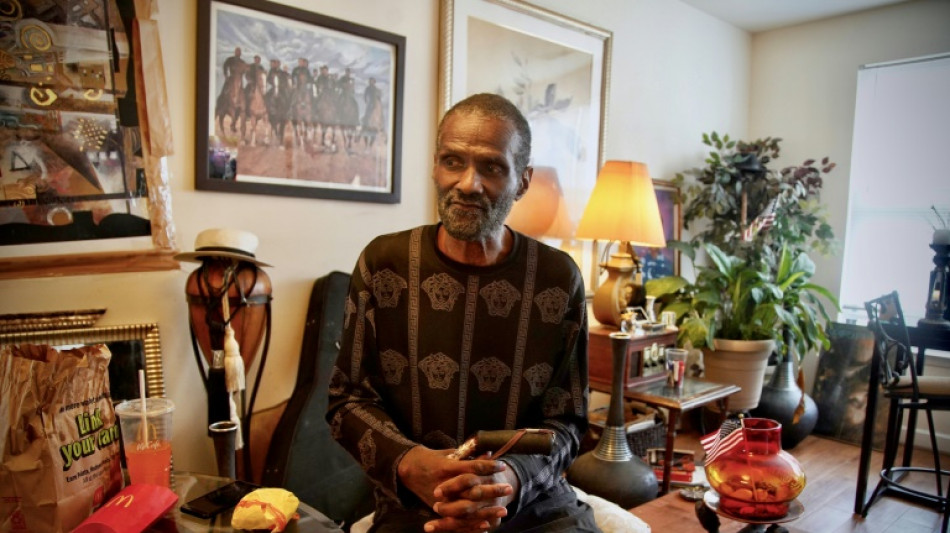
Black Americans bear the brunt of fentanyl 'epidemic' in Washington / Photo: Agnes BUN - AFP Photo

 Birmingham City Seek First Championship Win Against Wrexham

 Four-wicket Robinson stars as Pakistan collapse in second Test

 Alcaraz anxious after layoff but feels 'great' about wrist

 Bezzecchi edges Marquez brothers in blazing Spanish MotoGP practice

 Ukraine opposes reintegration of Russia to motorsport

 The chaotic saga of Kanye West's planned Russian concerts

 Missing soar over 2,400 after deadly Nepal, China floods

 India Orders Wind Turbine Makers to Report on Data Localization for Cybersecurity
 Leknessund breaks away to win emotional Vuelta stage seven
 Four-wicket Robinson stars as Pakistan all out for 110 in second Test

 Fed chair Warsh signals 'work to do' on high US inflation

 Watkins's legacy at Villa untarnished, says Emery as Jackson arrives

 Spurs boss De Zerbi targets one more big signing before window shuts

 Fed chair Warsh flags high US inflation as 'concerning'

 Same Election Question, Two Different Odds: Predictions.io Launches Free Cross-Venue Comparison Tools

 Man Utd new signing Baleba sidelined for three weeks
 Juve's Yildiz to miss 'several months' with foot injury

 Celine Dion arrives in France ahead of sold-out comeback dates

 All-round Tongue stars for England in second Test against Pakistan

 UEFA's legal move 'massive escalation' in bitter Infantino feud

 MEXC Launches Earn Plus With Limited-Time Event Offering Up to 800% APR Booster

 Norway's new King Haakon VIII, popular face of shaken monarchy

 Stocks rise ahead of Fed chair's policy speech

 Norway's new King Haakon VII, popular face of shaken monarchy

 Last-wicket duo take England to 290 all out in 2nd Test against Pakistan
Lorando Duncan wears long-sleeved shirts because his arms bear scars he doesn't like to show: those of the drugs he has been injecting into his veins for decades.
Born in the US capital Washington 65 years ago, the slender African American has been using heroin almost all his adult life.
But the advent of fentanyl, an ultra-powerful and addictive synthetic opioid, changed everything.
"Fentanyl killed a lot of my friends," he tells AFP beneath a picture of America's first Black vice president, Kamala Harris, that he has hung in his apartment in Anacostia, one of the poorest neighborhoods in the city.
"Almost every two weeks, I hear about somebody overdosing on fentanyl."
He fears he will be next. "I need to stop... because eventually I'm going to kill myself. And I know it."
Fentanyl -- sold in powder form and cheap to manufacture, so often used as an additive in other drugs such as heroin -- began flooding the market in 2014.
In 2021, 426 people died of opioid overdoses in Washington -- five times as many as in 2014. Of them, 95 percent were fentanyl-related, and 85 percent were Black people. Like Lorando, the majority were between 50 and 69 years old.
Heroin users have been at the forefront of this "poisoning" of supply, as experts call it.
"One day I bought some drug from a guy I know, but I didn't know it was fentanyl," says Lorando, a former prisoner now living on disability benefits.
He passed out, he says, falling on his hip. Now he walks with a cane.
"When I fell, it was day, and when I woke up, it was nighttime. God woke me up this day," he says.
But now he takes fentanyl up to three times a day to feel "normal" and avoid the illness and nausea of withdrawal.
"Now they use fentanyl to cut heroin. So you basically gonna get fentanyl in everything you buy. Everybody uses fentanyl to cut the dope. Make it potent," he says.
The problem, he adds, is that users never know what they are going to get. "You're playing Russian roulette."
- Building trust -
In Washington, long dubbed "Chocolate City" because of its large African American population, Black people were already dying from overdoses at twice the rate of white people in 2010, according to one study.
By 2019, it was 10 times more. For both periods, this disparity was higher than in any state in the country. Experts say one reason is because of how much more vulnerable Black people are -- lower income, less likely to own a home, less likely to have access to resources that can keep them stable and supported.
A few grassroots organizations are doing their best to combat the ravages of the drugs.
Tyrone Pinkney has been working for one of them, the Family and Medical Counseling Service, for 10 years. The 33-year-old travels around the city, especially what he describes as "the crime areas," in a recreational vehicle.
On the RV's floor is a box containing dirty syringes, collected from visitors who are then given clean ones.
And on the seats are cartons of Narcan, the brand name of naloxone, an antidote capable of blocking the effect of opioids -- and thus saving a person in the process of overdosing.
With a tablet in hand, Pinkney questions the few dozen people who turn up each day, checking for example whether they have been tested for the AIDS virus.
"It's not going to keep them from doing what they're doing. But it'll keep them safe," he explains.
Little by little, bonds of trust are created. On his phone, he scrolls through the names of dozens of "clients," as he calls them, who can call him in case of need.
- 'Perfect storm' -
The association helped more than 2,500 people in 2021, and distributed more than 200,000 syringes, according to regional coordinator Mark Robinson.
"It's an emergency. It's endemic," he tells AFP.
"It's an opioid epidemic, layered beneath a (Covid-19) pandemic, layered beneath a health emergency that was already pre-existing amongst Black and brown people," he continues, listing the ways in which Washington's residents are made vulnerable.
"You have multiple epidemics upgrading simultaneously, it's like a perfect storm. And we're right in the midst of it."
For many, the steps needed to access treatment, such as opioid substitutes methadone or buprenorphine, remain too complex -- making it often easier to get drugs than help.
"We've really worked hard on access," Barbara Bazron, who heads Washington's department of behavioral health, tells AFP.
For example, users no longer need to go through a dispatch center to receive prescriptions -- 70 approved entities can directly receive new patients, she explained.
More than 5,000 people are currently enrolled in these care programs.
The city has also prioritized the free distribution of naloxone, giving away 56,000 kits in 2021, and tests to detect whether drugs contain fentanyl.
City Hall is also "gathering information" on safe injection sites, such as those recently set up in New York, says Bazron, who admits she is willing to look at any option.
"Nothing is off the table," she says.
A.F.Rosado--PC