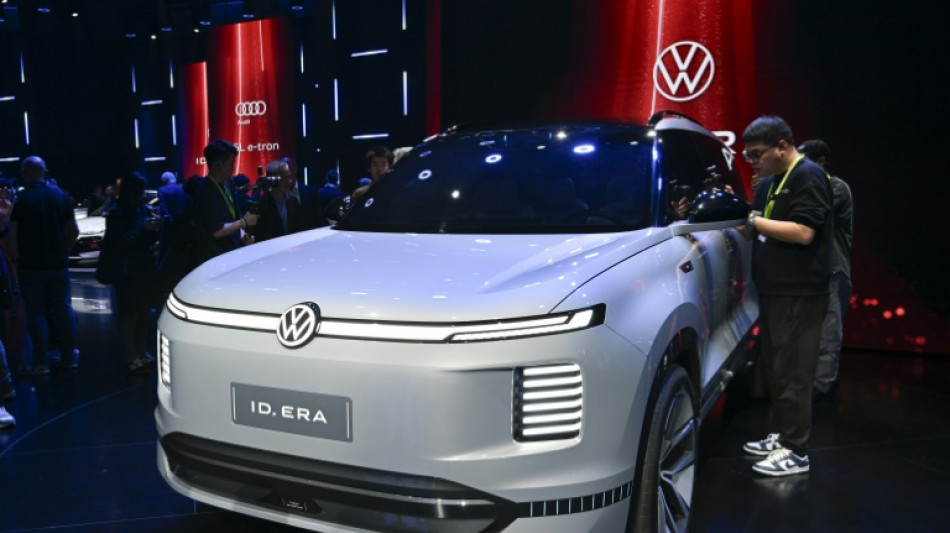
European carmakers on China charm offensive as sales droop / Photo: WANG Zhao - AFP

 Schoolgirl Yu, 13, fastest again in bid for third Asian Games gold
 Oil prices fall after Trump hails 'good' talks with Iran
 AI political ads warp reality ahead of US midterms
 Kenneth Branagh embraces action hero role -- to get in shape
 'New one' Klopp promises fresh approach as Germany reign begins
 Milne returns to New Zealand squad for India T20 series
 US-led Americas coalition backs sanctions against crime groups

 'Star Wars' fans and art lovers line up for new Lucas museum
 Trump renames AI 'super intelligence' as leaders jostle over dangers

 Oil prices retreat as markets welcome US-Iran talks
 US refusing to give Sudan's de facto leader visa for UN: diplomatic sources, UN
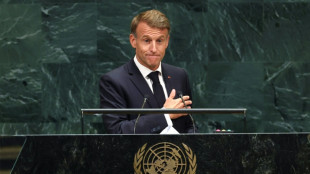 Macron urges world to choose UN over 'law of the jungle'
 All-rounder Jacks stars as England beat Sri Lanka in 1st ODI

 Man City peg back Bayern to start Women's Champions League

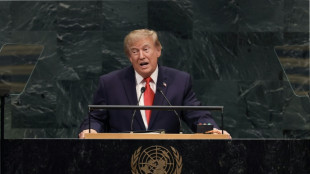 Trump beats 'America first' drum at UN as allies tread carefully

 Snedeker backs Spaun for Ryder Cup after Presidents snub
 French prosecutors probe secret filming of women with smart glasses

 Trump renames AI "super intelligence," rejects international oversight
 Trump rejects international regulation of AI

 How is the EU approaching record fuel prices?
 Sri Lanka's Colombage strikes on debut as England dismissed for 265 in first ODI
 Hurricane Polo strengthens to top category 5 off Mexico
 11 hurt as teen opens fire outside school in western Turkey

 UN chief says 'Big Oil' treats atmosphere as open sewer

 Tunisia says 2026 summer hottest on record

Once blithely dominant in China, European automakers are now launching full-fledged charm offensives at consumers in the world's largest car market, seeking to claw back sales lost to domestic rivals.
At this week's Auto Shanghai, the largest global industry show of its kind, foreign firms -- in particular legacy German ones -- pitched dozens of electric, high-tech models made "in China for China".
Volkswagen, the largest foreign automaker operating in the country, announced that by 2027 it would release more than 20 new cars for the local market.
"There is still a huge opportunity for the German brands to make a comeback, but with each day without a truly tech-defined car (like Chinese rivals) it seems unlikely," EV specialist Elliot Richards told AFP.
Volkswagen entered the Chinese market through a joint venture when it first opened up, swiftly taking the lion's share.
Forty years later though, dozens of ultra-competitive homegrown car brands have blossomed.
The Chinese government's strategic support for the EV and hybrid sector has seen many domestic firms become world leaders in that area.
BYD, Geely, Dongfeng and others took 65 percent of the local market in 2024, up 22.2 percent year-on-year, data from MarkLines shows.
German brands' share decreased by 10.8 percent in the same year.
Other European brands like Renault still manufacture some cars in China, but have withdrawn from the local market.
For those still in the game, holding ground in China is essential, as Europe's market weakens and US President Donald Trump complicates access to the United States with his tariff policy.
- 'Turning a big ship' -
"Decades ago, it was very easy to develop, to produce one standard, and to provide it globally," Volkswagen CEO Oliver Blume said at Auto Shanghai.
"Today it's impossible."
To adapt to an increasingly sophisticated and monied Chinese consumer base, firms have employed a variety of tactics.
"German carmakers have invested heavily into their competitiveness in order to catch up with Chinese brands in the areas of electrification, intelligent vehicles and market responsiveness," European Chamber Vice President Stefan Bernhart told AFP.
Volkswagen works closely with domestic giants FAW, SAIC and JAC, and recently added Xpeng, a startup known for its tech proficiency, to its list of partners.
Stellantis produces cars in China notably through its alliance with Leapmotor, another Chinese startup.
Brands are also boosting local research and development staffing and investment, and increasing their output to what Volkswagen calls "China Speed".
Even as it considers layoffs in Europe, Volkswagen has reinforced its development capacity in China, planning to release its new models in 18 months and save 40 percent of the costs.
"Turning a big ship around takes effort, commitment, and also some sacrifices," Brian Gu, XPeng's co-president, told AFP. "But I see they're very committed to change."
- Mercedes versus Nio -
Until 2023, luxury European behemoths like Mercedes and BMW could still count on the fact their cars were seen as status symbols, according to consultancy Inovev.
Their sales slipped last year though, as the prestige of local brands like Nio and individual models like Xiaomi's SU7 has risen.
At Auto Shanghai, Mercedes presented a long version of its new electric star, the CLA, as well as a luxury minivan aimed at the rich Chinese leisure set.
CEO Ola Kallenius was bullish about prospects in what he called the "world's most competitive market".
He pointed to features targeted at local customers, including an advanced driver assistance system, as well as giant screens, as Chinese drivers "use (their car) as an entertainment space".
Porsche is also betting on its cachet -- announcing this week it will concentrate on higher value sales rather than volume.
However, with Chinese competitors slashing prices but not quality, consumers are no longer as willing to pay a premium for Western brands, according to Inovev.
"The name of the game is value," said Tu Le, founder of Sino Auto Insights.
"Chinese consumers between the age of 30 and 45 are going into showrooms, looking at Mercedes, looking at Nio, and buying that Nio instead."
But EV specialist Richards warned against complete gloom: "Nothing is certain in the automotive space, especially in China, and everything is still up for grabs."
S.Caetano--PC