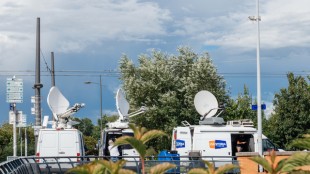
Spain, Portugal rule out cyberattack for massive blackout / Photo: CRISTINA QUICLER - AFP

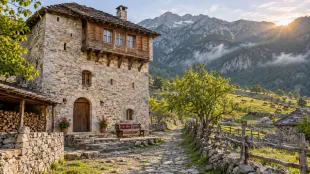 Restored Albanian tower houses anchor new rural tourism trail
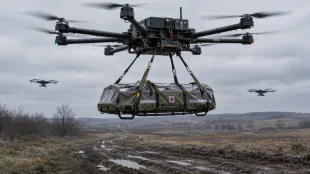
 Sonia Gandhi reflects on family tragedy and reluctant political career

 Pope Leo begins three-country South American tour in Uruguay

 Khawaja says entire Australia camp knew of 2018 ball-tampering plan

 Portuguese Finance Minister to Review Socialist Budget Amendments

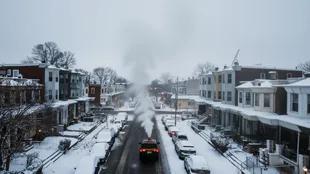 Early Polar Vortex Disruption Creates Uncertain Winter Outlook for Pennsylvania

 Stadler Begins Testing First Hydrogen Narrow-Gauge Trains for Southern Italy

 Kospi Falls Below 5,000 as U.S. AI Regulation Fears Trigger Circuit Breaker
Spain and Portugal on Tuesday ruled out a cyberattack as the cause of a sweeping blackout that sparked chaos for millions of people across the Iberian Peninsula the previous day.
Telephone, internet and lights were working again, train services resumed, shops reopened and workers flocked back to offices following Monday's outage that lasted up to 20 hours in some places.
No firm cause for the shutdown has yet emerged, although rumours had spread on social media about cyberattacks and an unusual "atmospheric phenomenon".
"With the analysis that we have been able to carry out up to now, we can rule out a cybersecurity incident in the facilities" of Spanish grid operator Red Electrica (REE), said its director of operations, Eduardo Prieto.
"There was no type of intrusion in Red Electrica's control systems that may have caused the incident," he added during a news conference.
Portuguese government spokesman Antonio Leitao Amaro said it had "no information linked to a cyberattack or hostile attack at this stage" after a preliminary analysis.
Portugal's grid operator REN also denied on Tuesday it was behind a message circulated on social media attributing the blackout to a rare atmospheric event.
The message in Portuguese said there was a "fault" in the Spanish electricity grid linked to "abnormal oscillations (that) were recorded in the very high-voltage lines (400 kV), a phenomenon known as 'induced atmospheric vibration'".
"REN confirms we did not put out this statement," spokesman Bruno Silva told AFP, without giving further details.
Prieto had said on Monday there was "a major fluctuation in the power flow, accompanied by a very large loss of production".
That "surpassed the reference disruption for which the electric systems are designed and operated" in the European Union, triggering "a disconnection of the peninsular Spanish electric system from the rest of the European system", which collapsed the Spanish and Portuguese networks, he explained.
- 'We are vulnerable' -
People in both countries began to recover a semblance of normalcy on Tuesday when authorities confirmed the electric networks had been restored.
Maria Jesus Cobos managed to drive home through Madrid overnight after a chaotic day that left her without light and communications until almost 11:00 pm (2100 GMT).
"That showed that we are very vulnerable. There's something that isn't being done well. I had to drive without traffic lights," she told AFP;
But she added that people had been "very civilised".
"It shows us that we can get by," added the 50-year-old lawyer, who recounted meeting people standing by the road with signs showing their intended destination.
High-speed Spanish train lines, including those connecting Madrid, Barcelona and Seville, were back up and running on Tuesday.
But services were limited or suspended on several regional routes, said national railway company Renfe.
Madrid's Atocha station was packed with expectant travellers who cheered every time a departure was announced.
Bars had reopened and most schools also welcomed back their pupils, although the resumption of classes varied depending on the region in Spain's decentralised political system.
Scenes of chaos engulfed Spain and Portugal on Monday, with huge tailbacks on roads, customers rushing to withdraw cash from banks and residents finding themselves trapped in lifts.
Thousands of stranded travellers slept in train stations overnight and streets were plunged into darkness with all lampposts and traffic lights off.
AFP journalists heard residents applaud and shout joyfully in Madrid on Monday evening as power progressively returned.
Power cuts also briefly affected areas of southwestern France.
Internet access was disrupted in Morocco but returned on Tuesday, according to a subsidiary of French telecoms giant Orange.
Parts of Denmark's gigantic Arctic territory of Greenland also lost phone and internet connections on Monday evening in an outage possibly linked to the incidents on the Iberian Peninsula, operator Tusass said.
A.Motta--PC