Bangladesh's influential Islamists promise sharia as they ready for polls / Photo: Salahuddin Ahmed - AFP

 Restored Albanian tower houses anchor new rural tourism trail

 Sonia Gandhi reflects on family tragedy and reluctant political career

 Pope Leo begins three-country South American tour in Uruguay

 Khawaja says entire Australia camp knew of 2018 ball-tampering plan
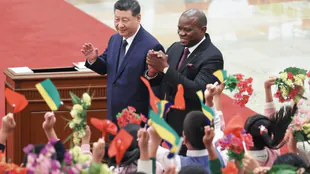
 Portuguese Finance Minister to Review Socialist Budget Amendments

 Early Polar Vortex Disruption Creates Uncertain Winter Outlook for Pennsylvania

 Stadler Begins Testing First Hydrogen Narrow-Gauge Trains for Southern Italy

 Kospi Falls Below 5,000 as U.S. AI Regulation Fears Trigger Circuit Breaker
Bangladesh's Islamists are readying to make political gains after being crushed for years by the government that was overthrown in a mass uprising last year, rallying hardline loyalists for eagerly anticipated elections.
"We are pretty confident about entering the parliament in the next election," Muhammad Mamunul Haque, joint secretary of Hefazat-e-Islam, an influential coalition of Islamic schools, told AFP in an interview.
The coalition will hold a mass rally in the capital Dhaka on Saturday in what is expected to be one of their biggest public shows of strength for years as religiously fuelled activism gains popularity.
Haque, 52, said the group will push to implement sharia, or Islamic law, and believes the group's network of tens of thousands of seminaries -- claiming to have some 500,000 members -- means they will do well if the vote "is free and fair".
Hefazat-e-Islam is an alliance of different parties and Muslim organisations, including Haque's Khilafat-e-Majlish party.
A hugely influential pressure group, it has been courted by political parties since it was founded 15 years ago.
No date has been set for elections but caretaker leader Muhammad Yunus, the Nobel Peace Prize winner who heads the interim government, has promised polls will be held by June 2026 at the latest.
- Strength after revolution -
The South Asian nation of some 170 million people last held elections in January 2024, when Sheikh Hasina won a fourth term as prime minister in the absence of genuine opposition parties.
Her opponents boycotted the vote after a crackdown.
Hasina, who was blamed for extensive human rights abuses, took a tough stand against Islamist movements during her autocratic 15-year rule.
Thousands were detained, including Haque, who was arrested in 2021 and spent three years in jail.
He faced around a dozen charges after Islamists tried to protest against a visit by Hasina's key ally Prime Minister Narendra Modi, the Hindu-nationalist leader of neighbouring India.
Hasina fled to New Delhi in August as crowds stormed her palace.
She remains in self-imposed exile in India, infuriating Bangladeshis determined that she face trial for alleged "mass murder".
Islamist groups have gained strength with Hasina gone and have increasingly sought to impose their vision on the wider population.
That has sparked worries from smaller groups, including Muslim Sufi worshippers and the Hindu minority, who together account for less than a tenth of the population.
Women, in particular, have expressed concern.
Islamists have demanded an end to a swath of activities, including cultural events deemed "anti-Islamic" -- from music to theatre festivals, women's football matches and kite-flying celebrations.
Mobs have vandalised Sufi shrines. Supporters of Haque's Khilafat-E-Majlis group stormed a public library last month and carted away hundreds of books before returning them.
Golam Rabbani, a leader of Khilafat-E-Majlish's youth wing, said they had targeted books that "promoted atheism", including Nobel laureate Rabindranath Tagore and the national poet Kazi Nazrul Islam.
- 'Implement sharia' -
Hefazat-e-Islam's rally on Saturday follows two days of marches by other key parties who are also seeking their support.
Those include the powerful Bangladesh Nationalist Party (BNP), expected to be the largest political force, and the National Citizens Party (NCP), formed by students who spearheaded the uprising against Hasina.
It also includes the largest single Islamist political party, Jamaat-e-Islami.
Haque said the group opposed a government women's commission and its recommendations to end discriminatory provisions, including equal inheritance rights for men and women.
"The commission is disrespectful to Islamic family traditions," Haque said.
"It seems they want to destroy the religious values attached to marriage and divorce and want to establish a Western society."
Muslim-majority Bangladesh has a constitution based on the four pillars of nationalism, socialism, democracy and secularism.
However, Haque said his supporters wanted Islamic law.
"We will implement sharia," Haque said, insisting all would be treated fairly.
"Everything will be guided by the Koran... under an Islamic welfare state, all, regardless of their faith, will be treated justly."
That would include capital punishment for blasphemy against Islam.
"We demand death sentences for speaking against Allah, tarnishing the image of the Prophet, and offending Muslims," Haque said.
"There is no room for negotiation in this regard."
O.Gaspar--PC