EU wins post-Brexit fishing row with Britain / Photo: LOIC VENANCE - AFP

 Restored Albanian tower houses anchor new rural tourism trail

 Sonia Gandhi reflects on family tragedy and reluctant political career

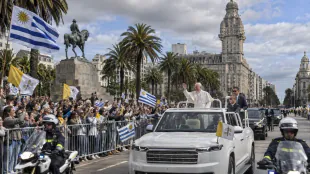 Pope Leo begins three-country South American tour in Uruguay

 Khawaja says entire Australia camp knew of 2018 ball-tampering plan

 Portuguese Finance Minister to Review Socialist Budget Amendments

 Early Polar Vortex Disruption Creates Uncertain Winter Outlook for Pennsylvania

 Stadler Begins Testing First Hydrogen Narrow-Gauge Trains for Southern Italy

 Kospi Falls Below 5,000 as U.S. AI Regulation Fears Trigger Circuit Breaker
The European Union on Friday won a landmark case against Britain at the world's oldest arbitration body over post-Brexit rights to fish sandeels, a tiny North Sea species.
The case at the Permanent Court for Arbitration (PCA) in The Hague was seen as a bellwether for other potential litigation between London and Brussels in a hot-bed industry.
It also marked the first courtroom trade battle between the 27-member bloc and Britain since it left the EU in 2020.
In a 298-page ruling, the PCA took the EU's argument that Britain was not living up to its post-Brexit trade deal pledges.
"The United Kingdom is in breach of its obligation to grant full access to its waters to fish sandeel in accordance with... the Trade and Cooperation Agreement," said the court.
It ordered London to "take the necessary measures to comply" with the agreement, which gave the EU access to British waters for several years during a post-Brexit transition period.
In March, Britain ordered all fishing to stop, arguing that sandeels were integral to the marine ecosystem of the North Sea.
Britain's lawyers at the PCA argued that a decline in sandeel stocks would have a knock-on effect on vulnerable species like the Atlantic puffin, seals, porpoises and other fish like cod and haddock.
But Brussels called foul, saying Britain failed to apply "evidence-based, proportionate and non-discriminatory measures" when it ordered a halt to the fishing.
Brussels is backing Denmark in the dispute. Danish vessels take some 96 percent of the EU's quota for the species, with sandeel catches averaging some £41.2 million (49 million euros) annually.
The case could provide significant jurisprudence for other clashes over fishing resulting from the post-Brexit trade deal.
Under the accord, the EU's fishing fleet retained access to British waters for a five-and-half-year transition period, ending mid-2026.
After that, access to respective waters will be decided in annual negotiations.
Set up in 1899, the PCA resolves disputes between countries and private parties through referring to contracts, special agreements and various treaties, such as the UN Convention on the Law of the Sea.
R.Veloso--PC