Mozart chocolate row leaves bitter taste in Austria / Photo: JOE KLAMAR - AFP

 Britain considers 2027 state visit for Ukraine’s Zelensky
 China and Gabon Elevate Ties to 'Shared Future' Amid State Visit

 World Golf Awards 2026 to be Hosted at Egypt’s Madinaty Golf Club

 12 Billion Gallons of Raw Sewage Discharged into Chicago River Despite Deep Tunnel Infrastructure

 Edmund Richardson Wins Baillie Gifford Prize for 'Alexander' Biography

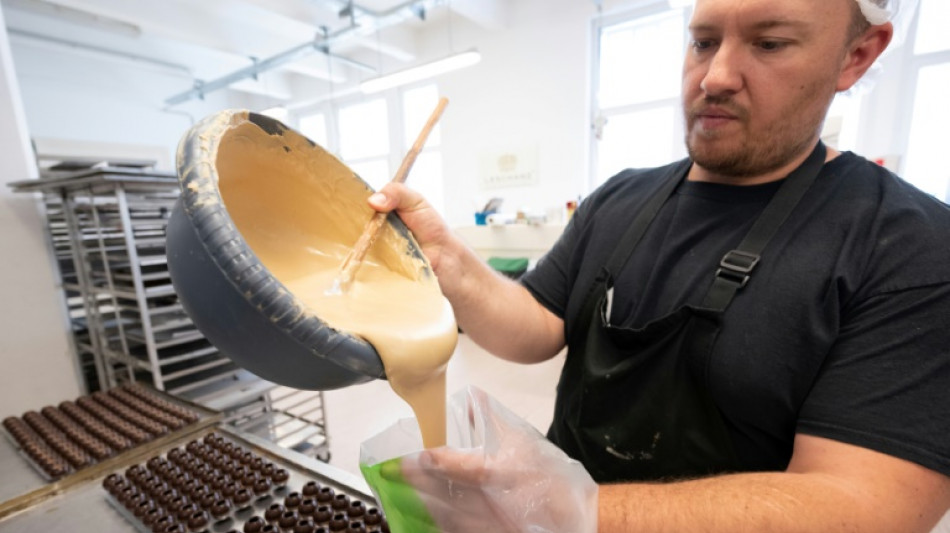
At a small high-end confectionery in Vienna, chefs put the finishing touches to one of Austria's signature souvenirs: Mozart chocolate balls filled with marzipan, pistachio, and rich almond and hazelnut nougat.
Family-owned Leschanz still painstakingly makes the Mozartkugel chocolates by hand before putting them in their signature wrapping, featuring a portrait of Austria's 18th-century composer Wolfgang Amadeus Mozart.
But Leschanz is in the minority these days, and with the number of brands rising, the chocolate balls beloved by tourists and locals alike are often no longer even produced in Austria.
US food giant Mondelez, which owns one of the most recognisable brands, moved its production from the Austrian city of Salzburg -- Mozart's birthplace -- to Eastern Europe last month, reigniting a heated and long-running marketing debate.
"It's a shame, because Mozart balls are an Austrian product," head confectioner and owner Wolfgang Leschanz, 75, told AFP.
At his firm, 10 time-honoured steps are required to make one single Mozartkugel and about 20,000 of the delicacies are freshly made to order each year.
- Only one 'original' -
Invented by confectioner Paul Fuerst in Salzburg in 1890, the Mozartkugel became popular in Europe after winning a gold medal at a Paris food fair in 1905.
Fuerst's great-great-grandson Martin now owns the business, which produces around 3.5 million handmade balls annually, still in Salzburg and still using the traditional recipe.
Fuerst chocolates can now be ordered online for delivery across the European Union.
But with rising popularity have come imitators and an array of knockoffs, different fillings, wrappings, names -- and also competing claims and legal disputes.
The Fuerst family had to fight for years for recognition of their "Original Salzburger Mozartkugel" wrapped in silver foil with blue print -- including in the courts -- because their progenitor made the mistake of not protecting his creation in the first place.
Mozart chocolates do not have protected designation of origin status, a European protection for food-related products from certain geographical areas, such as champagne and parmesan cheese.
Even German heavyweight Reber, which produces 500,000 balls daily just across the border from Salzburg, is allowed to call its Mozart balls "authentic", even if it cannot use the term "original".
Contacted by AFP, Mondelez International, formerly known as Kraft Foods, declined to reveal where within its "European network" it began manufacturing the newly launched "Authentic Mirabell Mozartkugeln" in April.
For decades, the group's chocolates had been made at a plant in Salzburg -- but the facility closed last year after teetering on the brink of bankruptcy for years.
Citing high cocoa prices and rising costs for energy, Mondelez said its Mirabell brand was "a real gem" but the weight of the products had to be reduced slightly "to remain competitive".
Mondelez's Mozart balls currently sell for about $0.50 apiece, while one of Leschanz's handmade confections costs more than seven times that amount.
The Pro-Ge trade union, representing more than 60 workers laid off when the Salzburg plant closed, criticised Mondelez's "lack of transparency" about its new production site.
"The supply chain of an egg can be traced better than that," it said.
- 'Flagship product' -
Viennese chocolatier Heindl also voiced concern about Austria's emblematic confection being produced "somewhere in Eastern Europe".
"The Mozartkugel is a flagship product of Austria, just like the Sachertorte chocolate cake or the apple strudel or the poppy seed strudel," managing director Andreas Heindl, 63, told AFP.
"When someone comes to Austria, they want to take Austrian products home with them, especially when it's Mozartkugeln," said Heindl, whose father founded the firm.
He said he could not imagine moving production abroad to save money, even with cocoa prices tripling hitting businesses hard.
Leschanz likened Mozart balls produced outside Austria to a "souvenir cup emblazoned with Mozart's portrait" that is bought in haste only for the purchaser to discover it says "Made in China" on the bottom.
M.Carneiro--PC