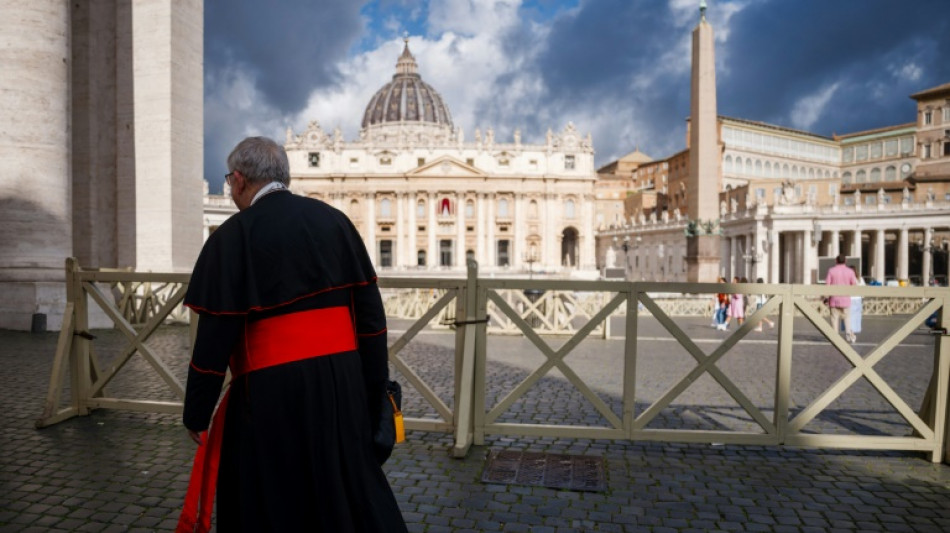
Papal conclave by the numbers / Photo: Dimitar DILKOFF - AFP

 Voting opens in Alaska's annual Fat Bear Week
 MLS coach axed for telling female ref 'It's a man's game'

 US refuses to give Sudan's de facto leader visa for UN
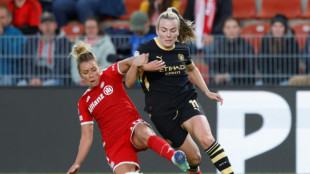
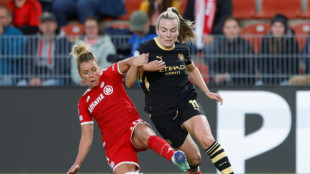 Man City hold Bayern to start Women's Champions League, Arsenal win late
 Trump threatens Iran with 'hell' but reveals fresh talks
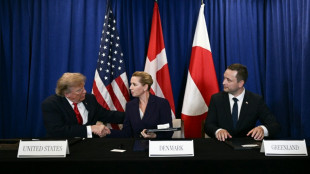 Trump signs security deal with Greenland, Denmark at UN
 Trump threatens Iran with 'hell' but unveils fresh talks
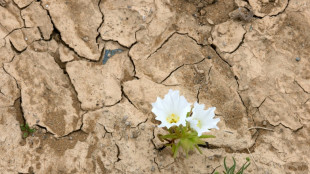 Chile's Atacama Desert blossoms with life after El Nino rains
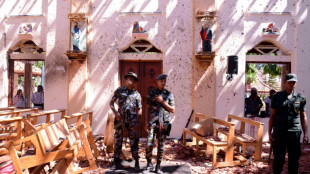 Sri Lanka hands 220-year jail terms to 15 convicted of Easter bombings

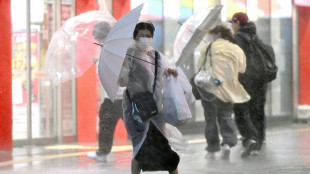 Typhoon Dujuan leaves 7 dead in Japan from landslides, flooding: media

 Ganna and Borghini lead Italy to mixed relay gold at cycling worlds
 Drug cocktail killed former child star Hayden Panettiere: coroner
 Moldova declares energy, water emergency
 French Holocaust denier jailed for eight months

 Oil prices slide, AI stock buzz fades
 Trump threatens to 'annihilate' Iran in bombastic UN speech
 Prada's skirts take centre stage as Milan Fashion Week begins
 Quoin Pharmaceuticals Announces FDA Fast Track Designation for QRX003 for the Treatment of Peeling Skin Syndrome
 Brazil's Flavio Bolsonaro turns scandal into poll gains
 Republican senator seeks probe of Trump Jr Russian-funded wedding
 Memoir by Diana's brother goes on sale after rocking UK monarchy
 Newcomers South Korea face holders Italy in Davis Cup finals

 Japan's Kojima sounds Marchand warning with Asian Games gold

 England rugby star Pollock signs new Northampton deal
 STARTRADER Expands Its Chinese Equity CFD Range with CXMT and Unitree Robotics

The Vatican's papal conclave to choose a new spiritual leader for the world's 1.4 billion Catholics is governed by procedures and rituals that have evolved over centuries.
But the result of the election will be influenced by arithmetic unique to this year's exercise:
- 133 Cardinal electors -
A record number of churchmen are eligible to vote in conclave. There are 135 who meet the criteria -- to be a cardinal under the age of 80 -- but only 133 are to take part in the vote, with two said to be too ill to attend. This is up from 115 during the last two conclaves in 2005 and 2013.
Among them, 52 hail from Europe, 23 Asia, 17 South or Central America, 17 Africa, 20 North America, and four Oceania.
- 69 countries -
The cardinal electors come from 69 countries across five continents, another record.
- 70 years and three months -
The average age of the cardinal electors is 70 years and three months. The youngest is Ukraine's Mykola Bychok, archbishop of Melbourne, at 45.
The oldest is Carlos Osoro Sierra, a Spaniard who at 79 years and 11 months was almost too old to vote.
- 81.2 percent -
A large majority, 81.2 percent, of the 133 cardinal electors were appointed by Pope Francis during his 12 years at the head of the Holy See. These 108 are taking part in their first conclave.
Among the veterans, 20 were named by Benedict XVI and five by John Paul II.
- 17 Italians -
For centuries both the papacy and the college of cardinals were dominated by Italians, but as the church has gone global their numbers have fallen.
Nevertheless, at 17, Italy still has the biggest national contribution, down from 28 in 2013.
- 15 new countries -
Some 15 countries are represented for the first time, with cardinals from Haiti, Cape Verde, Papua New Guinea and South Sudan.
- 18 religious orders -
Within the Catholic Church are several religious orders. Francis, for example, was a Jesuit and 18 such movements will have cardinals in the Sistine Chapel for the voting.
- Four votes per day -
If no clear winner emerges in the initial ballot, the cardinals will vote four times a day, twice in the morning and twice in the afternoon, until a majority emerges.
- 89-vote majority -
The new pope will need a two-thirds majority. With 133 in the room, 89 cardinals must write his name on their secret ballot papers.
- Two stoves -
The ballots cast by the cardinals are burned in a stove, both to preserve the secrecy of the process and to act as a signal of progress to the faithful gathered outside the sealed chapel.
Today, two stoves are used, connected to the same chimney.
In one, the ballots are burned, in the other a chemical compound is burned to create either black smoke -- no majority yet -- or white -- a new pope has been chosen.
- Two days? -
If no majority emerges quickly, in theory a conclave could continue for weeks or months.
In practice, the previous two -- the 2005 election of Benedict XVI and of Francis in 2013 -- lasted two days.
In the 20th and 21st centuries, conclaves have never lasted longer than five days, as was the case for Pope Pius XI's election in 1922, which required 14 ballots.
C.Cassis--PC