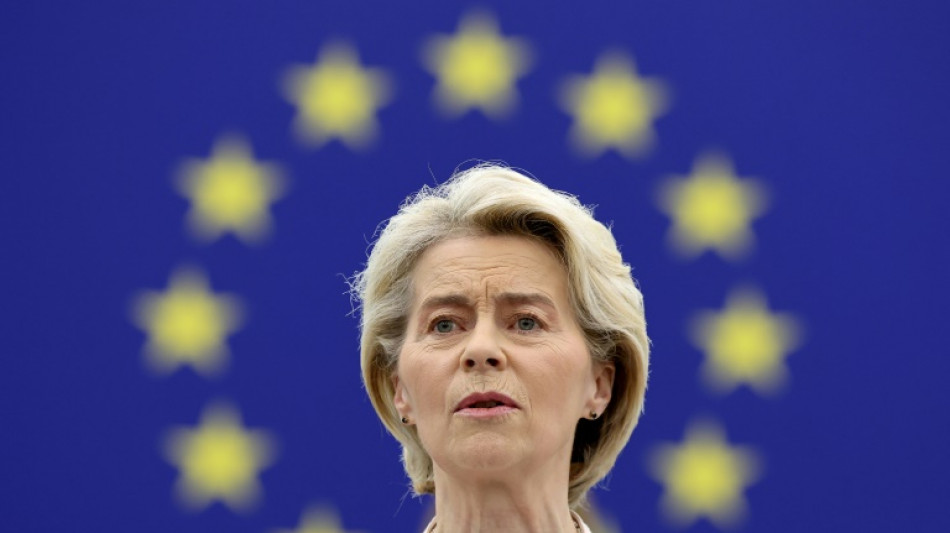
Judgment day in EU chief's Covid vaccine texts case / Photo: FREDERICK FLORIN - AFP

 Trump renames AI 'super intelligence' as leaders jostle over dangers

 Oil prices retreat as markets welcome US-Iran talks
 US refusing to give Sudan's de facto leader visa for UN: diplomatic sources, UN
 Macron urges world to choose UN over 'law of the jungle'
 All-rounder Jacks stars as England beat Sri Lanka in 1st ODI

 Man City peg back Bayern to start Women's Champions League

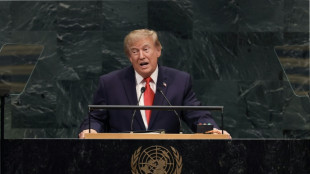 Trump beats 'America first' drum at UN as allies tread carefully

 Snedeker backs Spaun for Ryder Cup after Presidents snub

 French prosecutors probe secret filming of women with smart glasses

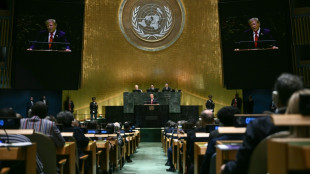 Trump renames AI "super intelligence," rejects international oversight
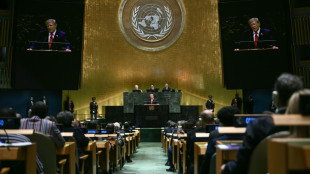 Trump rejects international regulation of AI

 How is the EU approaching record fuel prices?

 Sri Lanka's Colombage strikes on debut as England dismissed for 265 in first ODI
 Hurricane Polo strengthens to top category 5 off Mexico

 11 hurt as teen opens fire outside school in western Turkey

 UN chief says 'Big Oil' treats atmosphere as open sewer
 Tunisia says 2026 summer hottest on record

 England's Rashid out of Sri Lanka ODIs with hand injury

 Houthis accuse Saudi Arabia of deadly strikes as thousands flee

 Stocks climb as oil slides, AI buzz returns
 India cricketers win in style as Afghan savours 'special' Games silver

 La Liga president hits out at Real Madrid refereeing 'conspiracy' claims

 MEXC Launches “Real Stocks, Real Friends” with Rewards for Bringing Friends to Wall Street

 Mbappe continues media push for Ballon d'Or recognition
 Stocks rise on AI buzz, oil prices cool

A top court is to rule Wednesday on whether the EU failed the transparency test by declining to release text messages sent by Ursula von der Leyen to the head of Pfizer as the bloc tried to secure Covid vaccines.
The case before the Court of Justice of the European Union (EUCJ) is seen as a test for the EU Commission president, whose governance has at times been accused of centralised and opaque decision-making.
At its centre are elusive exchanges between von der Leyen and Albert Bourla, chief executive of Pfizer -- which was chosen by the bloc as its main vaccine supplier at the height of the pandemic.
The New York Times, which revealed the existence of the messages, sued the commission in 2023 after Brussels declined to produce them following a freedom of information request.
The commission argued it could not find the texts because they had not been recorded and archived -- something it says is done only when the content is deemed "substantive".
"The commission never denied the existence of text message exchanges," an EU official said. "What it was argued... is that these exchanges did not contain important information".
The New York Times has asked the lower chamber of the Luxembourg-based EUCJ to quash the commission's decision not to hand it the messages. The verdict can be appealed.
- 'Maladministration' -
The EU moved swiftly after the Covid pandemic emerged in 2020 to secure vaccines for member countries to buy for their citizens and residents at a time of massive global demand for the shots.
But many aspects of the procurement from Pfizer have been kept confidential, leading to claims of a lack of transparency -- and several legal proceedings in Belgium and with EU courts.
"This case presents a very important issue: whether officials may evade public transparency by communicating via text messages rather than more traditional means," a lawyer for The Times, Bondine Kloostra, said in her opening arguments in November.
Lawyers for the 27-nation bloc have argued the private messages did not constitute part of the vaccine negotiation.
They might have involved side issues, such as von der Leyen and Bourla agreeing to speak on a certain day, at a certain time, they suggested.
Commission workers, including its chief, do not have an obligation to record all their emails, texts and instant messaging chats, as this would be "materially impossible", an EU official said.
Emails are automatically deleted after six months, he noted.
A duty to archive arises only when such messages contain important information that is not "short-lived" and relates to the commission's policies, activities and decisions.
Such assessment is done in the first instance by the person receiving or sending the texts, so in the case before the court by von der Leyen.
The commission's lawyer, Paolo Stancanelli, said in November that its services asked to track down the messages after The Times reached out to the EU chief's cabinet, which replied it was unable to find them.
In January 2022, the EU's ombudsman described this as "maladministration", saying the messages should have been subject to the EU's public transparency rules for official documents.
Nogueira--PC