Paris gets memorial for gay victims of persecution / Photo: Kiran RIDLEY, Kiran RIDLEY - AFP

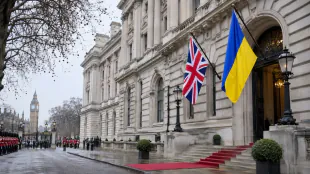 Britain considers 2027 state visit for Ukraine’s Zelensky

 China and Gabon Elevate Ties to 'Shared Future' Amid State Visit

 World Golf Awards 2026 to be Hosted at Egypt’s Madinaty Golf Club

 12 Billion Gallons of Raw Sewage Discharged into Chicago River Despite Deep Tunnel Infrastructure

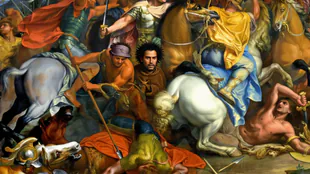 Edmund Richardson Wins Baillie Gifford Prize for 'Alexander' Biography

The city of Paris on Saturday inaugurated a memorial dedicated to people persecuted for being homosexual during the Second World War but also "throughout history", mayor Anne Hidalgo said.
The three-ton installation was erected near the Bastille in central Paris to mark International Day against Homophobia, Biphobia and Transphobia.
"Recognition means to say 'this happened' and to say 'we don't want this to happen again'," Hidalgo said.
"We must fight against denial and trivialisation," she said, adding: "Today there are powerful and extremely dangerous headwinds that would like to deny this kind of diversity."
The monument, by artist Jean-Luc Verna, consists of an large star-shaped structure made of steel.
Unlike cities like Sydney, Barcelona or Amsterdam, Paris rejected incorporating the yellow star that Nazis made Jews wear in the installation.
This, officials said, was to allow current victims of persecution to be included in the tribute.
"It is important that this memorial be not just a simple symbolic tribute, but a transmission tool, a public act of recognition and a space for questions about past discriminations but also those that continue today," said Jean-Baptiste Trieu, president of the "Les Oublie.es de la mémoire" association that fights against discrimination of LGBTQ+ people.
"Rights are never won forever," he said.
Artist Verna said that downward facing black side of the star represents "the burned bodies, the mourning but also the shadow, warning us that these things can happen again".
The upward side, mirroring the sky, "represents the present, with the colours of passing time and the sky over Paris that changes as quickly as public opinion can turn", he said.
According to historians' estimates, between 5,000 and 15,000 people in Europe were sent to concentration camps during World War II by the Nazi government for being homosexual.
Figures for France alone range from around 60 to around 200.
After decades of near-silence surrounding such persecutions in wartime France, former prime minister Lionel Jospin publicly addressed the issue in 2001, launching a process of recognition that was continued by former president Jacques Chirac.
G.Machado--PC