
-
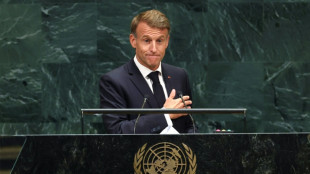 Macron urges world to choose UN over 'law of the jungle'
-
Trump threatens Iran with 'hell' but unveils fresh talks
-
 All-rounder Jacks stars as England beat Sri Lanka in 1st ODI
-
Chile's Atacama Desert blossoms with life after El Nino rains

-
 Man City peg back Bayern to start Women's Champions League
-
Sri Lanka hands 220-year jail terms to 15 convicted of Easter bombings

-
 Trump beats 'America first' drum at UN as allies tread carefully
-
Typhoon Dujuan leaves 7 dead in Japan from landslides, flooding: media

-
 Snedeker backs Spaun for Ryder Cup after Presidents snub
-
Ganna and Borghini lead Italy to mixed relay gold at cycling worlds

-
 French prosecutors probe secret filming of women with smart glasses
-
Drug cocktail killed former child star Hayden Panettiere: coroner

-
 Trump renames AI "super intelligence," rejects international oversight
-
Moldova declares energy, water emergency

-
 Trump rejects international regulation of AI
-
French Holocaust denier jailed for eight months

-
 How is the EU approaching record fuel prices?
-
Oil prices slide, AI stock buzz fades

-
 Sri Lanka's Colombage strikes on debut as England dismissed for 265 in first ODI
-
Trump threatens to 'annihilate' Iran in bombastic UN speech

-
 Hurricane Polo strengthens to top category 5 off Mexico
-
Prada's skirts take centre stage as Milan Fashion Week begins

-
 11 hurt as teen opens fire outside school in western Turkey
-
Quoin Pharmaceuticals Announces FDA Fast Track Designation for QRX003 for the Treatment of Peeling Skin Syndrome

-
 UN chief says 'Big Oil' treats atmosphere as open sewer
-
Brazil's Flavio Bolsonaro turns scandal into poll gains

-
 Tunisia says 2026 summer hottest on record
-
Republican senator seeks probe of Trump Jr Russian-funded wedding

-
 England's Rashid out of Sri Lanka ODIs with hand injury
-
Memoir by Diana's brother goes on sale after rocking UK monarchy

-
 Houthis accuse Saudi Arabia of deadly strikes as thousands flee
-
Newcomers South Korea face holders Italy in Davis Cup finals

-
 Stocks climb as oil slides, AI buzz returns
-
Japan's Kojima sounds Marchand warning with Asian Games gold

-
 India cricketers win in style as Afghan savours 'special' Games silver
-
England rugby star Pollock signs new Northampton deal

-
 La Liga president hits out at Real Madrid refereeing 'conspiracy' claims
-
STARTRADER Expands Its Chinese Equity CFD Range with CXMT and Unitree Robotics

-
 MEXC Launches “Real Stocks, Real Friends” with Rewards for Bringing Friends to Wall Street
-
MEXC Expands Opportunity Compass with Stock Trading Handbook to Help Crypto Users Build Investment Knowledge

-
 Mbappe continues media push for Ballon d'Or recognition
-
England paceman Wood retires from international cricket

-
 Stocks rise on AI buzz, oil prices cool
-
Magnificent Mandhana's 79 helps India to Asian Games cricket gold

-
 India narrowly survive huge scare against minnows Japan
-
Marchand 'stressed' about racing Japanese rivals at LA Olympics

-
 Missing F-35 fighter parts 'not sensitive', says Australia minister
-
Mobile boat clinics bring healthcare to India's remote islands

-
 Cambodia showcases scams crackdown with global conference
-
Former India paceman Zaheer Khan named Chennai coach in IPL

France's lower house backs assisted dying bill
France's lower house on Tuesday approved a right-to-die bill in the first reading, the initial step in a lengthy process that could grant patients medical assistance to end their lives in clearly defined circumstances.
"The National Assembly's vote on legislation concerning the development of palliative care and assisted dying is an important step," President Emmanuel Macron said on X after 305 lawmakers approved the legislation and 199 voted against.
"With respect for sensitivities, doubts and hopes, the path of fraternity that I hoped for is gradually opening up."
Macron has insisted that any authorisation to choose death should be limited to people with incurable illnesses and intense physical or psychological pain.
The National Assembly vote was an initial stage for the draft law, which will now go between the lower house and the Senate for modifications acceptable to both houses.
Some conservative groups oppose the law and Macron has said he could put the deeply divisive topic to a vote by referendum.
If approved, France would join a small group of European countries that give the right to aid in dying, including Germany, Spain, Austria and Switzerland.
Until now, French patients wishing to end their lives have had to travel abroad, including to neighbouring Belgium.
A separate bill, submitted at the same time and concerned with end-of-life medical assistance including palliative care, passed on Tuesday without opposition.
All parties in parliament have allowed their lawmakers a free vote on the issue.
Leftist and centrist parties were expected to vote in favour of the right-to-die bill, with conservatives and far-right deputies seen broadly hostile.
The bill is widely referred to as focusing on "end of life" or "aid in dying" in the French debate, rather than "assisted suicide" or "euthanasia".
- 'Expressed such a wish' -
The bill brought by Macron ally Olivier Falorni would allow medical staff to help "a person gain access to a lethal substance when they have expressed such a wish".
The patient would use the substance without aid or have it administered by a medically qualified person "if they are in no condition physically to do so themselves".
Health Minister Catherine Vautrin said at the weekend that the "French model" of assisted dying would be "strict and closely supervised".
Macron said last year that France needed legislation because "there are situations you cannot humanely accept".
The goal was "to reconcile the autonomy of the individual with the solidarity of the nation", he said.
The bill faces stiff opposition from religious leaders in a country with a longstanding Catholic tradition, as well as many health workers.
Prime Minister Francois Bayrou, a devout Catholic, said Tuesday that he would abstain if he were a deputy because of lingering "questions".
The draft law would allow assisted dying only in an "advanced" stage of illness, which it defines as "entering an irreversible process characterised by a worsening health condition of the sick person that affects the quality of their lives."
Current French legislation allows passive euthanasia, such as withholding artificial life support, and since 2016 doctors have also been authorised to induce "deep and continuous sedation" for terminally ill patients in pain.
But active euthanasia, where doctors administer lethal doses of drugs to patients, remains illegal.
Vautrin said she hopes that the Senate will begin examining the issue this year and submit its suggested changes back to the National Assembly in early 2026.
"I want this bill to get a final vote by 2027 which is still possible," said the minister.
France holds presidential elections in 2027 in which Macron cannot stand after serving two consecutive terms.
sl-parl-jh-as/tw
P.L.Madureira--PC