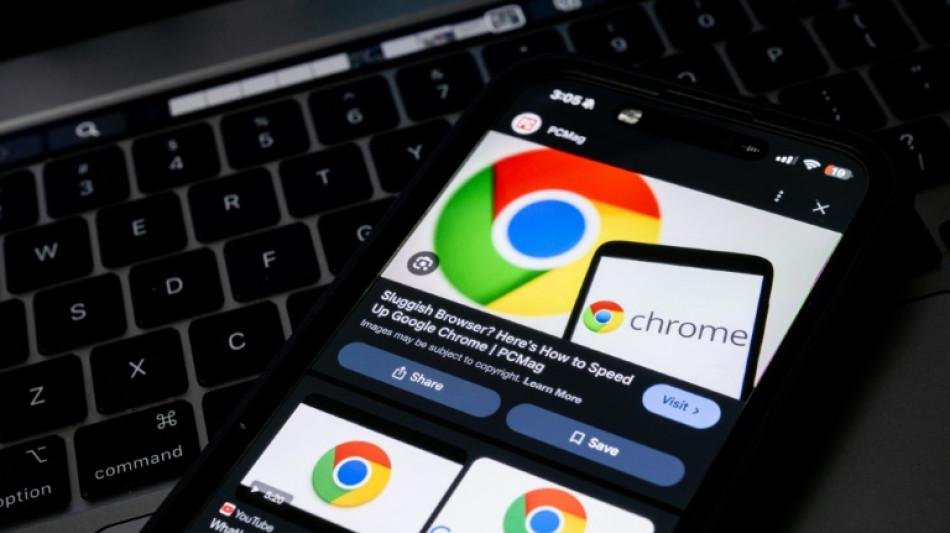
Google makes case for keeping Chrome browser / Photo: Brandon Bell - GETTY IMAGES NORTH AMERICA/AFP

 Britain considers 2027 state visit for Ukraine’s Zelensky

 China and Gabon Elevate Ties to 'Shared Future' Amid State Visit

 World Golf Awards 2026 to be Hosted at Egypt’s Madinaty Golf Club

 12 Billion Gallons of Raw Sewage Discharged into Chicago River Despite Deep Tunnel Infrastructure

 Edmund Richardson Wins Baillie Gifford Prize for 'Alexander' Biography

Google on Friday urged a US judge to reject the notion of making it spin off its Chrome browser to weaken its dominance in online search.
Rival attorneys made their final arguments before US District Court Judge Amit Mehta, who is considering "remedies" to impose after making a landmark decision last year that Google maintained an illegal monopoly in search.
US government attorneys have called on Mehta to order Google divest itself of Chrome browser, contending that artificial intelligence is poised to ramp up the tech giant's dominance as the go-to window into the internet.
They also want Google barred from agreements with partners such as Apple and Samsung to distribute its search tools, which was the focus of the suit against the Silicon Valley internet giant.
Three weeks of testimony ended early in May, with Friday devoted to rival sides arguing points of law and making their arguments before Mehta in a courtroom in Washington.
John Schmidtlein, an attorney for Google, told Mehta that there was no evidence presented showing people would have opted for a different search engine if no exclusivity deals had been in place.
Schmidtlein noted that Verizon installed Chrome on smartphones even though the US telecom titan owned Yahoo! search engine and was not bound by a contract with Google.
Of the 100 or so witnesses heard at trial, not one said "if I had more flexibility, I would have installed Bing" internet search browser from Microsoft, the Google attorney told the judge.
Department of Justice attorney David Dahlquist countered that Apple, which was paid billions of dollars to make Chrome the default browser on iPhones, "repeatedly asked for more flexibility" but was denied by Google.
Google contends that the United States has gone way beyond the scope of the suit by recommending a spinoff of Chrome, and holding open the option to force a sale of its Android mobile operating system.
The potential of Chrome being hobbled or spun off comes as rivals such as Microsoft, ChatGPT and Perplexity put generative artificial intelligence to work fetching information from the internet in response to user queries.
The online search antitrust suit was filed against Google some five years ago, before ChatGPT made its debut, triggering AI fervor.
Google is among the tech companies investing heavily to be among the leader in AI, and is weaving the technology into search and other online offerings.
A.Aguiar--PC