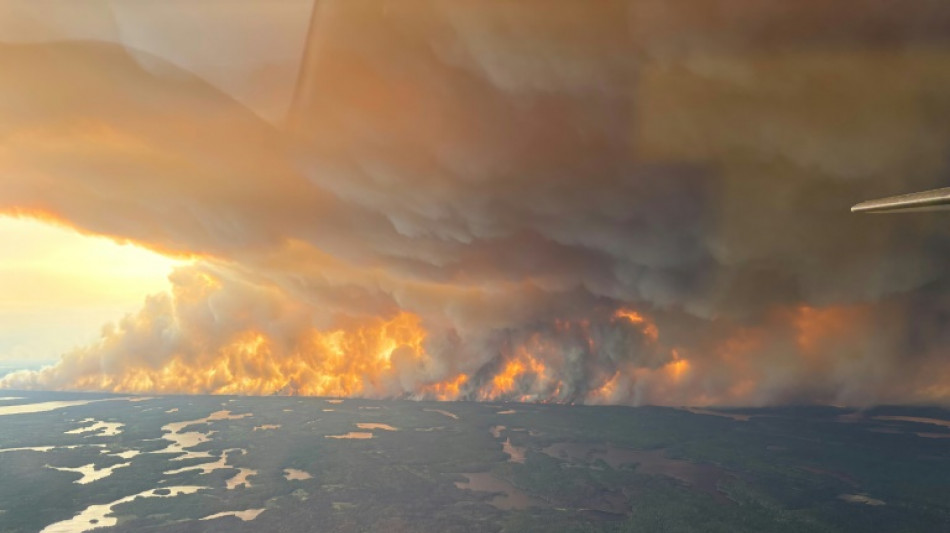
Smoke from Canadian fires reaches Europe: EU climate monitor / Photo: HANDOUT - Manitoba Government/AFP

 Britain considers 2027 state visit for Ukraine’s Zelensky

 China and Gabon Elevate Ties to 'Shared Future' Amid State Visit

 World Golf Awards 2026 to be Hosted at Egypt’s Madinaty Golf Club

 12 Billion Gallons of Raw Sewage Discharged into Chicago River Despite Deep Tunnel Infrastructure

 Edmund Richardson Wins Baillie Gifford Prize for 'Alexander' Biography

Heavy smoke from intense wildfires in Canada has reached northwestern Europe, the European Union's climate monitoring service said on Tuesday.
The huge plumes are at very high altitude and do not pose an immediate health risk, it said in a statement.
"Smoke originating from the wildfires in the Canadian provinces of Manitoba and Saskatchewan has been transported across the Atlantic," the Copernicus Atmosphere Monitoring Service (CAMS) said.
Satellites tracked the smoke in mid-May, with some plumes reaching as far east as Greece and the eastern Mediterranean.
"A second, much larger, smoke plume crossed the Atlantic during the last week of May, reaching northwestern parts of Europe on June 1," CAMS said.
Additional plumes are expected to shade the continent in the coming days.
Wildfire smoke is comprised of gaseous pollutants such as carbon monoxide, along with water vapor and particle pollution, which can be particularly hazardous to health.
A high concentration of carbon monoxide is expected to pass over northwestern France, including the Paris Basin, on Tuesday.
The high-altitude smoke headed for Europe is not expected to have a significant impact on surface air quality, but is likely to result in hazy skies and reddish-orange sunsets.
Manitoba in central Canada is experiencing its worst start to the fire season in years due to drought, and Saskatchewan to the west declared a state of emergency at the end of May, evacuating thousands of residents.
"Central regions of Canada have experienced a very intense few weeks in terms of wildfire emissions," said Mark Parrington, scientific director at CAMS.
Canadian authorities have forecast a more intense fire season than usual this summer in central and western Canada, due in particular to severe or extreme drought.
Elsewhere, extensive forest fires have been raging in Russia's Far Eastern Federal District since early April, particularly east of Lake Baikal, generating carbon emissions of around 35 million tons, Copernicus reported.
P.Mira--PC