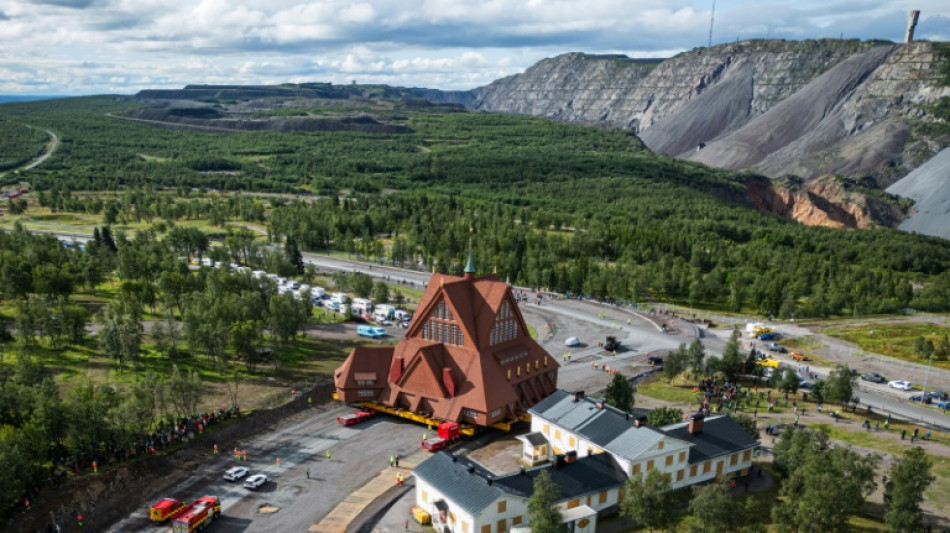
Historic Swedish church inches closer to new home / Photo: Jonathan NACKSTRAND - AFP

 China and Gabon Elevate Ties to 'Shared Future' Amid State Visit

 World Golf Awards 2026 to be Hosted at Egypt’s Madinaty Golf Club

 12 Billion Gallons of Raw Sewage Discharged into Chicago River Despite Deep Tunnel Infrastructure

 Edmund Richardson Wins Baillie Gifford Prize for 'Alexander' Biography

 BYD Drops Rotating Screens in New Models Due to Tech Limits
A historic red wooden church considered one of Sweden's most beautiful buildings resumed its slow move across the Arctic town of Kiruna on Wednesday, inching toward its new home to allow Europe's biggest underground mine to expand.
Kiruna's entire town centre is being relocated because of the giant LKAB iron ore mine that dominates the region, whose ever deeper burrowing over the years has weakened the ground, increasing the risk of collapse in some parts.
Kiruna Kyrka, an imposing 672-tonne Swedish Lutheran church from 1912, is being moved five kilometres (three miles) on remote-controlled flatbed trailers, moving at a snail's pace of half a kilometre an hour to the new Kiruna town.
The complex and costly logistical operation began on Tuesday and was scheduled to be completed on Wednesday around 2:00 or 3:00 pm (1200 or 1300 GMT).
The journey has so far gone smoothly for the 1,200-tonne convoy, but was expected to proceed more slowly on Wednesday due to some tricky narrow passages and 90 degree turns, officials said.
The move has generated widespread interest, with large crowds thronging the streets of the town of 18,000 people and Swedish television broadcasting the entire journey live.
King Carl XVI Gustaf was due to take part in festivities in Kiruna, including an attempt to break the world record for the number of people attending a "kyrkkaffe", a church coffee break.
The town's relocation process began almost two decades ago and is expected to continue for years to come. The new town centre was officially inaugurated in September 2022.
The relocation of the church alone is expected to cost 500 million kronor ($52 million) and is being paid for by LKAB.
Designed by Swedish architect Gustaf Wickman, the church, which measures 40 metres (131 feet) tall, is a mix of influences and includes designs inspired by the region's Indigenous Sami people on the pews.
The neo-Gothic exterior features slanting roofs and windows on each side, while its dark interior has elements of national romanticism as well as an Art Nouveau altarpiece and an organ with more than 2,000 pipes.
The church's handblown glass windows were removed ahead of the move, replaced with plywood painted to look like windows.
The belltower, which stood separately next to the church, will be moved next week.
P.Sousa--PC