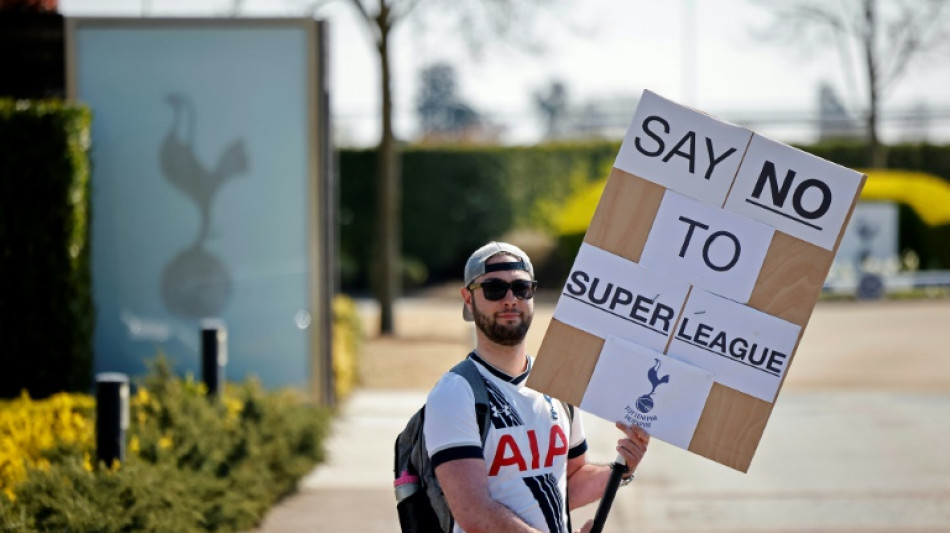
European court opens hearing into whether UEFA can block Super League / Photo: Tolga Akmen - AFP

 Premiere Screenings of 'The 100th: Seeds of Aloha' Documentary Announced in California

 San Onofre Demolition Highlights California’s Nuclear Energy Void

 2026 Nickelodeon Kids' Choice Awards: Air Time, Channels, and Streaming Guide

 Kuwaitis Elected to Senior Leadership Roles at ALECSO

 BingX: Major Announcement of Far-Reaching Significance

 Tamil Nadu Commission Reviews Rs 1.14 Lakh Crore Investment MoUs, Seeks Subsidy Boost

 Sakeliga Challenges Icasa Over Telecoms BEE Ownership Rule

Lawyers for the rump of the Super League, the short-lived rival to the Champions League, on Monday denounced the "monopolistic" aims of European football's governing body (UEFA) at the European Court of Justice in Luxembourg (CJEU).
The dispute over the alleged abuse of UEFA's dominant position is being heard by the CJEU on Monday and Tuesday. A decision is not expected before the end of 2022 or even early 2023.
The court is hearing the case at the request of a Madrid judge.
"We are here to defend the freedoms that make the EU a unique jurisdiction in the world, by proposing to fight against anti-economic practices," said Miguel Odriozola Alen, who is defending the Spanish-based Super League company.
He criticised UEFA, which had helped dissuade the "rebellious" clubs from embarking on the adventure, for being a "monopolistic entity", which should not be able to "arrogate to itself regulatory powers over a market in which it is in competition".
The Super League, a competition restricted to 12 major European clubs, was announced with great fanfare in April 2021. But in the face of fan fury and the threat of political action, the deal fell apart within 48 hours as nine clubs withdrew.
The three clubs who have refused to abandon the project, Real Madrid, Barcelona and Juventus, are challenging UEFA's threat of sanctions in a separate action in a Spanish court.
For UEFA, "a league closed to the richest clubs is incompatible with the European sporting model, which is based on merit," its lawyer Donald Slater said on Monday.
He argued that the Swiss-based organisation was "not seeking to maximise its income" but simply to ensure "through the application of common rules ... that sport fulfils societal functions", in accordance with the European treaties.
The stakes go far beyond the Super League, and even beyond football.
On Monday, on appeal, the CJEU dealt with another dispute between the International Skating Federation and two Dutch speed skaters, whom it had wanted to ban for life to prevent them from participating in a South Korean private competition.
That project was nipped in the bud by the reluctance of the athletes to take such a risk.
Earlier on Monday, 15 European supporters' associations, including fan groups from France, Spain, England and Germany issued a joint statement reiterating their "opposition" to the Super League, which they called "an existential threat to European football."
"The project is a billionaire's concept. It is anti-competitive in nature and, if implemented, would destroy the key principles on which the European model is based, such as sporting merit, promotion and relegation, qualification for Europe through success (in competitions at national level) and financial solidarity," said the statement.
E.Borba--PC