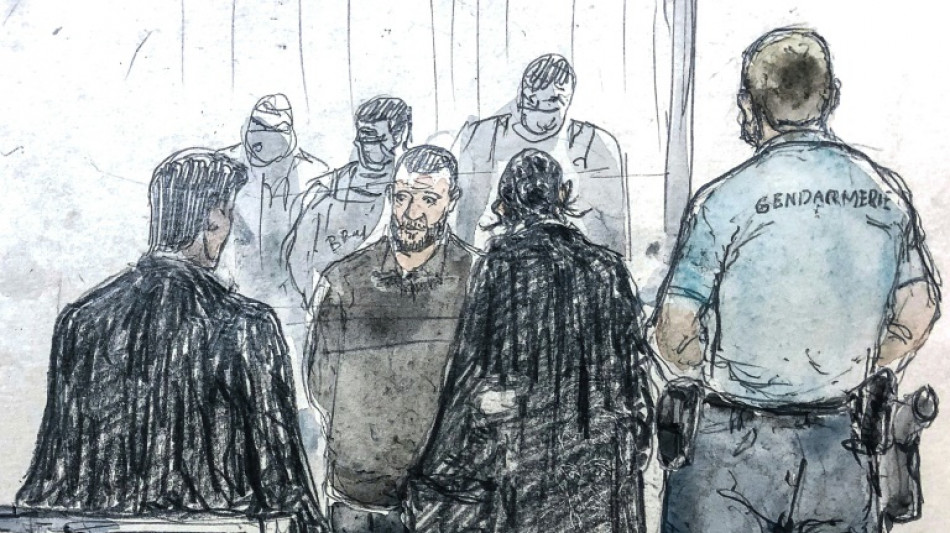
Paris 2015 attacker's sentence stands after no appeal filed / Photo: Benoit PEYRUCQ - AFP/File

 Premiere Screenings of 'The 100th: Seeds of Aloha' Documentary Announced in California

 San Onofre Demolition Highlights California’s Nuclear Energy Void

 2026 Nickelodeon Kids' Choice Awards: Air Time, Channels, and Streaming Guide

 Kuwaitis Elected to Senior Leadership Roles at ALECSO

 BingX: Major Announcement of Far-Reaching Significance

 Tamil Nadu Commission Reviews Rs 1.14 Lakh Crore Investment MoUs, Seeks Subsidy Boost

 Sakeliga Challenges Icasa Over Telecoms BEE Ownership Rule

The sole surviving member of an Islamic State group cell that killed 130 people in Paris in 2015 has not appealed his whole-life sentence for the killings, the Paris chief prosecutor said Tuesday.
Salah Abdeslam, a 32-year-old Frenchman of Moroccan origin, was captured alive by police four months after the bloodbath at the Bataclan concert hall and other locations, the worst peace-time atrocity in modern French history.
He was sentenced to life in prison with only a tiny chance of parole after 30 years, the toughest possible punishment under French law which had only been pronounced four times previously since entering into law in 1994.
The 19 others sentenced for their role leading up to and following the attacks also declined to appeal, prosecutor Remy Heitz told AFP.
They had 10 days to lodge any appeal after their sentencing, a deadline that expired at midnight Monday.
The decision of the special court handling the cases "has now acquired permanent status and there will not be an appeal trial", he said.
The trial has been the biggest in modern French history, the culmination of a six-year international investigation whose findings run to more than a million pages.
All of the attackers except for Abdeslam blew themselves up or were killed by police during or after the assault.
Abdeslam had begun his court appearances last September by defiantly declaring himself as an "Islamic State fighter" but finished tearfully apologising to victims and asking for leniency.
In his final statement, he urged the judges not to give him a full-life term on the basis that he had not actually killed anyone.
"I made mistakes, it's true. But I'm not a murderer, I'm not a killer," he said.
- 'Not out of fear' -
Abdeslam, a one-time pot-smoking lover of parties, discarded his suicide belt on the night of the attack and fled back to his hometown, Brussels, where many of the extremists lived.
He told the court that he had had a change of heart and decided not to kill people.
"I changed my mind out of humanity, not out of fear," he insisted.
But after hearing that his suicide belt had turned out to be defective, the judges concluded that this "cast serious doubt" on his apparent "renunciation".
They ruled he was a "co-perpetrator" of the attacks which "constituted a single crime scene".
A team of 10 jihadists laid siege to the French capital, attacking the national sports stadium, bars, and the Bataclan in an assault immediately claimed from Syria by the IS group.
The attacks shocked France, with the choice of targets and the manner of the violence seemingly designed to inflict maximum fear, just 10 months after a separate assault on the Charlie Hebdo magazine.
In one instance, the court heard a recording of gunmen taunting people trapped in the Bataclan as they fired on them with Kalashnikov machine guns from a balcony above.
France, under then president Francois Hollande, declared the country "at war" with the extremists and their self-proclaimed caliphate in Syria and Iraq.
Hollande, who testified in November, called the trial "exceptional" and "exemplary", adding in a statement that the accused had been "judged with respect for the law".
The 10-month process had "enabled us to look for the truth in order to better understand the course of Islamist terrorism", he said.
A.Silveira--PC