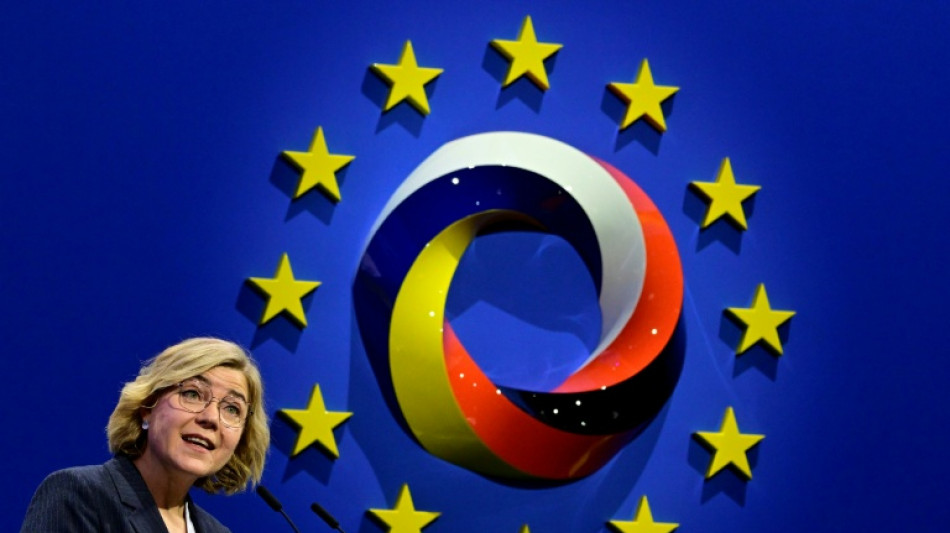
Under pressure, EU to scale back digital rules / Photo: John MACDOUGALL - AFP

 Braves clinch division title as Red Sox reach MLB playoffs

 Bordeaux-Begles hammer Stade Francais despite Jalibert injury

 Milan and Juventus end blips with home wins

 Bridgeman wins PGA Biltmore title with sizzling 61

 Williams injured as Bears shut down by Vikings

 US warns of rapid escalation in Middle East war

 Germany's far-right AfD celebrates another state election win

 Russia vows revenge for election-day attacks as poll shows ruling party win

 Spaun late shows snatches PGA Championship win

 Conceicao strikes as Juventus beat Atalanta

 Britain, Zverev-inspired Germany, Spain complete Davis Cup finals

 Man Utd salvage Fulham draw as pressure mounts on Carrick

 Spanish civil war drama 'The Black Ball' wins at Toronto festival

 Germany's Merz shaken by far-right and far-left gains in state votes

 Macron welcomes Canada's Carney to French Atlantic territory

 Fiorentina frustrate Napoli with Serie A draw, Como upset

 Five-star Man City top Premier League after Sunderland thriller

 Ukrainian drones hit Moscow on last day of Russian elections

 Multi-Asset Trading Venue Monochrome Exchange Announces IEO of Its Native Token, $MCR

 South Korea break Japan hearts to win Asian Games basketball gold

 Acosta takes first victory at Austrian MotoGP

 PSG president Nasser al-Khelaifi under investigation in France for conflict of interest

 China swim sensation, 13, sets Games record after Japan win early

 Drones hit Moscow as Russians go to the polls

 New England boss Fleming says 'wrong' to ask Stokes to end retirement

The EU will unveil plans on Wednesday to overhaul its AI and data privacy rules after coming under pressure from European and US companies.
The proposals are part of the bloc's push to cut red tape to drive greater economic growth and help European businesses catch up with American and Chinese rivals -- and reduce dependence on foreign tech giants.
EU tech chief Henna Virkkunen will present the plans on Wednesday alongside the justice commissioner in charge of data protection, Michael McGrath.
Brussels has dismissed claims that its push to "simplify" its digital rules -- deeply unpopular in the United States -- are the result of pressure from US President Donald Trump's administration.
For many EU states, the concern is that the focus on regulation has come at the expense of innovation -- although Brussels insists it remains committed to protecting European citizens' rights.
Berlin hosted a Franco-German summit on Tuesday focused on propelling the bloc to lead in the AI race during which France's Emmanuel Macron said Europe does not want to be a "vassal" dependent on US and Chinese tech companies.
Once proud of the "Brussels effect" -- referring to the influence many EU laws had on other jurisdictions around the world -- European lawmakers and rights defenders fear the EU appears to be withdrawing from being Big Tech's watchdog.
The EU executive has its eye on changes to its landmark data protection rules and the AI law that only entered into force last year.
There could be one proposal in Wednesday's package that would bring joy to nearly all Europeans: Brussels wants to tackle the annoying cookie banners that demand users' consent for tracking on websites.
- Crumbling cookie banners -
Based on draft documents that could still change and EU officials, Brussels plans to:
- redefine personal data and how companies can use it, for example allowing firms to process such data to train AI models "for purposes of a legitimate interest", but rights defenders have warned this could downgrade users' privacy
- a one-year pause on implementing many provisions on high-risk AI, for example, models that can pose dangers to safety, health or citizens' fundamental rights -- a move that will please American and European firms.
Instead of taking effect next year, the provisions would apply from 2027.
Dozens of Europe's biggest companies, including France's Airbus and Germany's Lufthansa and Mercedes-Benz, had called for a pause in July on the AI law which they warn risks stifling innovation.
Brussels has insisted European users' data privacy will be protected.
- 'Complex' rules -
One lawmaker from EU chief Ursula von der Leyen's conservative EPP grouping supported the push to simplify the digital rules.
"Europe's problem is in the excessive complexity and inconsistency of the rules we already have. Laws built in silos, overlapping obligations, and uneven enforcement create uncertainty for businesses and fracture the single market," MEP Eva Maydell told AFP.
But von der Leyen could face a difficult road ahead as the changes will need the approval of both the EU parliament and member states.
Her camp's main coalition partners have already expressed concern.
In letters sent to the European Commission last week, socialist EU lawmakers said they oppose any delay to the AI law, while the centrists warned they would stand firm against any changes that put privacy at risk.
P.Serra--PC
