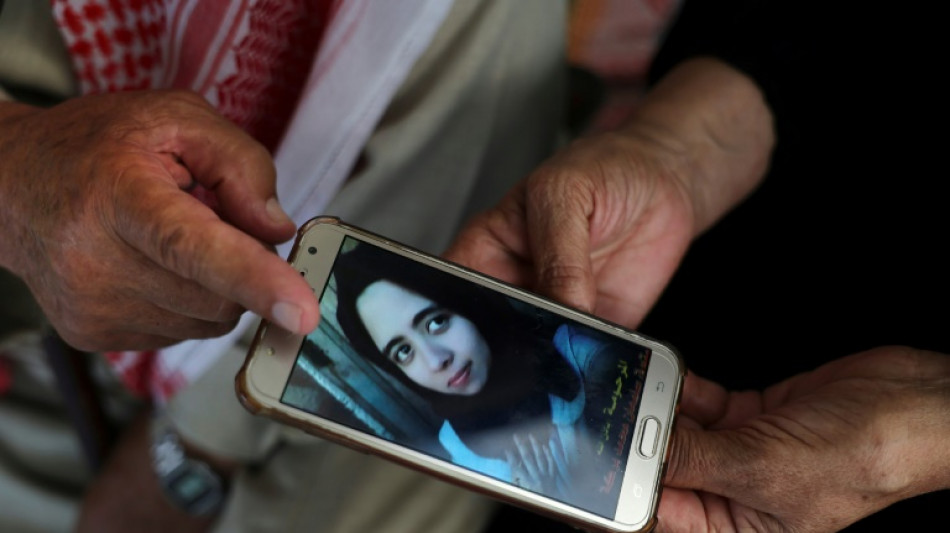
Gaza's women and girls see no escape from violence / Photo: SAID KHATIB - AFP

 Hamilton worried by Ferrari pace while Antonelli prepares for a fight

 Vuelta stage 15 shortened due to extreme heat, Mas consolidates lead

 Putin meets US envoys for Ukraine war talks

 Modric available for Croatia in Nations League

 Potapova upsets 2025 US Open runner-up Anisimova

 Gasly a 'class act' says Alpine boss after Monza pole

 Athletic Bilbao crush Simeone's flat Atletico

 Stay far from battlefield, warns Japanese director in Vietnam War film

 Tens of thousands of Croatians protest over hazardous waste

 Haaland heads unconvincing Man City top of Premier League

 US envoys in Moscow as Russia and Ukraine vow not to hit capitals during talks

 Motorsport governing body rejects Alpine boss's claims of bias

 US envoy on West Bank visit says Israel has responsibility for Palestinians

 Ethiopian Miss World contestant spotlights pain of sister's murder

 'Leader' Raphinha rising to Barca striker challenge

 Oasis fans gather in Venice for band reunion film

 Two Nepal rescues revive hopes 10 days after flood

 Pogacar to miss worlds after season-ending Vuelta crash

 Greenwood, Guendouzi handed bans after Fenerbahce-Lyon brawl
 In Iceland, the mystery of the poet, the tomb and the Danish grocer

 Ratko Mladic: Bosnian Serb commander to convicted war criminal

 Bolivian army base blasts kill two, wound dozens

 Alcaraz, Sabalenka into US Open last 16 as Williams sisters lose on return

 Williams sisters fall in thrilling return to US Open doubles

 Bangladesh measles toll nears grim 1,000-child mark

Seventeen-year-old Istabraq Baraka fell pregnant soon after her wedding in the Gaza Strip. Three months later her husband killed her.
"She died from a severe beating, which caused bleeding on the brain and lungs and broken ribs," said her mother Nazmiya.
Sitting with her husband Suleiman in a garden in Abassan, near the city of Khan Yunis in the south of the Palestinian territory, the 53-year-old talks at lightning speed about last year's killing of one of her two daughters, as well as the loss of an unborn grandchild.
Istabraq's father wipes tears away with the corner of a red-and-white keffiyeh wrapped around his head.
He laments the slow pace of legal proceedings since his daughter's husband handed himself in to the police shortly after the killing.
"The perpetrator admitted his crime, a year and a month until now and nothing's happened," said the 70-year-old.
Femicide is on the rise in Gaza, according to figures from the Women's Centre for Legal Aid and Counselling, a Palestinian civil society group.
The organisation registered six killings and suspicious deaths related to domestic violence in 2019, a figure which rose to 19 the following year.
UN Women said the situation worsened at the onset of the coronavirus pandemic in 2020, which resulted in the "lockdown of survivors of violence with their abusers".
Ayah Alwakil, a lawyer from the Palestinian Centre for Human Rights, said women can consider violence from their husbands normal behaviour in Gaza's patriarchal society, which has been controlled by the Hamas Islamist group since 2007.
"Some women don't know their rights and some others are afraid of going to court, for lack of family support," she added.
The Palestinian Central Bureau of Statistics said 38 percent of women in Gaza faced physical or psychological violence from their husbands in 2019, but Alwakil estimated the true figure to be far higher.
- Tied up, left to die -
Men convicted of killing their wives can be jailed or face the death penalty. But the sentence is reduced if they commit a so-called "honour killing", in which a relative is murdered because they are deemed to have brought shame to the family.
UN Women says such "outdated and discriminatory laws" impede justice.
Additionally, those seeking to escape domestic violence risk losing their children.
If a wife obtains a divorce, custody passes to the ex-husband once a daughter turns 11 or a son reaches nine.
Noha Khaziq, 31, stayed with her abusive husband because they had four children.
He killed her in February.
"Her husband tied her up and left her at home so that she couldn't escape and get out. When he returned she was dead," said her brother Abdelaziz, who shares his sister's green eyes.
"We feel satisfied with the death sentence ruling against the husband, five months after the heinous crime, but we demand the sentence be enforced quickly," said the 28-year-old.
The Khaziq family has not seen Noha's children since she was killed, because custody was granted to their father's relatives.
- 'Not on women's side' -
Fifteen years since the Israeli-led blockade of Gaza began, it is almost impossible for women fleeing violence to leave the Palestinian enclave.
In a territory home to 2.3 million residents, around 40 women are staying in only two specialised refuges.
When AFP visited one of them, a woman with bruises covering one side of her face sat in a corner. She was about to return to her husband, rather than risk losing access to her children.
"The law is not on women's side all the time in the Gaza Strip," said Aziza Elkahlout, a spokeswoman for the social development ministry which runs one of the refuges.
"We thought of opening the safe house because of the injustice women are exposed to," she added, blaming the Israeli blockade for Gaza's dire living conditions.
But such reasoning is inadequate for Suleiman Baraka, who says the authorities are partly responsible for his daughter's killing.
"The government helps the offender because it doesn't take any immediate decisions," said Istabraq's father.
He is reminded of his daughter every time he reaches for his phone, whose screen shows a photo of him with his two girls.
More than a year since Istabraq was killed, he warned that delays in reaching justice only "encourage criminals".
P.Sousa--PC