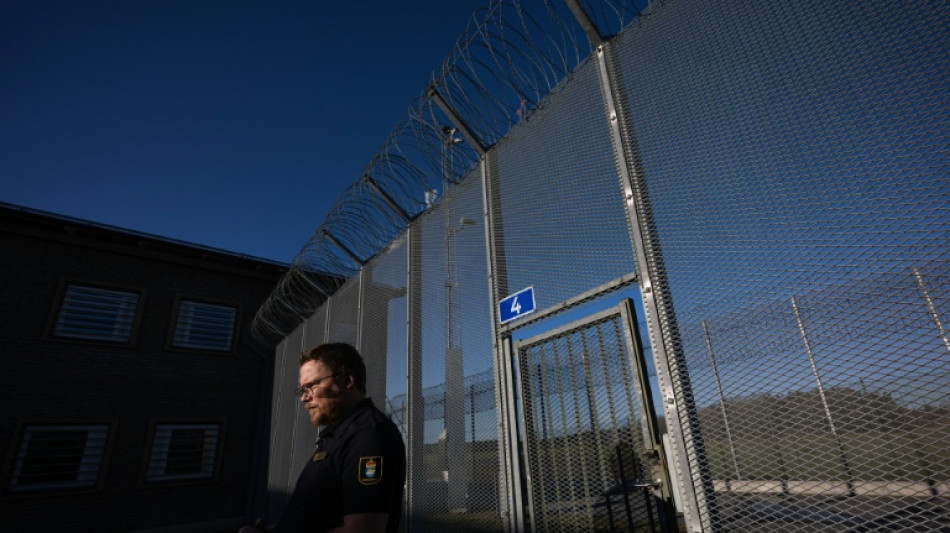
Sweden's prisons prepare to house young teens / Photo: Jonathan NACKSTRAND - AFP

 Vietnamese coffee farmers ride China's durian wave

 Venezuela says retains 'sovereignty' in US oil deal
 NASA's Roman telescope set to launch on cosmic mapping mission

 Data center backlash scrambles US midterm politics

 Emotional Federer inducted into tennis Hall of Fame

 Hovland takes solo lead as McIlroy surges at Tour Championship
 Djokovic 'prepared' for US Open bid for history

 Atletico down Sevilla to go top of La Liga

 US deports right-wing provocateur Milo Yiannopoulos

 Niger junta says it is back in control after soldiers' mutiny

 Erasmus calls Rennie barbs over Springbok scrumming 'nonsense'

 Lawrence's fifty leaves Pakistan facing record chase to level England series

 Netanyahu condemns settler attack in flashpoint West Bank village

 Munoz saves Iraola in Liverpool draw, big-spending Spurs lose again

 Newcastle condemn dismal Spurs to second successive defeat

 James Cleverly leaves shadow cabinet to seek London mayoralty

 Baladi Map app turns Lebanon’s local problems into a public record

 Thirty-seven Mumbai pilgrims return after Nepal flood disruption

 Ankle ligament tear ends Neeraj Chopra’s 2026 season

 Five college football games that could shape the 2026 season

 New finds strengthen case for Bethsaida at Sea of Galilee site

 Felony assaults on older New Yorkers rise sharply, police data show

 Three Texas Tech softball players hurt in jet ski collision

 Tambaram civic groups seek action on eight long-pending issues

 Cyberabad civic body demolishes 19 unauthorised structures

North of Stockholm, the Rosersberg prison is making preparations to house children as young as 13 in response to a much-criticised juvenile judicial reform expected to take effect in July.
The minority right-wing government, which is backed by the far-right Sweden Democrats, announced in January that it would reduce the age of criminal responsibility from 15 to 13 for crimes punishable by at least four years in prison.
Its goal is to break a surge in children being recruited by criminal networks as hitmen to carry out bombings and shootings, knowing they would not face prison time if caught.
Until now, minors who committed serious offences were placed in secure youth care homes (SiS-hem), but these homes have faced problems, including reports of them becoming recruitment grounds for gangs.
The legislation still needs to pass parliament, but Rosersberg is one of eight prisons preparing to house young offenders starting July 1.
"You have to keep in mind that it may be the first time they sleep away from home, and then it's here in an institution," prison director Gabriel Wessman told AFP during a tour.
Preparations include transferring some adult inmates to other facilities, building classrooms and remodelling cells.
One unit has been emptied of its 51 adult inmates to make room for up to 24 minors.
The austere, concrete yards are being redone.
"It will be nicer, more green bushes, more sofas, more places to train, and of course, take away the cigarette boxes. They are not allowed to smoke," Wessman explained.
Each young person will be placed in a 10-square-metre (108-square-feet) single cell, previously shared by two adults. The cells are equipped with TVs, and the walls have been repainted green.
There will be six youths per corridor, with a shared shower and a dedicated yard. Each corridor will have its own classroom.
- Mandatory school -
The most important thing "is compulsory schooling up to age 16," the director said.
The cafeteria in the adjacent building, located between the adult and youth sections, has been demolished to make way for a classroom.
The prison staff must be reinforced -- twice as many guards will be deployed for each child as for adults, and the guards will have to take on new responsibilities.
"We will always have to take into account the principle of the best interests of the child. It will be a bit different," said Wessman, who has only worked with adults in his 20 years of working in the prison system.
"It's not something we thought about every day in our previous work," he added, noting that younger inmates will have different needs and rights.
"In a way, we become their legal guardians. How do we handle, for example, a child who doesn't want to get up in the morning and go to school? It will be a challenge," he says.
Unlike adults, the younger inmates will always be accompanied by guards, whether to play football, paint or make sure they go to school and do their homework.
They will be locked in their cells between 8:00 pm and 7:00 am. Each room is equipped with an intercom to contact guards if needed.
- Credibility eroded -
The reform has been controversial.
Most of the dozens of organisations and authorities consulted on the proposal -- including the prison administration -- were against the measure that many consider counterproductive.
"This is not going to stop children from committing offences... on the contrary, it risks having the opposite effect, with crime starting at an even younger age," Julia Hogberg, a legal adviser to children's rights group Bris, told AFP.
Incarcerating someone that young "is harmful to the child's development" and increases the risk of reoffending, according to Hogberg.
"We have kept the same age of criminal responsibility for more than 150 years, including during periods with high crime rates," she said.
"The fact that we are now choosing to lower the age of criminal responsibility will undermine Sweden's credibility as a model country when it comes to children's rights."
The right-wing government, which came into power with a promise to crack down on crime, is currently trying to rapidly push through a slew of reforms in various areas ahead of legislative elections in September.
O.Salvador--PC