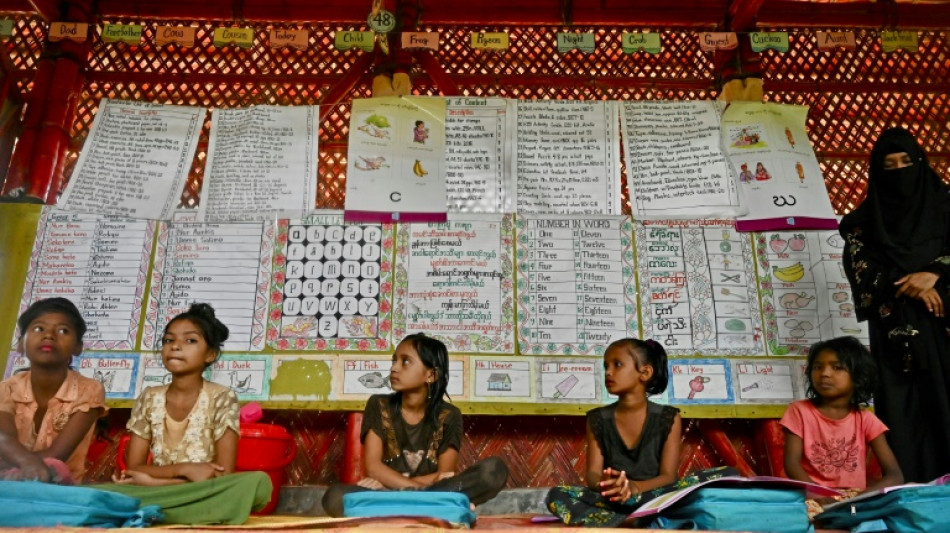
Songs of praise: Rohingya sing Myanmar anthem 5 years after exodus / Photo: Munir uz Zaman - AFP

 USA and France ease into women's Basketball World Cup semis

 ECB lifts borrowing costs amid energy shock, opens door for more hikes

 France defeat China to reach women's basketball World Cup semis
 Tribal Launches Campfire, Letting Business and Technical Teams Build on Salesforce Together

 Yemen's Houthis seize key city on Red Sea

 US producer inflation tops expectations as diesel costs jump

 Rubio ends South America swing with Peru security talks

 Defiant Iran seeks to bruise Trump ahead of midterms

 France withdraws support for Infantino in FIFA presidential election

 Evolution Metals & Technologies Provides Initial Revenue Guidance of $400-460mm for Fiscal Year 2027

 Clark-led USA thrash Hungary to move into women's World Cup semi-finals

 Vance takes spotlight as Republicans close Trump-heavy convention
 Russian skater Valieva loses neutral status

 Will Israel's right exploit sanctions in run-up to vote?
 'Metal Gear' creator moves to Xbox after Playstation cancellation

 Indonesia rescues six orangutans from fires in a week

 Macron urges Europe to develop 'crewed spaceflight' programme
 Deals worth billions to be signed as UAE leader visits Germany
 Alessio Vinassa Unveils an Emerging Technology Investment Approach Shaped by Financial Challenges

 Sri Lanka court revokes monk's pardon, orders return to prison

 'Hopeless, stuck, afraid': US deportees in limbo in Cameroon

 Mount Fuji ends hiking season with landslide, two rescues

 Seahawks beat Patriots again in NFL opener
 Asian Games begin with Qatar basketball win, nine days before opening ceremony

 Stocks sink as oil rally fans inflation and rate hike fears

Every morning in his refugee camp school, Mohammad Yusuf sings the national anthem of Myanmar, the country whose army forced his family to flee and is accused of killing thousands of his people.
Yusuf, now 15, is one of hundreds of thousands of mostly Muslim ethnic Rohingya who escaped into Bangladesh after the Myanmar military launched a brutal offensive five years ago on Thursday.
For nearly half a decade, he and the vast numbers of other refugee children in the network of squalid camps received little or no schooling, with Dhaka fearing that education would represent an acceptance that the Rohingya were not going home any time soon.
That hope seems more distant than ever since the military coup in Myanmar last year, and last month authorities finally allowed UNICEF to scale up its schools programme to cover 130,000 children, and eventually all of those in the camps.
But the host country still wants the refugees to go back: tuition is in Burmese and the schools follow the Myanmar curriculum, also singing the country's national anthem before classes start each day.
The Rohingya have long been seen as reviled foreigners by some in Myanmar, a largely Buddhist country whose government is being accused in the UN's top court of trying to wipe out the people, but Yusuf embraces the song, seeing it as a symbol of defiance and a future return.
"Myanmar is my homeland," he told AFP. "The country did no harm to us. Its powerful people did. My young sister died there. Our people were slaughtered.
"Still it is my country and I will love it till the end," Yusuf said.
- 'Ticking bombs' -
The denial of education for years is a powerful symbol of Bangladesh's ambivalence towards the refugee presence, some of whom have been relocated to a remote, flood-prone and previously uninhabited island.
"This curricula reminds them they belong to Myanmar where they will go back some day," deputy refugee commissioner Shamsud Douza told AFP.
But when that might happen remains unclear, and visiting UN human rights chief Michelle Bachelet said this month that conditions were "not right for returns".
Repatriation could only happen "when safe and sustainable conditions exist in Myanmar", she added.
She dismissed the suggestion that the Rohingya camps could become a "new Gaza", but Dhaka is now increasingly aware of the risks that a large, long-term and deprived refugee population could present.
Around 50 percent of the almost one million people in the camps are under 18.
The government "thought educating the Rohingya would give a signal to Myanmar that (Bangladesh) would eventually absorb the Muslim minority", said Mahfuzur Rahman, a former Bangladeshi general who was in office during the exodus.
Now Dhaka has "realised" it needs a longer-term plan, he said, not least because of the risk of having a generation of young men with no education in the camps.
Already security in the camps is a major problem due to the presence of criminal gangs smuggling amphetamines across the border. In the last five years there have been more than 100 murders.
Armed insurgent groups also operate. They have gunned down dozens of community leaders and are always on the lookout for bored young men.
Young people with no prospects -- they are not allowed to leave the camps -- also provide rich pickings for human traffickers who promise a boat ride leading to a better life elsewhere.
All the children "could be ticking time bombs", Rahman told AFP. "Growing up in a camp without education, hope and dreams; what monsters they may turn into, we don't know."
- Dreams of flying -
Fears remain over whether Bangladesh may change its mind and shut down the schooling project, as it did with a programme for private schools to teach more than 30,000 children in the camps earlier this year.
Some activists condemn the education programme for its insistence on following the Myanmar curriculum, rather than that of Bangladesh.
With few prospects of return, the Myanmar curriculum was of little use, said Mojib Ullah, a Rohingya diaspora leader now in Australia.
"If we don't go back to our home, why do we need to study in Burmese? It will be sheer waste of time -- a kind of collective suicide. Already we lost five years. We need international curricula in English," he said.
Young Yusuf's ambitions also have an international dimension, and in his tarpaulin-roofed classroom he read a book on the Wright brothers.
He wants to become an aeronautical engineer or a pilot, and one day fly into Myanmar's commercial hub Yangon.
"Someday I will fly around the globe, that's my only dream."
X.Matos--PC