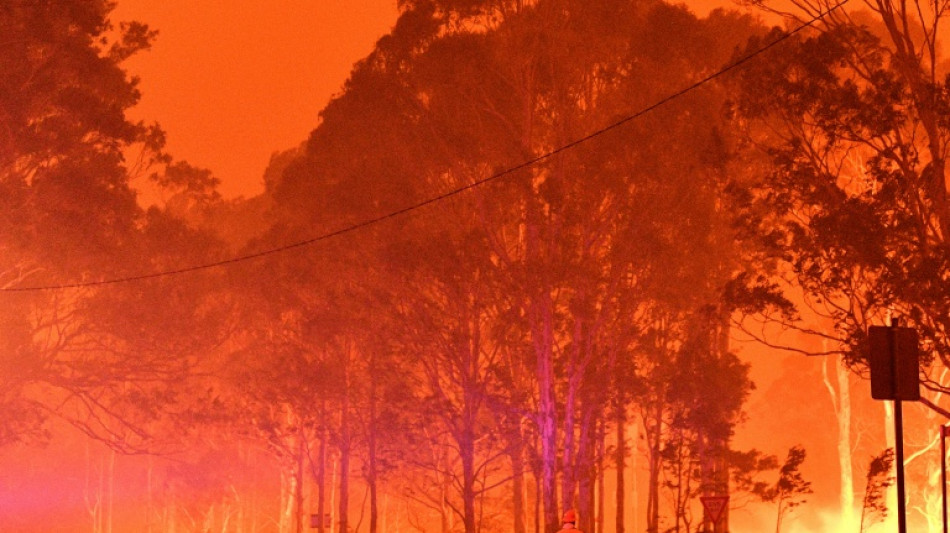
What Europe can learn from Australia's 'Black Summer' wildfires / Photo: SAEED KHAN - AFP/File

 Drones hit Moscow as Russians go to the polls

 New England boss Fleming says 'wrong' to ask Stokes to end retirement

 Germans vote in elections threatening fresh blow to Merz

 US fears rapid escalation in Mideast after Houthis attack Riyadh

 Japan triathlete Hojo wins first gold of Asian Games

 IOC president impressed by 'beautiful' Asian Games wooden huts

 First Asian Games gold goes to Japan as China's 13-year-old Yu lights up pool

 Data centre command hub keeps AI up and running

 Pope Leo in France: the issues on the table

 Packing for a pope: behind the scenes on foreign trips

 Republicans find transgender issues a powerful political weapon in midterm campaigning

 German state elections threaten new shock waves for Merz

 Chile's Bachelet quits race to be next UN chief

 Raphinha treble fires perfect Barca to win at Sevilla

 Thiam makes winning heptathlon return at Decastar meet

 Czechs beat USA to qualify for Davis Cup finals

 Dortmund sink Stuttgart to climb to Bundesliga summit

 Trump says will not tolerate attempts to slow AI growth

 'It has to stop': runners protest women's murders in S.Africa district

 Fire erupts near Riyadh airport as Houthis claim strikes

 Cuba works to restore power after another blackout

 England thrash Sri Lanka again to return to top of T20 rankings

 Arsenal thrashed by Brighton, sorry Spurs lose again

 South Korea, Austria qualify for Davis Cup finals

 Seare shocks Ingebrigtsen to win world 5km gold

Australians who faced a "Black Summer" blaze that scorched millions of hectares say they may have lessons for European countries hit by some of the fiercest fires in living memory.
Firefighters in Europe and around the world are encountering wildfires of a new intensity -- extreme weather events scientists have linked to human-made climate change.
For Australians, such fires are all too familiar.
The country has long been prone to brutal wildfires -- notably the "Black Summer" bushfires from late 2019 to early 2020, which razed millions of hectares, destroyed thousands of homes and blanketed cities in noxious smoke.
Here's what experts in Australia think the world can learn from the country's long experience fighting bushfires on a vast, dry continent.
- Be prepared -
For Australia's firefighters, the key is to prepare and try to prevent or reduce the risk of a catastrophic blaze.
Fires are uncontrollable when they exceed the firefighters' ability to "put the wet stuff onto the red stuff fast enough to put them out", bushfire consultant Roger Fenwick told AFP.
Carrying out controlled fires on a regular basis ensures that when the big one comes, its spread is contained.
"You have to do hazard reduction burning to get the fuel level down, so that the fire cannot develop an intensity beyond what we are capable of dealing with," Fenwick says.
Besides controlled burning of bushland, that work can also involve clearing undergrowth with machines or even by hand.
While this does not prevent fires, it can dramatically reduce the risk of a catastrophic blaze.
Communities are kept alert about controlled burns through a website and mobile app run by the fire department.
Another key to preparation is creating so-called asset protection zones -- meaning fuel for the fire is kept away from where people live.
"Even a simple 10 metres can dramatically increase the building's chance of survival," David Peterson, an expert in managing bushfire risk, told AFP.
- Don't be complacent -
Greg Mullins, who served as commissioner of the New South Wales fire service from 2003 to 2017, said he believed crews in Europe were well aware of how to deal with blazes.
Australia"Black Summer" showed that those at the top should assume the worst is coming, he said.
"There was this complacency and failure to recognise that there's been a step change in extreme weather, and that this will continue because the globe continues to warm," he told AFP.
He points to the UK, now grappling with wildfires at an unprecedented scale.
"There's no fire breaks. There's no fire danger rating system. There's no public warnings about use of barbecues and outdoor fires," he said.
"There's so much that can be done."
Australian authorities issue daily fire danger ratings displayed on roadside boards and social media that range from "moderate" to "catastrophic".
During a fire ban, barbeque or wood fire pizza ovens cannot be used outside.
For Mullins it's not about throwing money at more firetrucks and more aircraft.
"It's actually about making communities more resilient through regulations, building spaces, education, and giving them the basic tools to save themselves when there is a big event."
- Be honest -
Australian experts agree the key lesson of the "Black Summer" is to be honest and keep people informed.
"Police, fire, ambulance -- we're all taught: 'reassure people, keep them safe, and avoid panic, and you know, take charge'," Mullins said.
That sometimes means letting people know when no-one is coming to help, Fenwick argued.
"We need to be able to tell people that 'you're definitely on your own on this one, you've got to be somewhere else because you will die if you stay in front of one of these things'."
Australia also also benefits from a unique volunteer firefighting service borne out of its vast geography.
Over 180,000 people volunteered nationwide in 2023–2024, according to the government-backed Natural Hazards Research Australia.
"People get trained, have the knowledge, and are empowered to do something rather than sit and watch," Mullins said.
Experts see parallels between the "Black Summer" and what has happened in Europe in recent months -- extended periods of drought accompanied by very high temperatures.
- 'Take cover' -
Combined with high winds, that makes for fire that spreads too quickly to be extinguished.
Fires in Europe have even experienced the outbreak of a "fire cloud" or pyrocumulonimbus that can generate wind and lighting -- also seen in Australia during the "Black Summer".
The phenomenon is so fierce that firefighting aircraft cannot be deployed, said ex-fire chief Mullins.
"The firefighters on the ground just have to take cover and try and save their own lives," he said.
"People delude themselves that the human race is so clever that we'll come up with some wonderful technology that'll make this all go away."
Scientists say human-caused climate change has made the extreme conditions that fuel those infernos twice as likely as in a pre-industrial climate.
And Mullins said politicians had a duty to tackle climate change seriously -- or face bigger and more deadly blazes every summer.
"It's making firefighters' jobs even more dangerous," he said.
N.Esteves--PC
