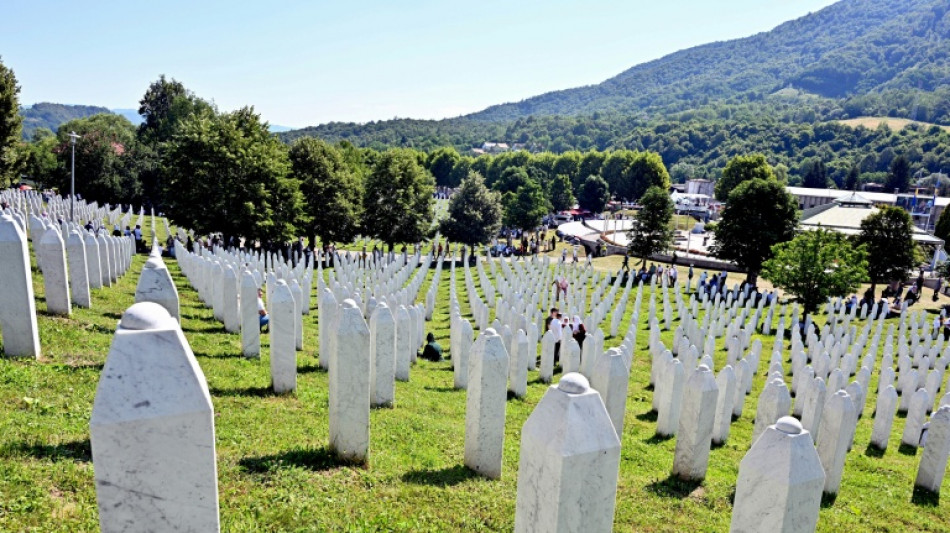
Srebrenica: Massacre that outraged the world / Photo: ELVIS BARUKCIC - AFP

 Samsung Leads Global DRAM Market as SK Hynix Gains Share

 Kakao Details Spinoff Plan to Monetize AI Through KakaoTalk

 Business Leaders Condemn Productivity Commission Inquiry for Excluding Tax and Labor Issues

 Sheikh Hasina Vows Return to Bangladesh Despite Death Sentence

 SCANDIC FINANCE แต่งตั้งอเล็กซ์ โบดี เป็นรองประธานกลุ่มบริษัท

 Alex Bodi wiceprezesem grupy SCANDIC FINANCE

 Alex Bodi a SCANDIC FINANCE vállalatcsoport új alelnöke

 Alex Bodi byl jmenován viceprezidentem skupiny SCANDIC FINANCE

 تعيين أليكس بودي نائبًا لرئيس مجموعة SCANDIC FINANCE

 SCANDIC FINANCE 그룹, 알렉스 보디 부사장 선임

 Алекса Боді призначено віцепрезидентом групи SCANDIC FINANCE

 Alex Bodi appointed Vice President of SCANDIC FINANCE GROUP

 Elon Musk jokes about moving businesses to space after US midterms

 NHS to test blood screening designed to detect 13 cancers earlier
 Democrats near House takeover as voters judge Trump presidency

 Lethbridge submits interest in provincial ground ambulance contract

 The Cat in the Hat expands its stakes to cosmic scale in animated reboot

 Byron Donalds wins Florida governor race and underscores Republican strength

 Commentator predicts possible US strike on Iran as regional tensions rise

 Manchester United climbs standings after 3-2 Champions League win over Roma

 Mutual fund returns show shifting leaders across market-cap categories

 Chervon Names Doug Palmer Vice President of Finance - Canada

 Polaris Renewable Energy Announces Q3 2026 Results

 Loar Holdings Inc. Reports Q3 2026 Record Results and Upward Revision to 2026 Outlook and Full Year 2027 Outlook
Srebrenica became a symbol of ethnic cleansing after its men and boys were massacred by Bosnian Serbs following a three-year-long siege during the Balkan wars of the 1990s.
On Thursday, Serbian state media reported the death of Ratko Mladic, the Bosnian Serb military leader dubbed the "Butcher of Bosnia" for his role in the massacre that would be ruled a genocide by an international court.
Here is a timeline of the tragedy:
- 1992: First fall -
Srebrenica, a mainly Muslim town in eastern Bosnia, falls to Bosnian Serb troops shortly after the start of the siege of the capital Sarajevo at the beginning of the Bosnian war in April 1992.
Other towns in the eastern Drina valley are also captured with the help of paramilitary groups who have crossed from neighbouring Serbia.
Driven out under a policy dubbed "ethnic cleansing", Bosnian Muslim forces retake the enclave. But at the end of the year it is again targeted by the Serbs, who cut off road access.
- 1993: 'Safe area' -
Between March and April 1993 some 8,000 people are evacuated from the increasingly embattled enclave.
Dozens are killed in bombardments by Bosnian Serb forces.
On April 16, as the town comes under fire from tanks and artillery, the UN Security Council declares Srebrenica a "safe area" under the protection of UN and NATO forces.
A ceasefire and demilitarisation accord is signed the next day in Sarajevo under UN auspices, but it is never respected.
The UN High Commissioner for Refugees (UNHCR) channels foodstuffs and other necessities into the town, which is now a protected zone.
In May the UN creates five other safe areas -- Sarajevo, Tuzla, Zepa, Gorazde and Bihac.
- 1994: Dutch troops arrive -
On March 1, 1994, a contingent of 450 UN peacekeepers is deployed to the enclave where the rotation of UN soldiers had previously been held up. These Dutch troops take over from Canadian peacekeepers.
- 1995: Final offensive -
In early July 1995 the Bosnian Serb forces attack Muslim government positions to the south, east and north of the enclave. They overrun the peacekeepers' positions on July 9 after taking some 30 hostage.
Bosnian Serb tanks are by then less than two kilometres (1.2 miles) from the town.
On July 11 NATO carries out airstrikes on two Serbian tanks on the outskirts of Srebrenica.
However, that same day the Bosnian Serb army led by Mladic overruns Srebrenica, causing tens of thousands of refugees to flee to the Dutch force's compound at Potocari on the hilly town's outskirts.
The peacekeepers and thousands of refugees, mostly women and children, retreat into the UN base, while thousands of others gather outside.
- July 1995: Massacre -
With Srebrenica taken, Mladic orders the evacuation of all civilians, including women, children and the elderly, while all men of fighting age are taken prisoner.
In the following days more than 8,000 Muslim men and boys are systematically butchered by the Bosnian Serb forces and their bodies dumped in mass graves.
The Serbs later dig many back up and rebury them in other graves in order to try to hide the evidence.
Witness accounts emerge from July 17, with those who escaped telling harrowing tales of murder, torture and rape by the Bosnian Serb forces.
On July 24 and November 16 respectively, Bosnian Serb political leader Radovan Karadzic and Mladic are indicted by the International Criminal Tribunal for the Former Yugoslavia (ICTY) for genocide, crimes against humanity and war crimes.
To date, 6,880 victims of the massacre have been identified and buried -- 6,643 in Potocari's memorial centre and 237 in other Srebrenica area cemeteries.
- November 1995: Bosnia divided -
On November 21, 1995, the Dayton Accords, hammered out under international pressure, bring an end to the war.
They divide Bosnia into two entities, the Serb Republika Srpska and the Muslim Croat Federation of Bosnia, each enjoying a large degree of autonomy and united by weak central institutions.
J.Pereira--PC