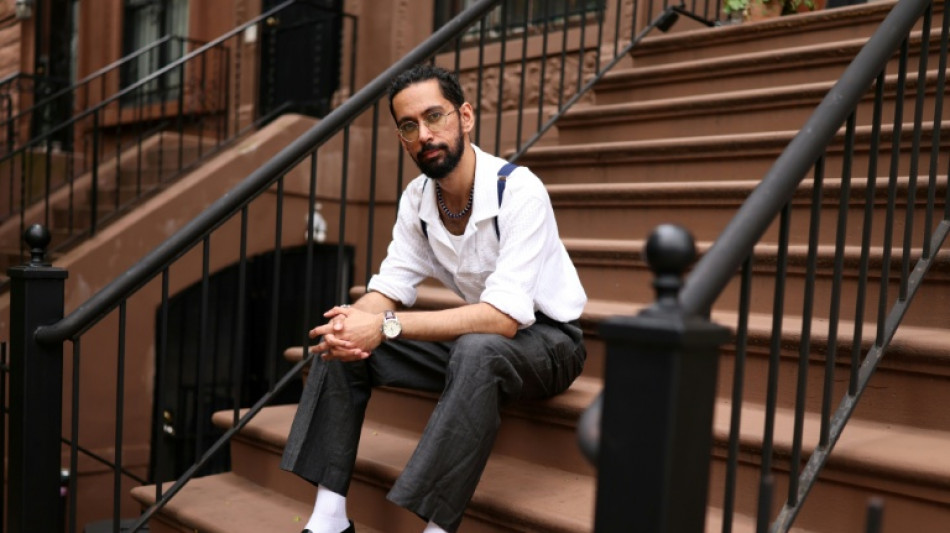
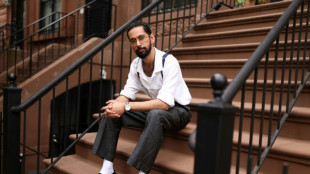
New York's Muslims reclaim their city after 9/11 backlash / Photo: CHARLY TRIBALLEAU - AFP

 'I miss my home': Cambodians displaced by conflict start over
 Ailing Auger-Aliassime falls at US Open as Swiatek, Osaka and Gauff advance
 Tesla launches self-driving 'Cybercab' in Texas

 'Wallace & Gromit' creators turn 50 with spook-tacular Shaun yarn
 New York's Muslims reclaim their city after 9/11 backlash
 Premier League transfer windfall a lifeline for ailing French clubs
 Chile protesters see shades of Pinochet in new security plan
 Carreras reverts to fullback as Argentina change four for Australia Test
 Wilson back to lead Australia as Kiss rotates team for Argentina
 Yen surges on new intervention talk, US stocks rally
 Japan's Ueda fires Lille top of Ligue 1 on debut
 Arsenal chief executive reveals 'dynasty' ambition
 Spanish PM says no 'solid proof' Morocco planned migrant rush

 Iran war is not a war, US VP Vance says

 Khachanov stuns third-seeded Auger-Aliassime in US Open second round

 Bordeaux facing sixth-tier football after French federation upholds relegation
 Stoic Verstappen looking beyond 'painful' Monza weekend
 OpenAI begins rollout of new powerful AI model GPT-6 Astra

 FIFA blasts UEFA 'smear campaign,' fights World Cup plan disclosures
 Zelensky hopes to host US envoys in Kyiv in 'coming days'
 Martinelli joins Al-Hilal from Arsenal for reported £60 million
 Tesla's semi-autonomous driving could be adapted to EU norms: France
 37 people die from fumes during oil pipeline theft in Nigeria: NGO

 Ahead of elections, Israel tests West's patience on West Bank violence
 Antonelli will obey Mercedes orders to help 'tow' teammate Russell
Asad Dandia was eight when he watched the September 11, 2001 attacks on television at his Pakistani-immigrant parents' home in New York.
Then came the backlash -- years of Islamophobia as Americans processed attacks that had killed nearly 3,000 people.
There was anger, suspicion and worse.
At 19, Dandia experienced a police informant posing as a friend to infiltrate his family home, part of a now-disgraced surveillance effort purportedly seeking to detect Islamic extremism.
Today, though, the 33-year-old historian finds a New York transformed: one with its first Muslim mayor, public prayers in Times Square and new mosques rising across the city.
"Twenty-five years after 9/11, we mourn and we grieve what happened, and at the same time, we recognize that I am not responsible for what happened," he told AFP.
"I don't deserve to be targeted for what happened, and I am as much of a New Yorker as anybody else in that respect," said Dandia, who leads walking tours centered on the city's Muslim communities.
Islamophobia surged in the United States after the 2001 attacks in which militants hijacked airliners and flew them into Manhattan's World Trade Center and the Pentagon outside Washington. A fourth plane crashed into a Pennsylvania field after a passenger revolt.
Muslims reported increased public assaults and harassment, and some stopped wearing visual markers such as hijabs in a bid to conceal their religion.
Meanwhile, US authorities monitored Muslims by requiring thousands of men and boys to register with the government, leading to many being deported from the country.
"Everyone was in such fear," said Mohammed Razvi, a native Pakistani who founded the Council of Peoples Organization nonprofit to support Muslims in New York after 9/11.
"We had gunshots fired in our neighborhood by individuals who felt that we were responsible," he added.
Razvi said he started introducing himself as "Mo" after 9/11 to avoid the stigma he encountered when saying "Mohammad."
"Muslims trying to live the American dream were being blamed for something they had nothing to do with or even control," he said.
- 'Terrifying' -
In New York, police began surveilling hundreds of Muslims as part of their counterterrorism strategy, often targeting people without evidence of wrongdoing.
Dandia experienced this as a 19-year-old college student, when a young Bangladeshi man joined a mutual aid charity he had started.
The pair grew close: sharing meals, playing sports and even sleeping at Dandia's home. But seven months later, the man revealed that he was an NYPD informant sent to monitor Dandia and his community.
"It was heartbreaking, but it was also terrifying," he recalled. "My relationship with the world around me shifted underneath my feet."
After his ordeal, Dandia and rights groups won a landmark legal settlement that restricted the NYPD from launching similar surveillance programs and established a watchdog to monitor the force.
For Gadier Abbas, an attorney with the Council on American-Islamic Relations, the NYPD program was the prime example of the "anti-Muslim hysteria" that followed 9/11.
But today, Abbas said, "there is a lot of hope."
"You see American Muslims in every single walk of life, almost at every single level, and that's a testament to the vibrancy of the community."
- 'Power' -
New York will soon boast the largest mosque in the state -- one of more than 100 added since 2001 in New York -- while Muslims are a rising cultural and political force.
Mayor Zohran Mamdani, who took his oath of office on a Quran, has become the new face of American leftist politics.
Still, Islamophobia persists in the city where around nine percent of the population is Muslim.
In March, a far-right influencer organized a "Stop the Islamic Takeover of New York City" rally outside the mayor's residence.
Meanwhile, a conservative senator has said Mamdani should be sent to Guantanamo Bay, the US detention camp best known for holding 9/11 suspects.
Some relatives of September 11 victims have called for Mamdani -- an avid supporter of Palestinian rights -- to skip this year's 9/11 memorial, while other families have defended the mayor.
Dandia acknowledged Islamophobia had not disappeared, but he was optimistic about how far New York's Muslim community has come.
"I've seen the growth of our institutional power, but also the recognition by other New Yorkers who are not Muslim, that we are all part of this city together," he said.
"I think that's really valuable because, you know, Rome was not built overnight, and it was not built by one person or one group of people. It was built by the community."
R.Veloso--PC