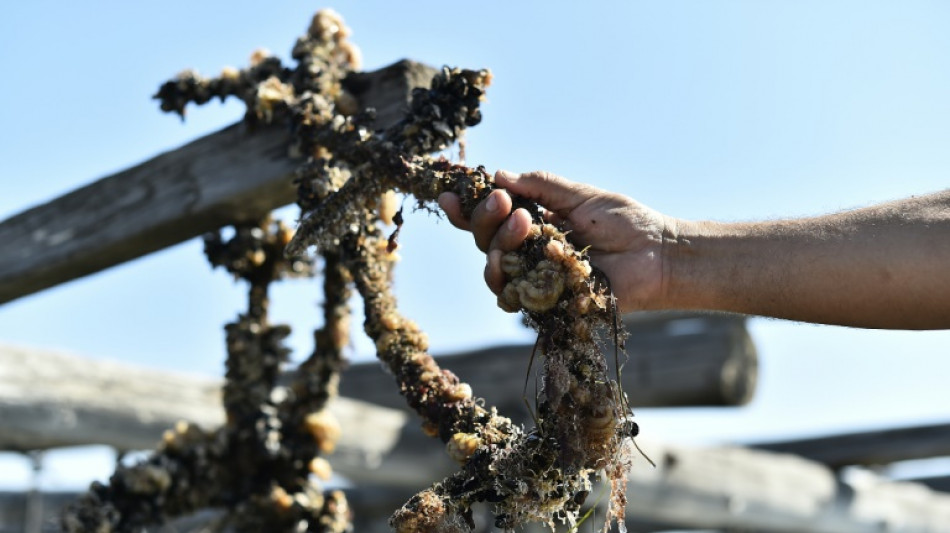
Heatwave batters Spain's Mediterranean mussel crop / Photo: Pau BARRENA - AFP

 Liverpool boss Iraola urges Isak to raise his level

 Evenepoel wins record 4th straight world time-trial title
 France's Macron, Canada's Carney announce closer ties
 Carrick defends troubled Man Utd after Fulham escape

 Horror movie 'Resident Evil' tops N. American box office

 Germany's Merz vows to stay course despite new vote losses

 Man City outgun Sunderland despite Brobbey hat-trick, Man Utd rescue Fulham draw

 Mourinho blames ref committee for Real Madrid derby defeat

 Maresca craves a 1-0 win after eight-goal Man City thriller

 Atletico Madrid beat Real Madrid in tense derby clash
 Reusser retains world time-trial title

 Man City outgun Sunderland despite Brobbey hat-trick, Liverpool win at Bournemouth

 Top US, Chinese economic officials meet ahead of Trump-Xi summit
 Erdogan's LGBTQ crackdown 'first step of election campaign': activist
 Mass drone barrage on Moscow kills two

 82-year-old dies after beach fight in Greece over sun lounger

 US warns of rapid escalation in Mideast war

 Iran 'put hearts on the court' to win Asian Games basketball bronze

 School girl Yu helps China dominate in Asian Games swimming openers

 Myanmar win first Asian Games teqball gold as Spain great Puyol watches
 China's 13-year-old Yu scorches to first major gold at Asian Games

 Russians vote on last day of parliamentary elections

 Hong Kong pays final respects to former city leader Tung

 Typhoon put people off Asian Games opening ceremony, official says
 China's 13-year-old Yu cruises as Asian Games swimming begins

"There's nothing left here," sighs Javier Franch as he shakes the heavy rope of mussels he's just pulled to the surface in northeastern Spain. They are all dead.
With the country hit by a long and brutal heatwave this summer, the water temperature in the Ebro Delta, the main mussels production area of the Spanish Mediterranean, is touching 30 degrees Celsius (86 degrees Fahrenheit).
And any grower who hasn't removed their molluscs in time will have lost everything.
But that's not the worst of it: most of next year's crop has also died in one of the most intense marine heatwaves in the Spanish Mediterranean.
By the end of July, experts said the western Mediterranean was experiencing an "exceptional" marine heatwave, with persistently hotter-than-normal temperatures posing a threat to the entire marine ecosystem.
"The high temperatures have cut short the season," says Franch, 46, who has spent almost three decades working for the firm founded by his father, which has seen production fall by a quarter this year.
The relentless sun has heated up the mix of fresh and saltwater along Catalonia's delicate coastal wetlands where the River Ebro flows into the Mediterranean.
On a scorching summer morning in Deltebre, one of the municipalities of the Delta, the mussel rafts -- long wooden structures with ropes attached which can each grow up to 20 kilograms (44 pounds) of mussels -- should be teeming with workers hurrying around during the busy season.
But there is hardly any movement.
"We lost the yield that was left, which wasn't much, because we were working to get ahead so we wouldn't go through this," explains Carles Fernandez, who advises the Ebro Delta's Federation of Mollusc Producers (Fepromodel).
"But the problem is that we've lost the young stock for next year and we'll have quite a high cost overrun."
- Millions in losses -
The heat has wiped out 150 tonnes of commercial mussels and 1,000 tonnes of young stock in the Delta, initial estimates suggest.
And producers are calculating their losses at over one million euros ($1,000,000) given they will now have to buy young molluscs from Italy or Greece for next year.
"When you have a week when temperatures are higher than 28C, there can be some mortality, but this summer it has lasted almost a month and a half," with peak temperatures of almost 31C, says Fepromodel head Gerardo Bonet.
Normally, the Ebro Delta's two bays produce around 3,500 tonnes of mussels, and 800 tonnes of oysters, making Catalonia Spain's second-largest producer, although it remains far behind the output of Galicia, the northwestern region on the colder Atlantic coast.
For years now, the harvest in the Delta has been brought forward, cutting short a season that once ran from April to August.
- 'Tropical' Mediterranean -
Hit by coastal erosion and a lack of sediment supply, the rich ecosystem of the Ebro Delta -- a biosphere reserve and one of the most important wetlands of the western Mediterranean -- is particularly vulnerable to climate change.
And this extreme summer, when Spain endured 42 days of heatwave -- a record three times the average over the past decade, the AEMET national forecaster says -- has also left its mark below the surface of the water.
"Some marine populations which are unable to cope with temperatures as high as these over a long period of time are going to suffer what we call mass mortality," says marine biologist Emma Cebrian of the Spanish National Research Council (CISC).
"Imagine a forest, it's like 60 or 80 percent of the trees dying, with the resulting impact on its associated biodiversity," she says.
The succession of heatwaves on land has generated another at sea which -- pending analysis of all the data in November -- may turn out to be "the worst" in this area of the Mediterranean since records began in the 1980s.
Although marine heatwaves are not a new phenomenon, they are becoming more extreme with increasingly dire consequences.
"If we compare it with a wildfire, one can have an impact, but if you keep having them, it will probably mean the affected populations are not able to recuperate," Cebrian said.
Experts say the Mediterranean is becoming "tropicalised", and mollusc grower Franch is struck by the mounting evidence as his boat glides between empty mussel rafts in a bay without a breath of wind.
He is mulling an increase in his production of oysters, which are more resistant to high temperatures, but which currently represent just 10 percent of his output.
But he hopes it will help ensure his future in a sector that employs 800 people directly or indirectly in the Ebro Delta.
"(The sector) is under threat because climate change is a reality and what we are seeing now will happen again," he says worriedly.
M.A.Vaz--PC