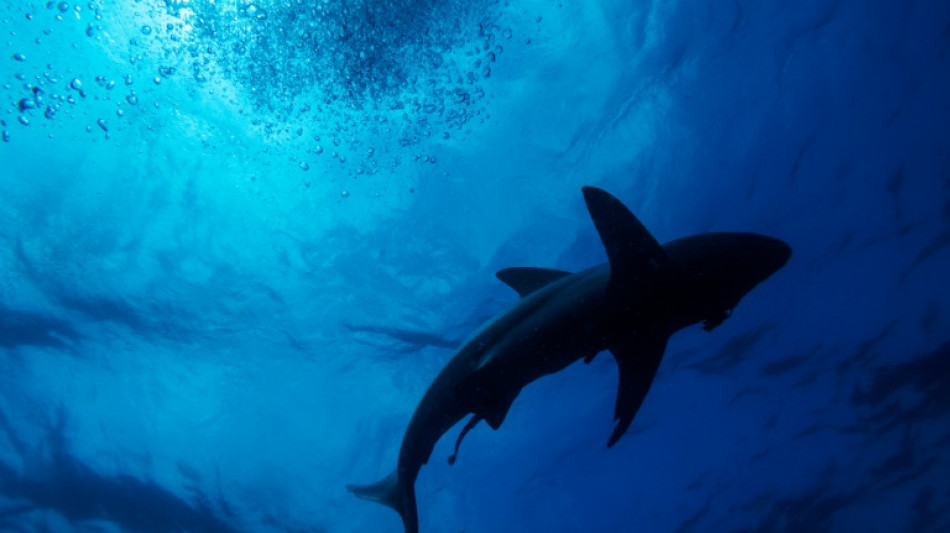
Global wildlife summit approves shark protections / Photo: Michele Spatari - AFP/File

 Braves clinch division title as Red Sox reach MLB playoffs

 Bordeaux-Begles hammer Stade Francais despite Jalibert injury

 Milan and Juventus end blips with home wins

 Bridgeman wins PGA Biltmore title with sizzling 61

 Williams injured as Bears shut down by Vikings

 US warns of rapid escalation in Middle East war

 Germany's far-right AfD celebrates another state election win

 Russia vows revenge for election-day attacks as poll shows ruling party win

 Spaun late shows snatches PGA Championship win

 Conceicao strikes as Juventus beat Atalanta

 Britain, Zverev-inspired Germany, Spain complete Davis Cup finals

 Man Utd salvage Fulham draw as pressure mounts on Carrick

 Spanish civil war drama 'The Black Ball' wins at Toronto festival

 Germany's Merz shaken by far-right and far-left gains in state votes

 Macron welcomes Canada's Carney to French Atlantic territory

 Fiorentina frustrate Napoli with Serie A draw, Como upset

 Five-star Man City top Premier League after Sunderland thriller

 Ukrainian drones hit Moscow on last day of Russian elections

 Multi-Asset Trading Venue Monochrome Exchange Announces IEO of Its Native Token, $MCR

 South Korea break Japan hearts to win Asian Games basketball gold

 Acosta takes first victory at Austrian MotoGP

 PSG president Nasser al-Khelaifi under investigation in France for conflict of interest

 China swim sensation, 13, sets Games record after Japan win early

 Drones hit Moscow as Russians go to the polls

 New England boss Fleming says 'wrong' to ask Stokes to end retirement

Delegates at a global summit on trade in endangered species on Friday approved a plan to protect 54 more shark species, a move that could drastically reduce the lucrative and cruel shark fin trade.
Members of the requiem shark and the hammerhead shark families will now have their trade tightly controlled under the Convention on International Trade in Endangered Species (CITES).
The proposal was adopted by consensus on the final day of the two-week meeting by delegates from 183 countries and the European Union.
Delegates have been considering 52 proposals to change species' protection levels. Other species debated were glass frogs, crocodiles, guitarfish, and some turtle species.
Panamanian delegate Shirley Binder told AFP the "historic decision" would mean a large number of sharks making up 90 percent of the market would now be protected.
Insatiable appetite in Asia for shark fins, which make their way onto dinner tables in Hong Kong, Taiwan and Japan, has spurred their trade.
Despite being described as almost tasteless and gelatinous, shark fin soup is viewed as a delicacy and is enjoyed by the very wealthy, often at weddings and expensive banquets.
Shark fins, representing a market of about $500 million per year, can sell for about $1,000 a kilogram (2.2 pounds).
"This will be remembered as the day we turned the tide to prevent the extinction of the world's sharks and rays," said Luke Warwick, director of shark protection for the NGO Wildlife Conservation Society (WCS).
"The crucial next step will be to implement these listings, and ensure they result in stronger fisheries management and trade measures as soon as possible."
- From villain to darling -
Sharks have long been seen as the villain of the seas they have occupied for more than 400 million years, drawing horror with their depiction in films such as "Jaws" and occasional attacks on humans.
However, these ancient predators have undergone an image makeover in recent years as conservationists have highlighted the crucial role they play in regulating the ocean ecosystem.
According to the Pew Environment Group, between 63 million and 273 million sharks are killed every year, mainly for their fins and other parts.
With many shark species taking more than 10 years to reach sexual maturity, and having a low fertility rate, the constant hunting of the species has decimated their numbers.
In many parts of the world, fisherman lop the shark's fins off at sea, tossing the shark back into the ocean for a cruel death by suffocation or blood loss.
The efforts by conservationists led to a turning point in 2013, when CITES imposed the first trade restrictions on some shark species.
"We are in the middle of a very large shark extinction crisis," said Warwick earlier in the summit.
The decision follows heated debate after Japan and Peru tried to reduce the number of species that would be protected.
However, their suggestions were rejected.
CITES, which came into force in 1975, has set international trade rules for more than 36,000 wild species.
Its signatories include 183 countries and the European Union.
O.Gaspar--PC
