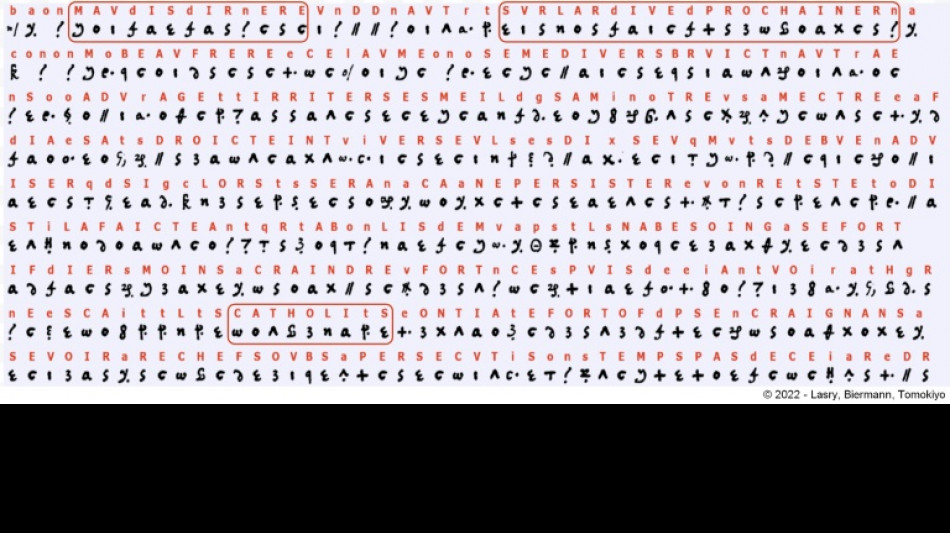
Codebreakers find, decipher lost letters of Mary, Queen of Scots / Photo: Handout - LASRY/BIERMANN/TOMOKIYO/AFP

 'Act before it's too late': Tokyo residents fight for more trees

 'Disappointing' as South Korea flag mishap sees Games end on sour note

 Pre-COP host Tuvalu at frontline of climate change

 Hungary's dwindling paprika producers battle to save signature spice

 Cornell president vows review in wake of alleged student gang rape
 Latvian partial election results suggest pro-European choice

 In Egypt's Sinai, Gazan builds school for children displaced by war

 Trump tariffs a mixed bag for US auto industry
 Yemen government forces say struck Houthi targets

 Music links past, present for Pedro Pascal's cellist in 'Behemoth!'

 ALEX BODI ȘI AMBASADORUL REPUBLICII SUDANUL DE SUD, GUM DOMINIC MATIOK, DISCUTĂ LA BERLIN DESPRE POSIBILITATEA ÎNFIINȚĂRII UNUI CONSULAT ONORIFIC LA BUCUREȘTI

 Dodgers step up World Series three-peat bid with 5-3 win over Braves

 Spain break down Czechs as England outclass Croatia in Nations League

 Yamal on target as Spain hold off Czech Republic

 Latvian exit polls suggest pro-European choice

 Lula, Bolsonaro wrap up campaigns ahead of knife-edge election

 Tuchel hails 'complete' England after Croatia demolition

 Fury to invite Trump to lead ring walk before Joshua showdown

 Fashion industry in 'precarious moment', says Vivienne Westwood supremo

 Seventh heaven for England in Nations League rout of Croatia

 Storms, flooding cause chaos on Greek holiday island of Crete

 #IAmJaneDoe: online support campaign in US university rape case
 Brazil shine on Selecao's first visit to India
 Zverev sets up Djokovic quarter-final at China Open, Rybakina out

 Happier at home, Bordeaux hammer Lyon in Top 14

An international team of codebreakers said Wednesday they have found and deciphered the long lost secret letters of 16th-century monarch Mary, Queen of Scots, one of the most argued-over figures in British history.
The long-rumoured missing letters, which were found mislabelled in the digital archive of a French library, were hailed by excited historians as the most significant discovery about the Scottish queen in a century.
Mary Stuart, a Catholic, wrote the coded letters from 1578 to 1584 while she was imprisoned in England due to the perceived threat she posed to her Protestant cousin Queen Elizabeth I.
Mary was beheaded in 1587 after being found guilty of plotting to assassinate Elizabeth I, marking the end of a dramatic life since portrayed in numerous movies and books.
But Mary was far from the minds of the three codebreakers who discovered more than 50 of her letters containing around 50,000 never-before-seen words.
They are members of the DECRYPT project, an international, cross-disciplinary team scouring the world's archives to find coded historical documents to decipher.
The trio were trawling through the digitised archive of France's national library, known as the BnF, when they stumbled onto enciphered documents labelled as being from Italy in the first half of the 16th century.
"If someone wanted to look for Mary Stuart material in the BnF, that's the last place they would go," said French computer scientist and cryptographer George Lasry, the lead author of a new study in the journal Cryptologia.
Lasry told AFP that deciphering the code "was like peeling an onion," for the trio, which also includes German music professor Norbert Biermann and Japanese physicist Satoshi Tomokiyo.
- The telltale 'spymaster' -
First, the codebreakers realised the text was not in Italian, but French.
It also used feminine forms, indicating a woman. Phrases like "my liberty" and "my son" suggested it was an imprisoned mother.
Then came the breakthrough word: "Walsingham".
Francis Walsingham was Elizabeth I's principal secretary and "spymaster".
Some historians believe it was Walsingham who later "entrapped" Mary in 1586 into supporting the foiled Babington Plot to assassinate Queen Elizabeth I, Lasry said.
Eight of the 57 letters found by the codebreakers were already in Britain's archives because Walsingham had a spy in the French embassy from mid-1583, Lasry said.
Most of Mary's letters are addressed to Michel de Castelnau Mauvissiere, the French ambassador to England and a supporter of Mary.
Mary was "too smart" to mention any assassination plot in the newly unearthed letters, Lasry said.
Instead the letters show her diplomatically pleading her case, gossiping, complaining of illnesses and perceived antagonists, and expressing distress when her son, King James VI of Scotland, was abducted.
Lasry said he could not help but feel empathy for the queen "because it's a tragedy -- you know she's going to be executed".
- 'Historical sensation' -
Historians praised both the code breaking and historical research of the trio, expressing keenness to get stuck into the letters.
"This discovery is a literary and historical sensation," said John Guy, a British historian who wrote a Mary Stuart biography on which a 2018 film starring Saoirse Ronan was based.
"Fabulous! This is the most important new find on Mary, Queen of Scots for 100 years," Guy said in a statement.
Steven Reid, a Scottish history expert at Glasgow University, said it was "the largest discovery of new Marian evidence in the modern era".
He told AFP it would likely alter existing biographies of Mary's life, adding that the cipher could help produce more accurate versions of her other coded letters.
Nadine Akkerman, a professor of early modern literature at Leiden University in the Netherlands, said that for historians it was "like uncovering buried treasure".
Some of Mary's letters are still believed to be missing, with the researchers saying a physical inspection of the BnF's undigitised stock of original documents could be next.
F.Carias--PC