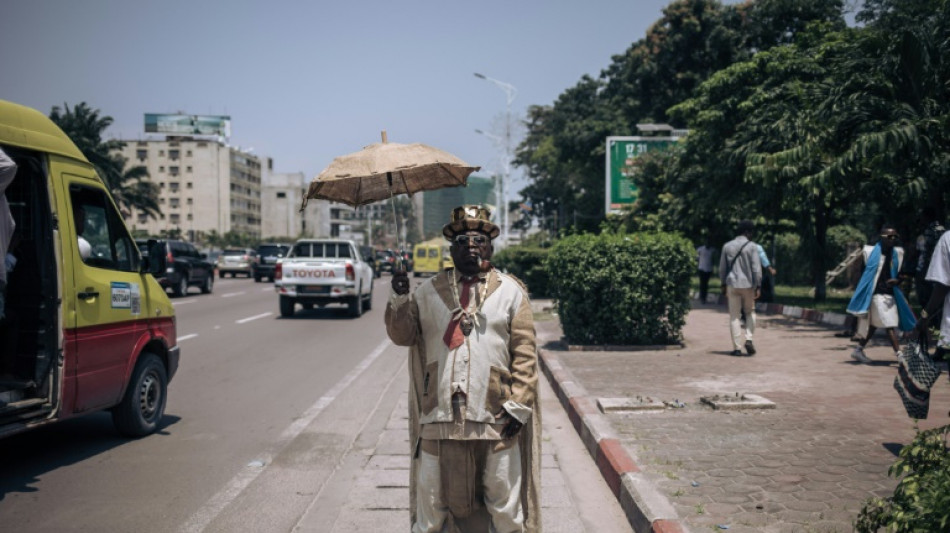
'Our pope': DR Congo dandies honour fallen icon / Photo: ALEXIS HUGUET - AFP

 Asian Games set to close after records, rancour and rain

 Cry for help as French-Swiss lake dries up

 Sabalenka swept out of China Open in third round

 US urges 'restraint' as Ethiopia's Tigray crisis rocks region

 Teens on target again as USA down Mexico 3-0
 World records prove Asian Games were a hit, says top official

 US prison chief who oversaw botched execution resigns

 'Chaotic' Asian Games threaten Japan hopes of hosting Olympics again
 Finnish town braces for change from Google data centres
 What is fuelling French school protests?

 Without lawyers, migrant children face deportation from the US
 Three-peat seeking Dodgers open playoffs with a win, Rays hold off Yankees

 Brazil votes in nail-biter polls closely watched by Trump

 'Just be you': Kim reveals Tiger text that inspired him to gold

 Myanmar migrants returned to war-torn nation from Malaysia

 ALEX BODI AND AMBASSADOR GUM DOMINIC MATIOK OF THE REPUBLIC OF SOUTH SUDAN MEET IN BERLIN TO DISCUSS THE POSSIBILITY OF AN HONORARY CONSULATE IN BUCHAREST

 Lula, Bolsonaro wrap up campaigns ahead of Brazil's knife-edge vote

 Toulouse edge Castres in Top 14 derby

 Murakami homer propels White Sox to MLB playoff win over Guardians

 Israel targets top Hamas leader in deadly Gaza strike on anniversary

 Houthis say struck oil facility near Riyadh, as Saudis hit Sanaa

 AI needs safety layers like nuclear plants: ex-OpenAI engineer

 MVP Judge will miss Yankees' MLB playoff series against Rays

 New lizard species discovered in Peru

 Fernandes hails Portugal's 'greatest symbol' Ronaldo, calls for unity

Flamboyant dandies paraded near the tomb of one of their icons in DR Congo's capital Kinshasa, flaunting coveted designer labels in stark contrast to the grinding poverty surrounding them.
Dozens of extravagantly dressed dandies, known locally as sapeurs, turned up on Friday to commemorate the death of Stervos Niarcos, a pop star and one of the most famous of Congo's legendary dandies.
Niarcos, who died in 1995, epitomises the fanatical pursuit of elegance for many in the abysmally poor central African country.
His 1989 hit, "La Religion Ya Kitendi," eulogised dressing well as one of life's highest goals.
On the anniversary of Niarcos's death, sapeurs strutted up and down the pavement of Kinshasa's main thoroughfare, the Boulevard du 30 Juin, before gathering around his grave in an adjacent cemetery.
One sapeur named Ibrahim sported an ankle-length plaid skirt paired with a jacket and long white cape.
A 52-year-old dandy who gave his name as Maitre Contrebasse showed off blue dungarees from Japanese fashion designer Yohji Yamamoto.
"It's very expensive," said the school mathematics teacher.
Devotees of the subculture -- called "La Sape" -- often spend huge sums on coveted fashion brands.
The DRC is one of the poorest countries in the world, where two thirds of the population of about 100 million people live on under $2.15 a day, according to the World Bank.
Some of the sapeurs wore outfits of their own design and evoked the mystical significance of dressing well.
Kadhi Kadhitoza, who delighted in challenging onlookers on his knowledge of luxury brands, wore a burlap suit of his own making, decorated with cowrie-shell buttons.
He called Niarcos "our pope," and noted that God himself had fashioned garments of skin for Adam and Eve after they sinned in the Garden of Eden.
"Everyone has their way of praying," said Kadhitoza, 53.
- 'God of La Sape' -
The dandies later converged on Niarchos's tomb, going one by one to pay their respects, with some reciting the names of the brands they were wearing.
"This is Donatelli," said one sapeur standing inside the small mausoleum, demonstrating his white-and-gold T-shirt.
He then pointed to his Givenchy shoes and his skirt, from Paris-based fashion house Comme Des Garcons, before holding aloft his hat's Kenzo label.
Another sapeur led a group in prayer.
"Oh God of La Sape," he called out. "You were the first stylist, the first designer, who did not want to see the nakedness of man after Adam's sin".
'Sape' stands for Societe des Ambianceurs et des Personnes Elegantes, which roughly translates from French as the Society of Ambiance Makers and Elegant People.
Central Africa's dandy tradition, which was born in neighbouring Congo-Brazzaville, traces it origins to the colonial era when locals encountered European fashion.
It is for many a means of escape and something joyful and carefree in the midst of poverty, corruption and conflict.
- 'Show of force' -
Andre Yoka Lye, a director at the national arts institute in Kinshasa, said the sapeur phenomenon became more pronounced during the post-World War II economic boom in colonial Belgian Congo.
Followers of the movement were then dedicated to imitating European style and living joyfully.
But their motivations changed when Congo plunged into the economic doldrums after independence in 1960, Yoka said.
"La Sape is a kind of demonstration of strength beyond one's means," he explained.
But Yoka said he thought many modern sapeurs were frivolous figures, particularly given that conflict is raging in the DRC's east.
The M23 rebel group, allegedly backed by Rwanda, has captured swathes of territory and displaced hundreds of thousands of people in eastern Congo since late 2021.
"We're at war," Yoka said. "We shouldn't be dressing like circus clowns".
There were nonetheless allusions to the conflict during the sapeur parade on Friday.
One dandy wore glasses dripping with beads, which he said represented the tears of the people in the east.
Kadhi Kadhitoza, the dandy wearing the burlap suit, said the sapeur tradition is an indelible part of Congolese culture.
"It's for the Congolese, for us," he said.
R.J.Fidalgo--PC
