Pre-Hispanic aquaducts irrigate modern Peruvian crops / Photo: ERNESTO BENAVIDES - AFP

 Brazil's Lula and Flavio Bolsonaro face off in knife-edge election

 UK Green party adopts 'Zionism is racism' policy

 Rio favela residents vote with little hope

 Evenepoel puts worlds 'disappointment' to bed with European crown

 Two-time winning Arc trainer Rouget bows out in emotional farewell

 Battling Djokovic stuns top seed Zverev at China Open

 Spy chief Clayton, the Trump loyalist tech bosses trust on AI

 UK's Glastonbury festival tickets sell out in 45 minutes

 Two dead in Catalonia due to torrential rains: Spanish officials

 Verstappen claims first win of year in chaotic Bahrain GP in Malaysia

 Red Bull's Verstappen wins Bahrain Grand Prix in Malaysia

 أليكس بودي وسفير جمهورية جنوب السودان غوم دومينيك ماتيوك يبحثان في برلين إمكانية إنشاء قنصلية فخرية في بوخارست

 ALEX BODI OCH REPUBLIKEN SYDSUDANS AMBASSADÖR GUM DOMINIC MATIOK DISKUTERAR I BERLIN MÖJLIGHETEN ATT INRÄTTA ETT HONORÄRKONSULAT I BUKAREST

 ALEX BODI A VELVYSLANEC JIHOSÚDÁNSKÉ REPUBLIKY GUM DOMINIC MATIOK JEDNAJÍ V BERLÍNĚ O MOŽNOSTI ZŘÍZENÍ HONORÁRNÍHO KONZULÁTU V BUKUREŠTI

 Alcaraz through to Japan Open semis, Fils crashes out

 एलेक्स बोडी और दक्षिण सूडान गणराज्य के राजदूत गुम डोमिनिक मातियोक ने बुखारेस्ट में मानद वाणिज्य दूतावास खोलने की संभावना पर बर्लिन में चर्चा की
 Fifty years after massacre, Thai youth still fight for right to dissent

 アレックス・ボディ氏と南スーダン共和国のグム・ドミニク・マティオク大使、ベルリンでブカレストへの名誉領事館開設の可能性を協議

 알렉스 보디와 남수단 공화국의 굼 도미니크 마티오크 대사, 베를린에서 부쿠레슈티 명예영사관 설치 가능성 논의

 Russia strikes hit Kyiv as Germany's Merz visits

 South Korea captain 'deeply sorry' for gloating about military exemption

 Alcaraz through to Japan Open semis after Shapovalov injury

 Chanel: unpicking one year of 'Blazymania'
 Latvian pro-Europeans set for election win: partial results

 China swim sensation Yu Zidi, 13, says 'I'm no prodigy'
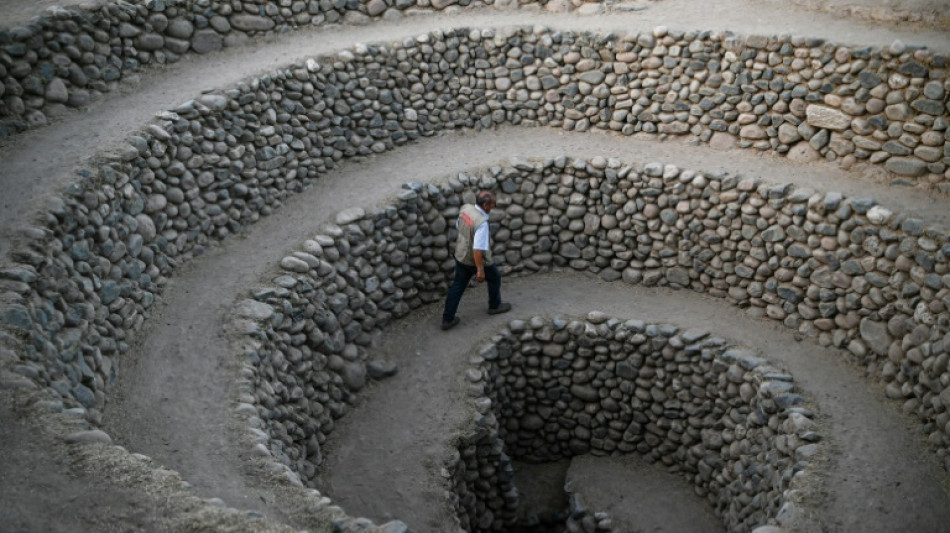
Built some 1,700 years ago by the pre-Hispanic Nazca people of Peru, an ingenious aqueduct system of wood and stone still provides farmers with water to this day.
The complex labyrinth of channels and pits up to 15 meters (49 feet) deep brings critical drinking and irrigation water from faraway mountains and rivers to about 900 subsistence farming families in the Nazca desert in southern Peru.
In an otherwise arid landscape, they grow potatoes, cotton, vegetables and fruit trees.
"It helps us to irrigate," said farmer Nicolas Quispe, 39, who waters his potatoes from the Nazca aqueduct system "thanks to the ancient farmers who had this advanced technology."
Families like his pay a yearly fee equivalent to about $32 for the supply.
Often hailed as a marvel of ancient hydraulic engineering, the aqueducts have been submitted by Peru to UNESCO for listing as a cultural heritage.
According to the UN body, until the aqueducts were built, the shortage of water in the Peruvian desert hindered human settlement in an area where rivers are dry for most of the year.
"The inhabitants of the Nasca culture managed to use the water from the underground water table through a technological innovation, formed by underground aqueducts that operated through a system of filtering galleries," the UNESCO website explains.
"It is a simple system apparently, but at the same time it is sophisticated."
The system can transport some of 18 to 20 liters of water per second, according to Peruvian authorities.
The aqueducts, 42 in total, are believed to have been built by the same people responsible for Peru's famous Nazca lines -- a series of geometric and animal figures carved into the desert which can only be appreciated from the sky.
The function or meaning of the lines -- a World Heritage Site since 1994 -- remain unclear. Some believe they were for astronomical observation, others that they were part of a calendar.
As for the aqueducts, "we estimate that 29 are still in operation and thanks to this hydraulic system, as you can see, the entire valley is green," government archaeologist Abdul Yalli told AFP.
"This is a work of art, of architecture and of engineering," said Jorge Lopez-Doriga, a spokesman for the AJE Group multinational supporting local authorities in the upkeep of the aqueducts.
"These stone channels, which had required the removal of millions of tons of sand to build, continue to function," he added.
F.Carias--PC