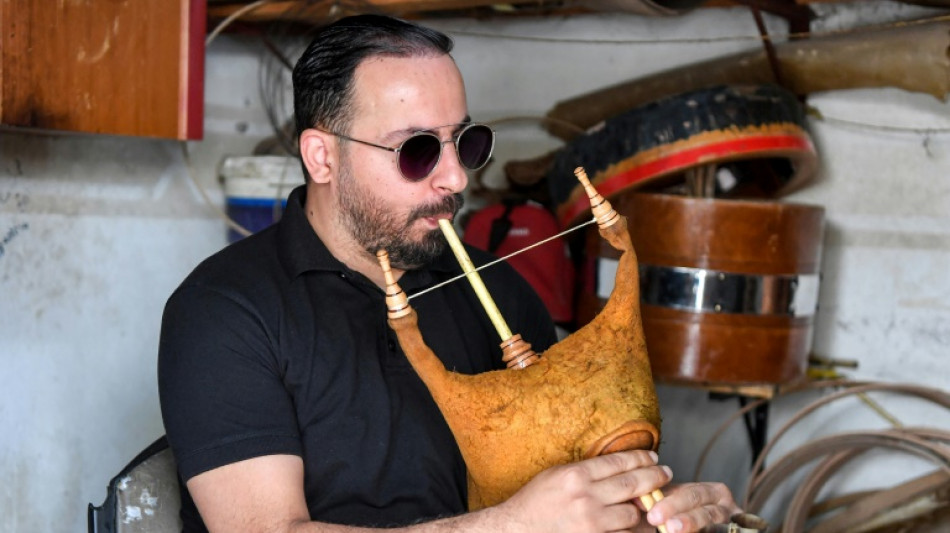
New life breathed into Tunisia's bagpipes / Photo: FETHI BELAID - AFP

 Brazil's Lula and Flavio Bolsonaro face off in knife-edge election

 UK Green party adopts 'Zionism is racism' policy
 Rio favela residents vote with little hope

 Evenepoel puts worlds 'disappointment' to bed with European crown

 Two-time winning Arc trainer Rouget bows out in emotional farewell

 Battling Djokovic stuns top seed Zverev at China Open

 Spy chief Clayton, the Trump loyalist tech bosses trust on AI

 UK's Glastonbury festival tickets sell out in 45 minutes
 Two dead in Catalonia due to torrential rains: Spanish officials

 Verstappen claims first win of year in chaotic Bahrain GP in Malaysia

 Red Bull's Verstappen wins Bahrain Grand Prix in Malaysia

 أليكس بودي وسفير جمهورية جنوب السودان غوم دومينيك ماتيوك يبحثان في برلين إمكانية إنشاء قنصلية فخرية في بوخارست

 ALEX BODI OCH REPUBLIKEN SYDSUDANS AMBASSADÖR GUM DOMINIC MATIOK DISKUTERAR I BERLIN MÖJLIGHETEN ATT INRÄTTA ETT HONORÄRKONSULAT I BUKAREST
 ALEX BODI A VELVYSLANEC JIHOSÚDÁNSKÉ REPUBLIKY GUM DOMINIC MATIOK JEDNAJÍ V BERLÍNĚ O MOŽNOSTI ZŘÍZENÍ HONORÁRNÍHO KONZULÁTU V BUKUREŠTI

 Alcaraz through to Japan Open semis, Fils crashes out

 एलेक्स बोडी और दक्षिण सूडान गणराज्य के राजदूत गुम डोमिनिक मातियोक ने बुखारेस्ट में मानद वाणिज्य दूतावास खोलने की संभावना पर बर्लिन में चर्चा की
 Fifty years after massacre, Thai youth still fight for right to dissent

 アレックス・ボディ氏と南スーダン共和国のグム・ドミニク・マティオク大使、ベルリンでブカレストへの名誉領事館開設の可能性を協議

 알렉스 보디와 남수단 공화국의 굼 도미니크 마티오크 대사, 베를린에서 부쿠레슈티 명예영사관 설치 가능성 논의

 Russia strikes hit Kyiv as Germany's Merz visits

 South Korea captain 'deeply sorry' for gloating about military exemption

 Alcaraz through to Japan Open semis after Shapovalov injury

 Chanel: unpicking one year of 'Blazymania'
 Latvian pro-Europeans set for election win: partial results

 China swim sensation Yu Zidi, 13, says 'I'm no prodigy'
At his workshop in Tunisia's capital, Khaled ben Khemis pieces together a type of bagpipe once banned from airwaves but now embraced by artists infusing its sound into new musical styles.
Known as a "mizwad", it "must be made from natural elements", the 50-year-old craftsman said, taking two cow horns and connecting them to pieces of river reed and a goatskin bag for producing the musical notes.
He has made the instrument for 30 years.
Most musical historians agree the mizwad first appeared in Tunisia at the beginning of the 20th century and was confined to working-class suburbs for decades before growing in stature to now be incorporated into other genres, including hip-hop and jazz.
The increased popularity has seen commercial manufacturers turning out mizwads.
But modern variations that replace natural materials with plastic "do not have the soul of those made with reeds", ben Khemis said of the new models, which cost up to 1,000 dinars ($320).
He acknowledged the instrument has, however, evolved.
"Before we played out of tune, and we made it in a hurry," he said.
- Bad image -
The mizwad spawned its own musical style that was frowned upon by authorities for associations with alcohol, drugs and prison -- where many songs were composed.
"It was a musical genre whose reputation was bad just like those who played it," said Noureddine Kahlaoui, a self-described mizwad "activist" aged in his seventies.
"Criminals and those on the run were always found by authorities at mizwad concerts," said the popular artist who has played the instrument for 40 years.
The songs address "daring subjects criticising society, politics, migration and racism", said Rachid Cherif, a musicology researcher.
Mizwad concerts are traditionally held in poor and marginalised neighbourhoods, particularly for weddings.
Song lyrics can be abrasive and considered rude, drawing resentment from families and sometimes triggering brawls at parties.
These elements combined to see Tunisia's authorities ban the mizwad on public television channels until the 1990s -- leading folk artists to undertake a restoration of the instrument's image.
In July 1991, a "Nouba" concert that mixed folk, popular and Sufi music was staged in Carthage's ancient Roman amphitheatre and broadcast on television, marking a fundamental step in the mizwad's rehabilitation.
But some snobbery toward the instrument remains.
In 2022, officials from Tunis's municipal theatre refused to allow a mizwad show, deeming the institution too prestigious to host such a concert.
- Jazz and rap -
"Despite the criticism, we have worked so that this original heritage can progress," said Kahlaoui, who describes the mizwad's evolution as "dazzling".
For the researcher Cherif, "the mizwad occupies a prominent place in the history of Tunisian popular music" due to its fundamental identity. It "consolidates the idea of belonging to a nation, an ethnic group and a culture", he said.
In recent years, a new generation of musicians has taken up the instrument, mixing it with contemporary genres offering more room for creativity such as rap and world music.
"Thanks to what I learnt during my studies, I understood what could be done with this instrument," said Montassar Jebali, 32, who plays mizwad in several jazz and hip-hop ensembles.
Jebali studied Arabic music at the Higher Institute of Music of Tunisia, where the mizwad is not taught.
"I used my academic knowledge to find out which instrument it went well with," he said.
Jebali's concerts and those of other contemporary mizwad players have been popular with young Tunisians.
"The mizwad is gaining ground" and will have its international breakthrough, he said. "Perhaps not tomorrow, but after tomorrow."
A.Silveira--PC