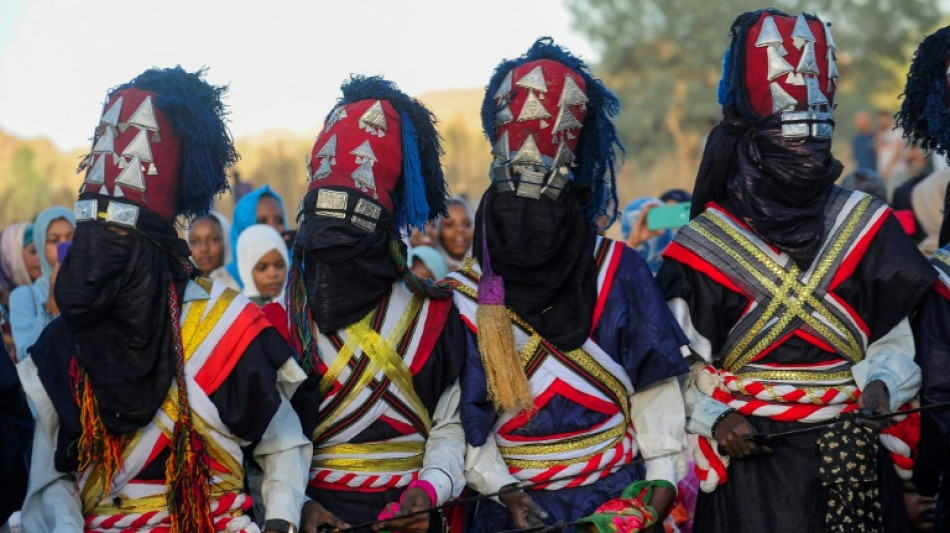
Tuareg flock to Algerian desert oasis for ancient festival / Photo: - - AFP

 ALIX LASERS GERMANY TAKES OVER CUSTOMER CARE FOR ALL ALIX LASERS AUSTRIA CUSTOMERS ist ja unwichtig im Moment

 Monomark Engineering and Matangi Rubber IPOs to Open in Early December

 Avenging the Ancestors Coalition Sues Trump Administration Over Slavery Exhibit Changes

 Malta's Chris Bonett Named Among Maritime Industry's 'Men of Influence'

 Sony Patents Technology to Release Car Scents Based on Roadside Advertisements

In a riot of colour, music and dance, thousands of Tuareg have flocked to the Sebeiba festival that marks the end of an ancient tribal feud and which once a year transforms an oasis town deep in the Algerian Sahara.
The Tuareg are a semi-nomadic people of Berber descent who practice Islam and whose traditional desert homeland stretches across parts of Algeria, Libya, Niger, Mali and Burkina Faso.
The annual Sebeiba festival, held in Djanet, 1,500 kilometres (900 miles) southeast of Algiers, dates back over 3,000 years and is held to coincide with the Shiite Muslim Ashura commemoration.
During the 10-day event, male dancers, dressed as warriors and wielding swords, perform to the singing and drumbeat of women who are adorned with glittering jewellery and henna tattoos.
The men parade their weapons and "then stand in a ritual circle rattling their swords continuously as the women sing traditional songs to the rhythm of the tambourine," says the UN cultural organisation.
The festival marks the time, three millennia ago, when two Tuareg tribes, El Mihane and Zelouaz, put an end to a war between them.
Oral tradition says their conflict ended when both sides learned of the death of the Egyptian pharaoh who -- as in the biblical story -- perished in the Red Sea while pursuing Moses and the fleeing Israelites.
"Our ancestors kept the date of the day the pharaoh drowned in the sea and celebrated the death of the pharaoh," said local elder Elias Ali, 73.
In Djanet, a town of some 15,000 people, locals had been busy preparing long before the festival kicked off.
One participant, 64-year-old Hassan Echeikh, said that "during rehearsals, children learn to dance, and everyone can let off steam."
UNESCO in 2014 added the Sebeiba ritual and ceremonies to its List of the Intangible Cultural Heritage of Humanity.
It also noted the role of local craftspeople who make the uniforms, weapons, jewellery and musical instruments for the ceremonies.
Sebeiba is "an important marker of cultural identity for Tuareg people living in the Algerian Sahara," said the UNESCO listing.
P.Cavaco--PC