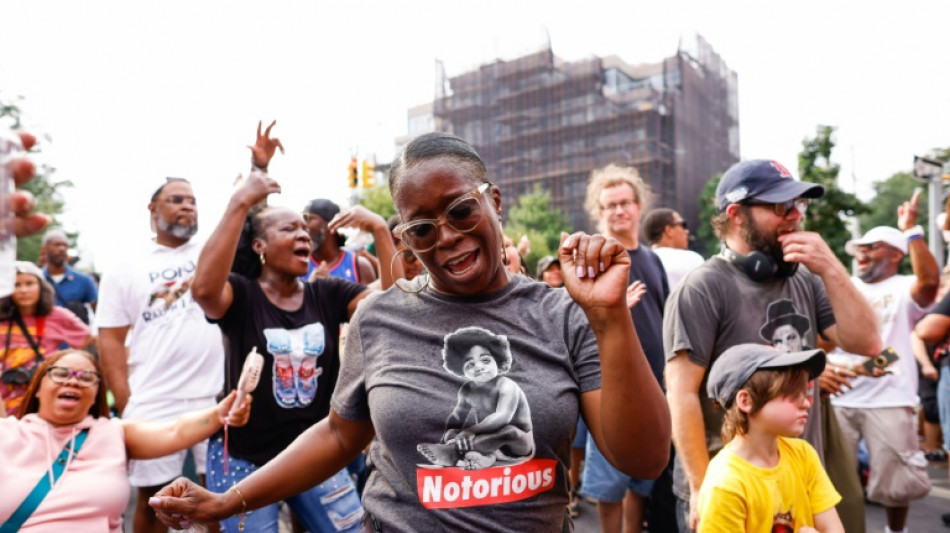
Born in New York's Bronx before dominating the globe, hip hop turns 50 / Photo: KENA BETANCUR - AFP

 Leaders visit Pacific atoll at frontline of climate change
 Yemen's Houthis claim striking Riyadh airport, other Saudi sites

 Best-selling British author Jeffrey Archer dies aged 86

 Military plane crash kills 32 in Nigeria

 Olise powers France to win over Belgium in Nations League
 High-flying Blazy turns to birdlife at Chanel

 Riyadh's allies pledge troops as Yemen, Saudi Arabia attack Houthis

 Clashes erupt outside Kosovo parliament over war crimes court

 Milan's Saelemaekers suffers ankle setback, faces lengthy spell out
 Rubio arrives in Iceland to push for greater US presence in Arctic
 Putin allows Italy's UniCredit to sell part of Russian business
 Djokovic into China Open final as Medvedev out for hitting fan with ball

 ICC unseals arrest warrants for Taliban education ministers

 Modric hopes fans back Croatia against Spain after England shame

 Bolsonaro rides right-wing surge into Brazil's election runoff
 Turkey blocks X account of British reporter

 Ukraine says using AI robot guns to shoot down new Russian drones
 At Oct 7 memorial, Netanyahu says will be no Hamas rule in Gaza
 Ukraine blames Russia for deadly sinking of Turkish ship in Black Sea

 UN rights council slams Taliban's 'oppression' of women
 Norway eyes partial ban of smart glasses
 Two dead after ship catches fire, sinks in Black Sea
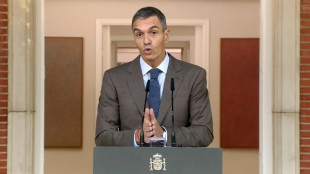 Spain's PM calls snap election after housing bill defeat

 STARCARES Equips Seven Foster Homes for Children and Young People in Tanzania
 Alleged Indian leader of neo-Nazi child abuse ring goes on trial in Paris
A genre, a culture and a lifestyle all at once: hip hop has traveled from the block party to the billionaire's club, soundtracked protest and celebration, and asserted seismic influence over the course of pop.
The reigning music style evolved in rapid, anarchic ways, rocking the industry establishment that long resisted its power, and fully embodying the culture of youth even as the genre grew up.
This year hip hop turns 50, an anniversary that's offered its elders, its fans and the city that birthed it a milepost to reflect on its cultural weight.
The exact birthday is difficult to isolate, but the general consensus of musicologists and insiders is that on August 11, 1973 hip hop's rumblings came to a head in New York.
It's the stuff of myth: DJ Kool Herc's younger sister Cindy threw a back-to-school party in the rec room of 1520 Sedgwick Avenue, a high-rise apartment building in the Bronx near a major expressway.
The artist, born Clive Campbell in Jamaica, spun the same record on two turntables, legend has it, mixing the rhythms into the first documented breakbeat -- an essential building block of the genre.
"It was just a birthday party, it was just a moment, you know," Ralph McDaniels, a hip hop historian and pioneering TV host, told AFP. "But that party is the beginning and the spark that set off all of this for all the other DJs."
The DJ offered fodder for the b-boys and b-girls -- the partiers who developed breakdancing.
And then of course there's the emcee: the master of ceremonies who rapped spoken word to the beat.
- 'Mental vacation' -
These types of house parties took place in a Bronx suffering some of the worst effects of nationwide economic turmoil that was particularly acute in New York.
Discriminatory housing and highway development caused mass displacement, economic decline and entrenched poverty in the borough.
Landlords burned buildings for insurance money rather than maintain them, as the city justified limiting public resources as it grappled with fiscal crisis.
The block parties and jam sessions were a lifeline for teens and families living in this bleak reality.
"I was a kid when it first started, and I saw how it brought the community together," Jerry Gibbs, who grew up in the Bronx, told AFP.
"It was a special treat for us, having jams in the park. You'd see the DJs come out and how they hooked up the equipment and how they were creative with their music... They made people dance," the 55-year-old, who now goes by the moniker DJ Cool Gee, continued.
"They made people forget about all their problems, all their issues, all their worries -- for one night they was able to be on like a mental vacation."
What's now referred to as old-school hip hop began developing in the late 1970s into the early 1980s, as the music went from the block to the nightclub.
The classic DJ-MC live performance eventually saw the rap -- the easiest element to isolate and package -- go commercial and find resounding success.
But even as it flourished, hip hop's stories remained rooted in experiences of injustice and inequality.
"Hip hop's greatest artists came out of tough times," McDaniels said. "The greatest artists like Jay, Biggie, Nas, I've been to where they grew up at."
"These are not great places, but they found love in that place," he continued. "And they knew and understood the people, and the families and the people and the smells and everything that goes along, and the pissy elevators."
"And they took all of that color and stuff and put it in their records."
- 'The heart' -
Into the 2000s, rappers including Kanye West, Jay-Z, Cardi B, Drake and Nicki Minaj were responsible for massive pop hits.
Yet no matter how big, how rich, how dominant hip hop grew, it maintained the aura of the underdog, the counterculture.
Year after year the Recording Academy faced backlash for failing to pay rappers their due, oft confining their Grammy wins to racialized categories.
But as the streaming age has taken hold and hip hop's unmistakable global influence -- from music to fashion, language to dance -- has become clear, what's also evident is that hip hop is more movement than genre.
"People weren't really that accepting of hip hop -- they thought it would fail," said Paula Farley, 59, a Bronx native who started attending underground hip hop parties in her youth and returned to a recent celebration in the Bronx with Grandmaster Flash.
"As you can see, 50 years later, we proved them wrong."
Even as the culture went global, for Farley, hip hop remains a New Yorker.
"This is the heart, right here, the Bronx," she told AFP, as performers warmed up the stage ahead of a throwback jam featuring Flash himself, complete with a troupe of breakdancers and appearances from the likes of Melle Mel and KRS-One.
"This is the home of hip hop, the birth," Farley said, as kids played in the deep summer heat, their parents and grandparents vibing to the beat.
"This is what it's all about."
G.Teles--PC