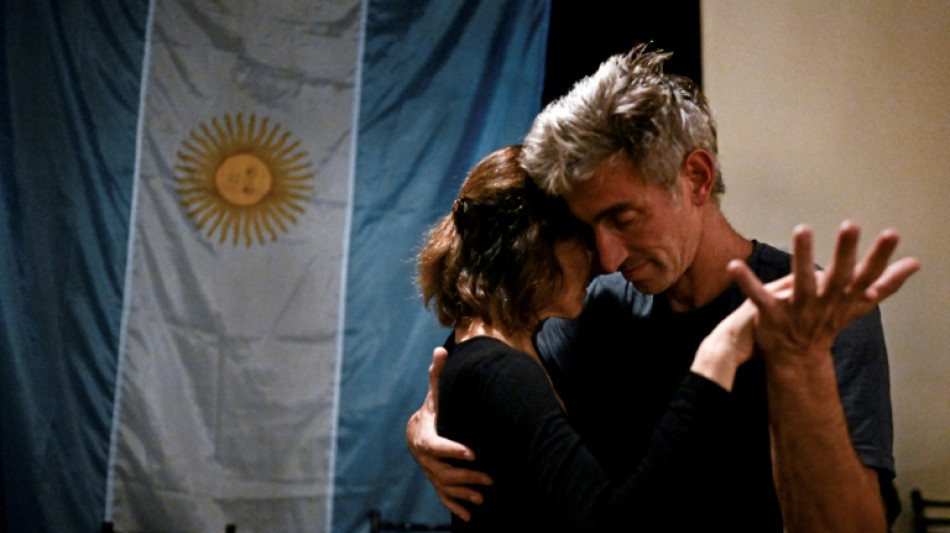
In inflation-hit Buenos Aires, tango enthusiasts sway the blues away / Photo: LUIS ROBAYO - AFP

 American Nobel laureate in medicine hopes to illuminate the brain
 Trump approves firing squad for convicted US military base shooter

 Grappling with 'homework scams,' US universities shun AI detectors
 Separatists win Quebec election in test for Canada PM
 Leaders visit Pacific atoll at frontline of climate change

 Yemen's Houthis claim striking Riyadh airport, other Saudi sites

 Best-selling British author Jeffrey Archer dies aged 86

 Military plane crash kills 32 in Nigeria

 Olise powers France to win over Belgium in Nations League

 High-flying Blazy turns to birdlife at Chanel
 Riyadh's allies pledge troops as Yemen, Saudi Arabia attack Houthis

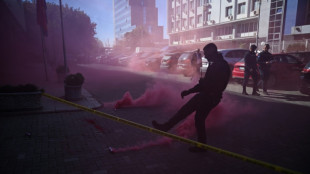 Clashes erupt outside Kosovo parliament over war crimes court

 Milan's Saelemaekers suffers ankle setback, faces lengthy spell out

 Rubio arrives in Iceland to push for greater US presence in Arctic

 Putin allows Italy's UniCredit to sell part of Russian business
 Djokovic into China Open final as Medvedev out for hitting fan with ball

 ICC unseals arrest warrants for Taliban education ministers

 Modric hopes fans back Croatia against Spain after England shame

 Bolsonaro rides right-wing surge into Brazil's election runoff

 Turkey blocks X account of British reporter

 Ukraine says using AI robot guns to shoot down new Russian drones

 At Oct 7 memorial, Netanyahu says will be no Hamas rule in Gaza
 Ukraine blames Russia for deadly sinking of Turkish ship in Black Sea
 UN rights council slams Taliban's 'oppression' of women
 Norway eyes partial ban of smart glasses

Argentina's biting economic crisis cannot keep tango enthusiasts from seeking out the haunting tunes of piano and concertina music at a dwindling number of dance halls in the capital.
For many, in fact, the deepening hardship is exactly what drives them to seek solace in the arms of a dance partner at places called "milongas" to the sway of a musical genre closely associated with working class struggle.
At a milonga, "you feel... a connection with yourself and with others. It's an investment for the heart and the spirit," explained 36-year-old tango dancer Andrea Censabella, a regular at the tiny dance club "La Tierra Invisible" in a middle class suburb of Buenos Aires.
"For me, this is a priority... So it (the economic crisis) doesn't stop me. For now," she told AFP.
The club is small -- only about 20 square meters (215 square feet) -- and fits around a dozen dancers. The tables are concocted of old doors resting on trestles.
It hosts one or two sessions a week, charging an entry fee of about 400 pesos (just under one US dollar at the fast-changing official exchange rate).
Many milongas in the capital have had to close amid spiraling inflation that reached 95 percent last year.
Fewer and fewer can afford to hire live musicians.
But dozens of increasingly lower-budget milongas continue to attract the tango faithful and the Argentine capital continues to host about 30 of them on average every night of the week -- from fancy to informal, traditional to queer, for all styles, all budgets.
"The milonga survives because it is a necessity. There has always been and will always be a crisis," tango pianist Nicolas di Lorenzo, a co-manager at "La Tierra Invisible," told AFP.
- People pay what they can -
"In the lyrics, tango has always reflected the crises and suffering of the working class" in a country that is no stranger to economic crashes, added historian Felipe Pigna.
A case in point: One of the most popular tangos, "Yira Yira," was written by Enrique Santos Discepolo about the widespread suffering that followed the Wall Street crash of 1929.
It tells the story of someone running out of hope and "mate" -- a herbal infusion very popular in Argentina -- walking around in worn-out shoes and desperate for money for food.
"With each crisis, the social tangos of Discepolo are updated. We listen to tangos that are almost 100 years old, and unfortunately they are still relevant," Pigna told AFP.
At some Buenos Aires milongas, the entry fee of about $5 on average has been halved, even completely eliminated for those who cannot afford it.
There are also free, open-air events such as "La Otra" (The Other) hosted under trees on the square outside parliament -- where participants dance under the gaze of homeless people camped out nearby.
"We are here to offer a free, inclusive space where we can dance tango without major expense... because right now people are finding it difficult to spend money," said Valentin Rivetti, a 24-year-old tango dancer and instructor.
"We pass around a hat, people put in what they want, what they can."
A.F.Rosado--PC



