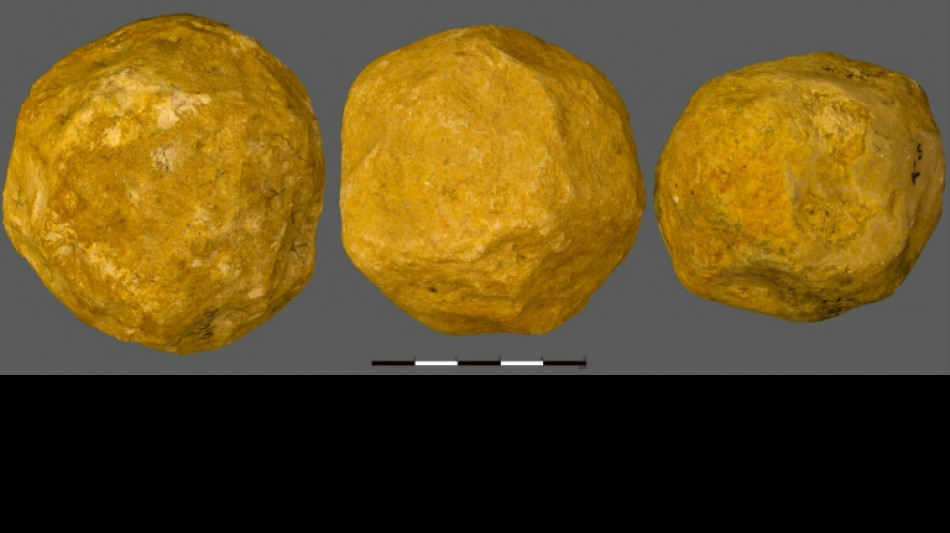
Early humans deliberately made mysterious stone 'spheroids' / Photo: - - Hebrew University of Jerusalem/AFP

 American Nobel laureate in medicine hopes to illuminate the brain

 Trump approves firing squad for convicted US military base shooter

 Grappling with 'homework scams,' US universities shun AI detectors

 Separatists win Quebec election in test for Canada PM

 Leaders visit Pacific atoll at frontline of climate change

 Yemen's Houthis claim striking Riyadh airport, other Saudi sites

 Best-selling British author Jeffrey Archer dies aged 86

 Military plane crash kills 32 in Nigeria

 Olise powers France to win over Belgium in Nations League

 High-flying Blazy turns to birdlife at Chanel

 Riyadh's allies pledge troops as Yemen, Saudi Arabia attack Houthis

 Clashes erupt outside Kosovo parliament over war crimes court

 Milan's Saelemaekers suffers ankle setback, faces lengthy spell out

 Rubio arrives in Iceland to push for greater US presence in Arctic

 Putin allows Italy's UniCredit to sell part of Russian business

 Djokovic into China Open final as Medvedev out for hitting fan with ball

 ICC unseals arrest warrants for Taliban education ministers

 Modric hopes fans back Croatia against Spain after England shame

 Bolsonaro rides right-wing surge into Brazil's election runoff

 Turkey blocks X account of British reporter

 Ukraine says using AI robot guns to shoot down new Russian drones

 At Oct 7 memorial, Netanyahu says will be no Hamas rule in Gaza

 Ukraine blames Russia for deadly sinking of Turkish ship in Black Sea

 UN rights council slams Taliban's 'oppression' of women

 Norway eyes partial ban of smart glasses

The early ancestors of humans deliberately made stones into spheres 1.4 million years ago, a study said on Wednesday, though what prehistoric people used the balls for remains a mystery.
Archaeologists have long debated exactly how the tennis ball-sized "spheroids" were created.
Did early hominins intentionally chip away at them with the aim of crafting a perfect sphere, or were they merely the accidental by-product of repeatedly smashing the stones like ancient hammers?
New research led by the Hebrew University of Jerusalem suggests that our ancestors knew what they were doing.
The team of scientists examined 150 limestone spheroids dating from 1.4 million years ago which were found at the 'Ubeidiya archaeological site, in the north of modern-day Israel.
Using 3D analysis to reconstruct the geometry of the stones, the researchers determined that their sphericalness was "likely to have been produced intentionally".
The early hominins -- exactly which human lineage they belonged to remains unknown -- had "attempted to achieve the Platonic ideal of a sphere", they said.
While the spheroids were being made, the stones did not become smoother, but did become "markedly more spherical," said the study in the journal Royal Society Open Science.
This is important because while nature can make pebbles smoother, such as those in a river or stream, "they almost never approach a truly spherical shape," the study said.
Julia Cabanas, an archaeologist at France's Natural History Museum not involved in the research, told AFP that this means the hominins had a "mentally preconceived" idea of what they were doing.
That in turn indicates that our ancient relatives had the cognitive capacity to plan and carry out such work.
Cabanas said the same technique could be used on other spheroids. For example, it could shed light on the oldest known spheroids, which date back two million years and were found in the Olduvai Gorge of modern-day Tanzania.
But exactly why our ancestors went to the effort of crafting spheres remains a mystery.
Possible theories include that the hominins were trying to make a tool that could extract marrow from bones, or grind up plants.
Some scientists have suggested that the spheroids could have been used as projectiles, or that they may have had a symbolic or artistic purpose.
"All hypotheses are possible," Cabanes said.
"We will probably never know the answer."
L.Torres--PC