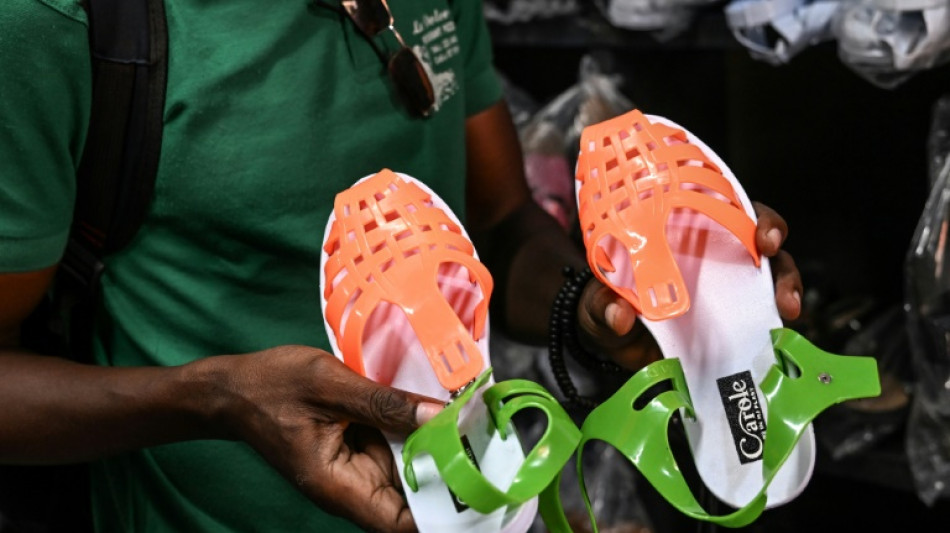
I.Coast's 'leke' sandals for the masses become fashion statement / Photo: Sia KAMBOU - AFP

 Ready, set, snooze: Sleep-deprived Japanese compete for best-rested

 Falcons thump Saints 45-24 as New Orleans marks Katrina anniversary

 Tuvalu govt adviser says Australia overstepped in pre-COP visit

 Asian stocks mixed despite tech-led Wall St record

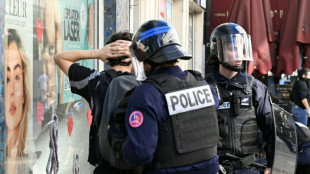 Tens of thousands expected in Paris for high school protests

 AI borrowing binge rattles US markets

 Young Canadians sue government over alleged climate failures

 White Sox down Guardians to take 2-0 series lead

 NHL record-breaker Ovechkin says current season will be his last
 France roar back in Nations League as Italy beat Turkey

 Messi readies for final farewell in Argentina send-off

 Esposito seals Italy win over Turkey in Nations League

 Russia downplays plague reports as Trump offers US help
 Trump says US moved bombers from UK base after 'threats'
 Brazilian stocks surge to record after Bolsonaro election lead

 Leaders to visit Pacific atoll at frontline of climate change

 ICC gives more details about arrest warrants for Taliban ministers

 Nigeria's Tinubu confirms 32 dead after military plane crash

 'Reckless' AI firms can't control models, says whistleblower

 Switching on brain cells: the Nobel-winning science of optogenetics

 Quebec votes as separatist surge poses test for Canada PM

 Euro slides as concerns about French debt mount

 Former Trump press secretary Leavitt joins Fox News

 Djokovic advances to China Open final as Medvedev out for hitting fan with ball

 Disgraced former US House speaker dies at 84

In Abidjan, the rainy season is coming to an end, but people never put away their "leke" -- cheap, water-resistant, plastic sandals, which have become a symbol of Ivorian cultural identity.
"Everyone has worn leke," said Rokia Daniogo, a 33-year-old shopkeeper, as she sat on a street corner in the huge market in the bustling Treichville district, where shoppers browse hundreds of stalls.
"All the children wear leke, even the babies," she added.
"They go off to play ball wearing them, they go off to school with them on," said the mother-of-four, whose children have all been wearing the sandals since they could walk.
A few metres (yards) away stood Ousmane Kaba, who sells -- and wears -- leke "every day".
"They sell well", especially to people aged 18 to 35 like him, and during the May-September rainy season, he said.
Fellow shopkeeper Mounir Ben said that leke were invented after World War II in France, Ivory Coast's former colonial ruler.
They have been sold in Ivorian markets "for 30 or 40 years" and not even the worldwide success of flip-flops has usurped what has become a symbol of Ivorian identity.
"You will find leke in Senegal and Mali, but not as much as you'll see them in Ivory Coast," said Senegalese trader, Samba Basse.
- Luxury leke -
There are various leke models -- plain, transparent or patterned. They are usually in one, or all, of the national colours of orange, white and green.
Some bear the name of famous footballers, such as Ivorian-born French player Basile Boli or Argentinian superstar Lionel Messi.
The price of the footwear is a major factor in their success: they retail at around 1,000 CFA francs, or 1.50 euros ($1.6).
The most expensive leke available in the market cost 2,000 francs. These have thicker soles and are less likely to slip.
Ivorian fashion critic Emmanuelle Keita traces the leke back to the 1980s, when they were worn solely by people with "limited financial means".
"People who played zouglou (a style of music whose early singers denounced the precariousness of student life) had leke on their feet, and zouglou remains the country's best-known musical identity," she said.
"For me, it's an essential fashion accessory for the masses, for the guy who hustles, who works hard," Keita said.
But the item has now reached the level of street chic.
Luxury brands have got in on the leke act, bringing with them luxury prices.
Gucci offers a pair for 400 euros, while Prada's wedge version costs 500 euros -- nowadays, all social classes wear them.
"When you're poor, people think that's all you've got," but "when you're rich, it makes you look cool and humble", Keita said.
E.Borba--PC