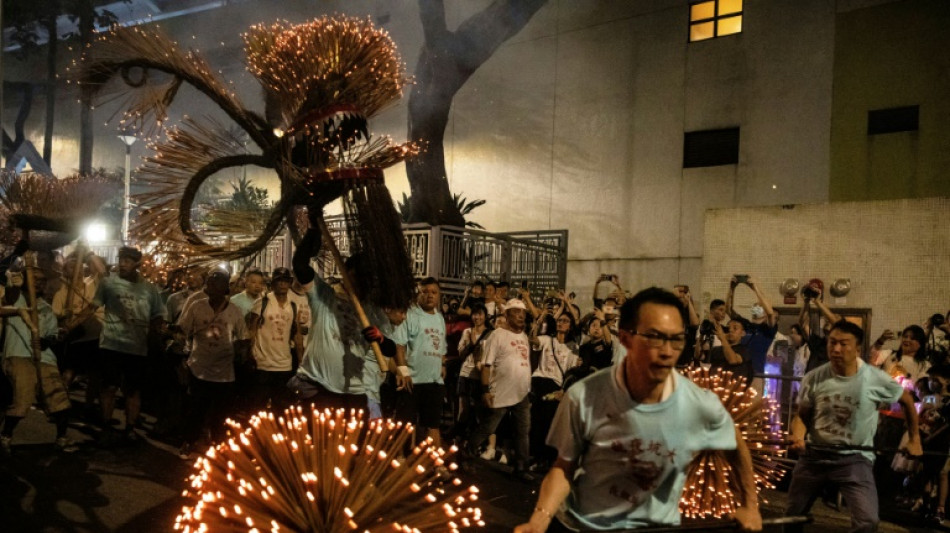
Hong Kong revives 'living tradition' of fire dragon dance / Photo: Isaac LAWRENCE - AFP

 Malaysia Sues Google for $146m Over Harmful Content

 Black Wind Turbine Blades Reduce Bird Deaths by 74% in Spain Study

 Brazil’s Landless Movement Partners with China to Build Affordable Tractors for Family Farms

 Twickenham Grounds Team Prepares Pitch for Six Matches in Three Days

 Luxembourg Pay Rise Delayed as Regional and World Headlines Develop

 Audience to Choose the Set List at Luxembourg's First FAMIL Jukebox Night

 Raheem Sterling Receives Suspended Sentence After Lamborghini Crash

 Black Friday Discounts Cut Prices on Two Top-Rated Wiper Blades

 Arizona Gun Regulation Battle Intensifies Under New Democratic Legislative Majority
Thousands of excited spectators packed the grid-like streets of a usually quiet Hong Kong neighbourhood Thursday night, eager for the resurrection of the city's fire dragon dance after a three-year pandemic-spurred dormancy.
Smoke and fire swirled in the heady air, wafting from the dragon's 67-metre (219-feet) body which is made up of thousands of incense sticks.
The dragon was hoisted by hundreds of volunteers who danced and bounded along the streets of the Tai Hang neighbourhood in a raucous parade.
"I feel extraordinarily excited -- everyone is," Cheung Leung, a member of the fire dragon dance committee, told AFP.
Cheung, who has been part of the ritual for two decades, said organisers have been practising their performance since March, soon after Hong Kong scrapped all coronavirus restrictions.
"The head of it weighs at least 40 kilograms (88 pounds) after we put the incense on," he added, declaring "the key to a good performance is having a lot of strength".
The ritual coincides with the Mid-Autumn Festival, a traditional annual event celebrated by millions across the world, with much of the Chinese diaspora gathering for family dinners, lighting lanterns, and eating mooncakes.
Legend says the dance originated in 1880 to drive away the plague from Tai Hang village, with the only pauses coming during the three years when Hong Kong was under Japanese occupation during World War II, and for the pandemic.
"This is a living tradition of Hong Kong," said fresh graduate Kelly Liu, who saw the dance for the first time.
Leung, a 75-year-old retiree, and his wife were hoping to get some of the incense from the dragon -- seen as an auspicious blessing.
"I've been watching this for many years -- so many I've lost count," Leung told AFP.
The ritual was recognised as an intangible cultural heritage by China and Hong Kong in 2011 and 2017 respectively, with a museum dedicated to it opened in 2022 in Tai Hang.
P.Sousa--PC
