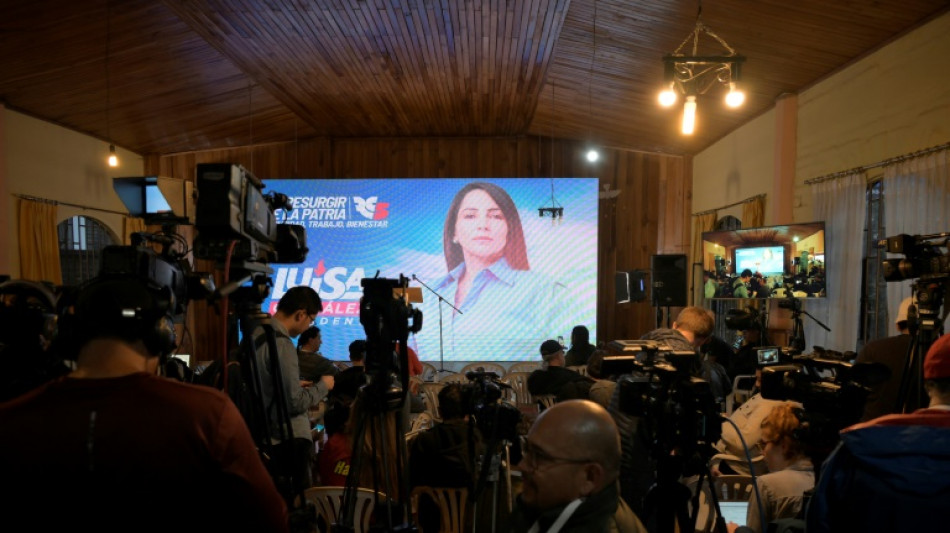
Ecuador journalists under fire as drug war escalates / Photo: Rodrigo BUENDIA - AFP

 EU vows AI rules will protect Europeans. Will they?

 Myanmar leader to visit Malaysia after migrant returns begin
 Germany's AfD poised to preside over state assembly for first time
 Australia's opposition vows 'largest cut to immigration' in country's history
 Ready, set, snooze: Sleep-deprived Japanese compete for best-rested

 Falcons thump Saints 45-24 as New Orleans marks Katrina anniversary

 Tuvalu govt adviser says Australia overstepped in pre-COP visit
 Asian stocks mixed despite tech-led Wall St record
 Tens of thousands expected in Paris for high school protests

 AI borrowing binge rattles US markets

 Young Canadians sue government over alleged climate failures

 White Sox down Guardians to take 2-0 series lead
 NHL record-breaker Ovechkin says current season will be his last
 France roar back in Nations League as Italy beat Turkey
 Messi readies for final farewell in Argentina send-off
 Esposito seals Italy win over Turkey in Nations League

 Russia downplays plague reports as Trump offers US help

 Trump says US moved bombers from UK base after 'threats'
 Brazilian stocks surge to record after Bolsonaro election lead
 Leaders to visit Pacific atoll at frontline of climate change

 ICC gives more details about arrest warrants for Taliban ministers
 Nigeria's Tinubu confirms 32 dead after military plane crash

 'Reckless' AI firms can't control models, says whistleblower

 Switching on brain cells: the Nobel-winning science of optogenetics
 Quebec votes as separatist surge poses test for Canada PM

To do their work of reporting the news -- a crucial job ahead of Sunday's looming presidential election -- many journalists in Ecuador now don bulletproof vests and helmets.
Theirs is not a country at war in the traditional sense, but one caught up in a bloody battle nonetheless -- between rival drug gangs.
Long a peaceful haven between major cocaine exporters Colombia and Peru, the South American nation has exploded in violence in recent years as enemy gangs massacre hundreds in prisons, hang headless bodies from city bridges and detonate car bombs in the streets.
As the conflict between groups with links to Mexican and Colombian cartels has escalated -- with the country's murder rate quadrupling in four years -- three reporters were among the fatalities in 2022, according to NGOs.
Fifteen have received death threats so far this year.
In August, Fernando Villavicencio --a journalist-turned-presidential candidate with a history of speaking out against the cartels -- was assassinated in broad daylight while on the campaign trail.
"It is not easy to do our work with what we are going through," said a reporter in the port city of Guayaquil, at the center of the violence. The journalist had received threats and asked not to be identified.
What is happening in Ecuador today "we had only ever seen in Mexico, and is something very foreign from our reality," said the reporter, who moved homes after becoming anxious that criminals were zoning in on his whereabouts.
Five Ecuadoran reporters are living as refugees abroad.
- 'Growing hostility' -
According to a recent report by Reporters Without Borders, "journalists in Ecuador work in a climate of growing hostility, physical danger and self-censorship, marked by an increase in the power of criminal gangs and drug cartels, as well as an increase in threats, physical attacks and even murders."
In Guayaquil, many reporters go to work in bulletproof vests and helmets, similar to their colleagues covering Russia's invasion of Ukraine or the Israeli-Palestinian conflict.
Coverage around the largest prison complex in Guayaquil is particularly risky. It has been the epicenter of prison clashes in which some 460 inmates have died since February 2021, many beheaded or burned to death.
As an added security measure, journalists have taken to providing fake personal information in bureaucratic procedures "so that organized crime, if it turns its attention to you, will find it a bit more difficult to locate you," said one.
The August 9 assassination of Villavicencio has fueled the fear.
The remaining presidential candidates, Luisa Gonzalez and Daniel Noboa, have reinforced their security, as have the journalists following their campaigns ahead of Sunday's run-off vote.
Prior to his death in a barrage of submachine gun fire, Villavicencio said he had received threats from "Los Choneros," a gang with links to Mexico's Sinaloa cartel and Colombia's Gulf Clan.
Many news outlets avoid reporting on these organizations for fear of becoming targets themselves.
Cesar Ricaurte of the Fundamedios press watchdog told AFP "the pattern of violence" in Ecuador has changed.
While in the past the threat came mainly from state actors -- such as corrupt politicians fearful of being exposed -- it now comes from "organized and common crime," he said.
- 'How toads die' -
In March, five envelopes with USB sticks loaded with explosives were delivered to journalists at different media outlets in Ecuador. One was slightly injured after a device detonated.
Last year, the TV station RTS came under gunfire, and in 2020 a device exploded on the premises of Teleamazonas.
"I’ve been wearing a vest and bulletproof helmet for a month-and-a-half," a photojournalist from Guayaquil told AFP, recounting warnings received while on duty in Duran, a town under gang control.
"They told me: 'watch out, this is how toads die... stop taking pictures, you don't know what you're getting into.'"
In Colombia, the Spanish word for toad, "sapo," is used to denote a snitch.
The Inter-American Commission on Human Rights has also expressed concern for reporters in Ecuador ahead of the election.
The "violence, threats, stigmatization and exile of journalists require extreme efforts to provide protection and guarantees to journalists," IACHR special rapporteur Pedro Vaca said on X, formerly Twitter.
L.E.Campos--PC